
Estrovera is a rhapontic rhubarb root extract called ERr 731, sold in the US by Metagenics. Two placebo trials of about 110 perimenopausal women each found big drops in symptom scores over 12 weeks. Nearly every study was run by one German research firm, and a 2024 meta-analysis counted some of the same women twice.
Listen to this article, about 13 minutes. A synthetic voice reads the article and announces each section title as it begins; tables are read row by row and the questions at the end are left out.
Recorded 19 November 2026 from the article as published that day. Press a chapter to jump there; the highlighted line is what is playing. A play button sits beside every section heading, and once you scroll past this player a bar at the bottom of the screen keeps the controls in reach. Tap or click any sentence to hear the reading start from there.
On this page: every ERr 731 study read from PubMed with its size, comparison and who ran it, how a 2024 meta-analysis counted the same women twice, where the 83 percent figure on the marketing comes from, and what seven users reported.
Think you already know this? Five questions, one minute.
Every answer is on this page. Answer from what you know now; the page fills in the rest.
-
1. How many women were randomised in the 2006 placebo trial of ERr 731?
The 2006 trial gave 54 women the extract and 55 a placebo, 109 in all. Read the section
-
2. In the 2009 trial, where did the placebo group’s symptom score end after 12 weeks?
The 2009 trial reports placebo falling from 27.0 to 24.0, against 27.0 to 12.4 on the extract. Read the section
-
3. What kind of study was Hasper 2009, which the meta-analysis pooled as a trial?
Its own abstract says its 80 women came from the 109 in the 2006 trial and that it was observational. Read the section
-
4. According to the brand’s own footnote, where does the 83 percent figure come from?
The Metagenics detail aid footnotes an online survey of 75 women run by the company in 2020. Read the section
-
5. Who funded the 2025 records study on ERr 731 and breast cancer?
The 2025 study states it was funded by Health Research Services, which employs two of its authors. Read the section
This page is an evidence review, not a shopping guide, and it recommends nothing. It reads every ERr 731 study on PubMed, says how many women were in each, what they were compared with and who ran it, then traces the percentages in the brand’s own marketing. Checked on 19 November 2026.
What is actually in Estrovera?
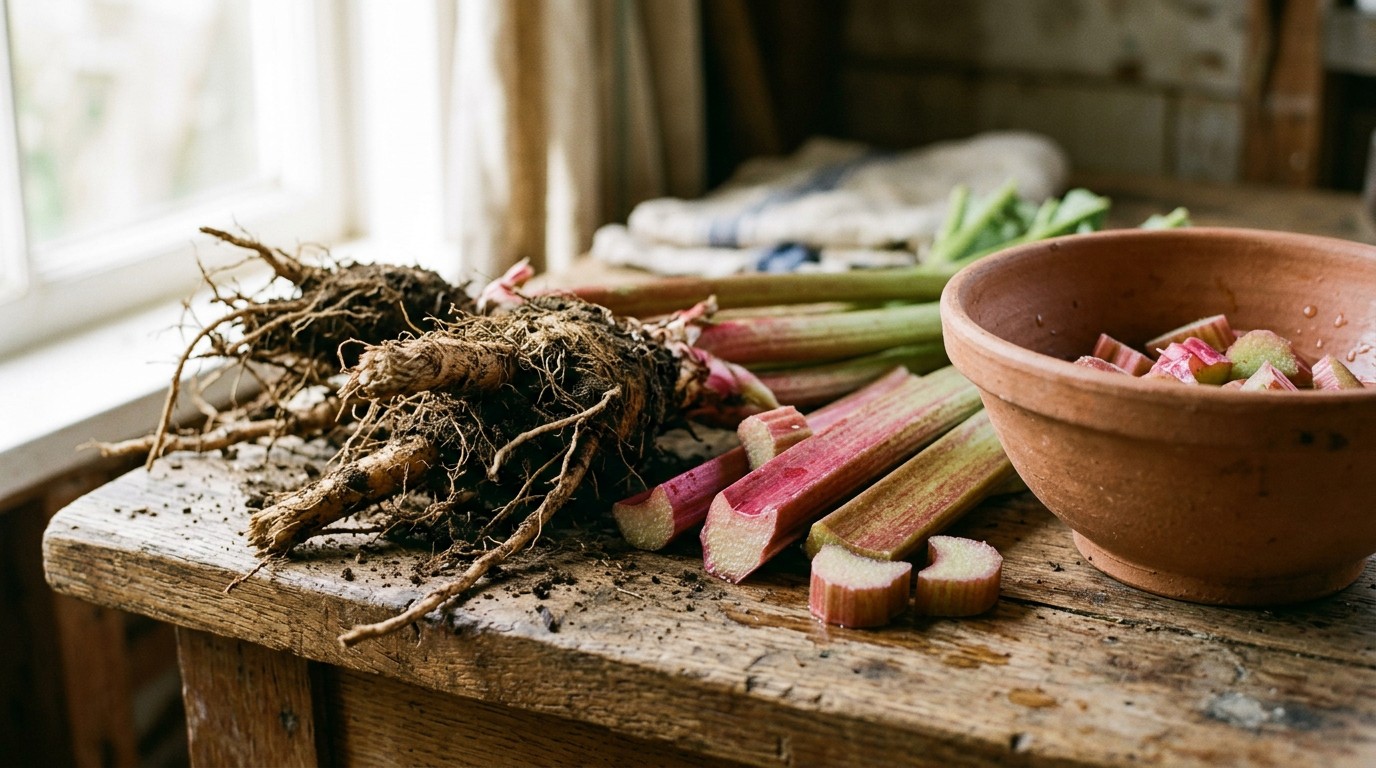
One ingredient, and it is not the rhubarb in a crumble. The Metagenics Estrovera detail aid, which reproduces the label, lists 4 mg of rhapontic rhubarb root extract per tablet, also called Siberian rhubarb, providing 2.2 mg rhaponticin and 1 mg desoxy rhaponticin. The label caution reads: “Do not use if pregnant or nursing. If taking medication, consult your healthcare practitioner before use.”
The extract has a longer history than the brand. A 2016 safety report written by Metagenics staff and the German maker says it has been sold in Germany since 1993 as Phytoestrol N and femi loges, and in the US and Canada as Estrovera. So when you read the trials, look for ERr 731 and Phytoestrol N, not the American name.
It is a plant oestrogen. The brand describes it as binding preferentially to the beta type of oestrogen receptor, which it presents as the safer type. That claim rests on laboratory and animal work cited in the same detail aid, not on studies of women.
How many women were in the Estrovera trials?
Two randomised trials, 221 women in total, both in perimenopause, both 12 weeks. The 2006 trial in Menopause gave 54 women ERr 731 and 55 a placebo. A 2009 confirmation trial gave 56 women each. Everything else is either an extension of those women or has no comparison group.
That matters for the tidy looking number in the 2024 meta-analysis, which pooled four “trials” and 390 participants. One of the four is Hasper 2009. Its own abstract says its 80 women were drawn from the 109 in the 2006 trial, and that it was an open observational follow up, not a randomised trial. So at least 80 women appear in the pool twice. The fourth study, credited to Thiemann in 2017, could not be found on PubMed; its group sizes, 44 and 45, match the analysed groups of a 2026 paper describing a 112 woman trial in Ukraine run from 2004 to 2007. This page could not establish whether that is the 2009 trial reported again.
| Study | Who and how many | Compared with | Length | Run or paid by |
|---|---|---|---|---|
| Heger and colleagues, 2006 | 109 perimenopausal women | Placebo | 12 weeks | First author at Health Research Services |
| Kaszkin-Bettag and colleagues, 2009 | 112 perimenopausal women | Placebo | 12 weeks | Authors include the firm’s owner |
| Hasper and colleagues, 2009 | 80 women from the 2006 trial | Nothing, open follow up | 96 weeks | Health Research Services |
| Kaszkin-Bettag and colleagues, 2008 | 363 enrolled, 252 analysed | Nothing, before and after only | 6 months | Health Research Services |
| Heger and colleagues, 2026 | 89 women from a 112 woman trial | Nothing during the follow up | 52 weeks | Health Research Services |
| Dubey and colleagues, 2024 | 4 studies, 390 counted | Meta-analysis | Not applicable | Authors at a supplement company |
What did the placebo trials find?
On paper, a large effect. The 2009 trial reports the Menopause Rating Scale total falling from 27.0 to 12.4 points on ERr 731, against 27.0 to 24.0 on placebo, with hot flushes also falling more on the extract. The 2006 trial reports a significant drop in the same score and in hot flush number and severity from week four. The 2006 trial reported no difference in endometrial biopsies or bleeding between groups.
Three things temper it. Both trials share several authors, including the owner of the research firm behind them, so the second is less independent confirmation than the word suggests. A 2007 letter to Menopause took up the first trial’s clinical significance, and the authors replied in the same issue. And the meta-analysis found heterogeneity of 93 percent, meaning the studies disagreed with each other on size of effect far more than chance would explain; it could not analyse hot flushes separately at all.

Who ran and paid for the research?
Mostly one firm, as far as the public record shows. Health Research Services, a German contract research company, appears as the affiliation on the 2006 trial, the 2008 study, the 2009 extension and the 2026 paper, whose authors state that the firm’s owner and staff wrote it. That 2026 paper says no financial support was received, yet its own limitations section says the firm funded the study. Both sentences are in the same article.
The safety data come from closer still. The 2016 postmarketing report was written by Metagenics medical affairs staff, a director of the German maker and the research firm. It counted 124 adverse event reports in Germany against about 140 million daily doses from 1993 to 2014, mostly allergic and digestive, and 79 North American consumer complaints, 22 of them that it did not work. The meta-analysis declares no conflicts, though all three authors list a supplement company as their employer.
Where do the 83 percent and 90 percent figures come from?
From a survey and an extension, mostly. The detail aid says Estrovera is clinically proven to reduce 12 common symptoms, including hot flashes, by 83 percent. Its footnotes trace the 83 percent to an online survey of 75 current Estrovera users run by Metagenics in 2020, and a “90 percent noticed improvements” line to an online survey of 424 current or past customers in 2023, shown as a conference poster. Surveys of people who kept buying a product are not trials.
The same sheet compares ERr 731 with Swedish pollen extract, the ingredient in Relizen, claiming 66 percent fewer hot flashes against 22 percent. A footnote says the 66 percent was extrapolated from Hasper 2009, the open follow up with no placebo, while the pollen figure comes from a placebo trial. That is two different kinds of study set side by side as if they were one race.
| Claim you may see | Where it comes from | What the source shows |
|---|---|---|
| Reduces 12 symptoms by 83 percent | Metagenics detail aid | Online survey of 75 users, 2020 |
| 90 percent noticed hot flash improvement | Metagenics detail aid | Online survey of 424 customers, 2023 |
| 66 percent fewer hot flashes than pollen’s 22 | Metagenics detail aid | Extrapolated from an uncontrolled follow up |
| 2 year safety study | Hasper 2009 | Open follow up of 80 women, no placebo |
What is known about Estrovera and breast cancer?
One study looked, and it was run by the same firm. A 2025 study in Breast Cancer Research and Treatment used German gynaecology records to compare 5,686 women prescribed ERr 731 with 17,058 matched women who were not. Breast cancer rates were 3.5 and 3.4 per 1,000 person years, a ratio of 1.01 with a confidence interval from 0.81 to 1.26. The study was funded by Health Research Services, and two authors work there.
The authors list the gaps themselves: prescriptions only, though the extract went over the counter in Germany in 2005, no data on smoking, alcohol or weight, and an association, not proof. It was not a study of women who have had breast cancer. Anyone who has had breast cancer, or takes tamoxifen or an aromatase inhibitor, has a specific reason to talk to their oncology team before adding any plant oestrogen. Bleeding after 12 months without a period, or bleeding that is new, heavy or unusual, needs a doctor whatever else is going on. Our page on bleeding after menopause sets out what the guidance says.
What do NICE and the Menopause Society say about supplements like this?
Neither names Estrovera or rhubarb. The Menopause Society’s 2023 nonhormone therapy position statement does not recommend supplements and herbal remedies for hot flashes; whether it discusses ERr 731 specifically could not be confirmed for this page. NICE NG23, last updated 15 April 2026, says in recommendation 1.4.6 that the safety, quality and purity of constituents in unregulated preparations may be unknown, and in 1.4.7 that there is some evidence for isoflavones or black cohosh. Rhapontic rhubarb is not mentioned.
The FDA explains that dietary supplements need no approval for safety or effectiveness before sale. The words “clinically proven” on a badge are the brand’s, not a regulator’s.
What do people taking Estrovera report?
Reddit search for the past year turned up 10 comments mentioning Estrovera, six of them from people describing their own use, plus one Trustpilot review. Four of the six Reddit users said it helped. A user in r/GenX said in July 2026 that it lessened hot flashes without removing them. A user in r/HormoneFreeMenopause wrote in October 2026 that they took it for a few years for hot flashes and palpitations, then stopped at 54. A user in r/osteoporosis said in November 2026 that it eliminated their hot flashes and night sweats.
Others cut the other way. A user in r/Menopause wrote in October 2026 that they could not say they noticed a huge change. A user on tamoxifen in r/breastcancer said in November 2026 that their oncologist approved it and the hot flashes faded, but they had a hysterectomy at about the same time and could not say which did it. And a Canadian reviewer on Trustpilot in June 2026 reported a faster heart rate and worse hot flashes over nine months, a normal medical workup, and symptoms easing within a day of stopping.
These are things people report, not findings. Hot flashes change on their own over months and years, and a comment thread cannot separate a tablet from time, surgery or placebo. One pattern is worth noticing: two say a doctor or naturopath suggested it, and one chose it to avoid hormone therapy altogether.
What is worth asking before buying any menopause supplement?
The same questions work for every bottle on the shelf. Our reviews of the Amberen perimenopause trials and the Estroven Complete trials ask them of other brands, and our page on natural relief for hot flashes covers the approaches with stronger evidence.

- Did the trial enrol women at my stage, perimenopause or postmenopause?
- What happened in the placebo group, in numbers?
- Is a figure on the box from a trial, a follow up with no placebo, or a customer survey?
- Who ran the trial, and has anyone unconnected to the product repeated it?
- Do I take tamoxifen, an aromatase inhibitor or any other prescription a pharmacist should know about?
- Have I had breast cancer, or bleeding that has not been looked at?
Questions to ask a pharmacist before buying any menopause supplement
Drawn from how this product’s studies and marketing read. Tick each one you have an answer to. It scores nothing and names no product as advised.
General information only. Anyone treated for breast cancer should speak to their oncology team before adding a supplement. Bleeding after 12 months without a period needs a doctor.
Frequently asked questions
Is Estrovera the same as Phytoestrol N?
Same extract, different names. The 2016 safety report says ERr 731 is sold in Germany as Phytoestrol N and in North America as Estrovera.
Is Estrovera a hormone?
No. It is a plant extract that acts on oestrogen receptors, which is why it is called a plant oestrogen. It contains no oestradiol or progesterone.
How long were the Estrovera trials?
Both placebo controlled trials lasted 12 weeks. The longer follow up ran 96 weeks but had no placebo group.
Was Estrovera tested in perimenopause?
Yes. Both placebo trials, the 2006 trial and the 2009 trial, enrolled perimenopausal women only.
Has the FDA approved Estrovera?
No. Supplements are sold without FDA approval for safety or effectiveness, as the FDA’s own guidance explains.
What side effects were reported?
The 2016 postmarketing report found allergic reactions and digestive symptoms were the most common reports in Germany.
Finished the page? The same five questions from the top, to see what stuck.
This article is general information, not medical advice, and is not a substitute for care from a qualified healthcare professional. Speak to your doctor about your own situation.

Leave a Reply