
Irregular periods and stress are genuinely linked: the NHS lists stress as a cause, and a study of 3,346 women found high stress went with more irregular cycles. But those women were 21 to 45. In your 40s, perimenopause changes cycles too, and only a pattern across several cycles, not one late period, starts to tell them apart.
Listen to this article, about 12 minutes. A synthetic voice reads the article and announces each section title as it begins; tables are read row by row and the questions at the end are left out.
Recorded 12 November 2026 from the article as published that day. Press a chapter to jump there; the highlighted line is what is playing. A play button sits beside every section heading, and once you scroll past this player a bar at the bottom of the screen keeps the controls in reach. Tap or click any sentence to hear the reading start from there.
On this page: a dated table of what the NHS, NICE NG23, STRAW+10 and the Endocrine Society each say about a changed cycle, the PRESTO stress figures and who they were measured in, a worked 12 cycle example against the 7 day rule, and what women in their 40s reported on Reddit.
Think you already know this? Five questions, one minute.
Every answer is on this page. Answer from what you know now; the page fills in the rest.
-
1. In the PRESTO study of 3,346 women, what age range were the participants?
Nillni and colleagues studied women aged 21 to 45 who were trying to conceive, so the stress evidence was gathered largely before the transition. Read the section
-
2. How does STRAW+10 mark the start of the early menopause transition?
STRAW+10 compares consecutive cycles and counts the difference as persistent when it recurs within 10 cycles. Read the section
-
3. Under NICE NG23 recommendation 1.3.1, what identifies perimenopause without tests at 45 or over?
NICE NG23 needs both parts in otherwise healthy people aged 45 or over, and section 1.3 does not mention stress. Read the section
-
4. In the worked example of 12 cycles from 22 to 28 days, what was the largest difference between consecutive cycles?
The consecutive differences ran from 0 to 3 days, short of the STRAW+10 threshold of 7, and every cycle sat inside the NHS range of 21 to 35 days. Read the section
-
5. After how many missed periods in a row does the NHS say to see a GP?
The NHS stopped or missed periods page says to see a GP after 3 missed periods in a row, whatever the suspected cause. Read the section
Most pages on this were written for a 24 year old with exam nerves. At 44, being told a late period is probably stress is not wrong. It is just not an answer, because stress and the transition can both be true at once. This page sets out what each official source counts, side by side, and names no treatment.
Can stress really make your periods irregular?
Yes. The NHS irregular periods page, last reviewed on 26 June 2026, lists stress and anxiety among the common causes, and the NHS page on stopped or missed periods lists it for a late or missed period. Neither says how much stress, or for how long.
The best numbers come from a 2018 study by Nillni and colleagues in Clinical Epidemiology, which followed 3,346 women in the PRESTO pregnancy planning cohort and asked about their cycles every 8 weeks for up to a year. Women scoring 25 or more on the 10 item Perceived Stress Scale reported irregular cycles more often than women scoring under 15: a prevalence ratio of 1.33 in the abstract and 1.31 in the results table, a discrepancy the paper does not explain. Stress showed little consistent link with cycle length, and regularity was self reported.
Two details matter here. Everyone in that study was 21 to 45 and trying to get pregnant, so the evidence was gathered largely before the transition begins. And the link was modest: high stress raised the chance of an irregular cycle by about a third, it did not make irregularity the norm.
At the far end sits what the Endocrine Society’s 2017 guideline calls functional hypothalamic amenorrhea, where stress, weight loss or heavy exercise switch periods off. The guideline treats it as a diagnosis made only after other causes have been excluded, which is the opposite of the quick shrug many women in their 40s describe getting.
What does perimenopause do to a cycle that stress does not?
Perimenopause leaves a signature that stress research has not been shown to produce: a progression. The STRAW+10 staging system, the research standard for reproductive ageing, marks the start of the early transition as a persistent difference of 7 days or more between consecutive cycle lengths, where persistent means it happens again within 10 cycles. The late transition is marked by 60 days or more without a period, and the final period is only confirmed after 12 months with none.
Before any of that, STRAW+10 describes subtly shorter cycles in the late reproductive stage, one stage before perimenopause officially begins. So a cycle that drifts from 28 to 24 days does not meet the 7 day rule, and STRAW+10 would not call it the transition yet. It also says its bleeding criteria cannot be used after a hysterectomy or endometrial ablation, or for women with polycystic ovary syndrome.
Stress, in the research above, looks more like noise with no direction of travel. That contrast describes two research literatures; it is not a test you can run on yourself. Our page on the usual order in which periods change in perimenopause walks through the stages in more detail.
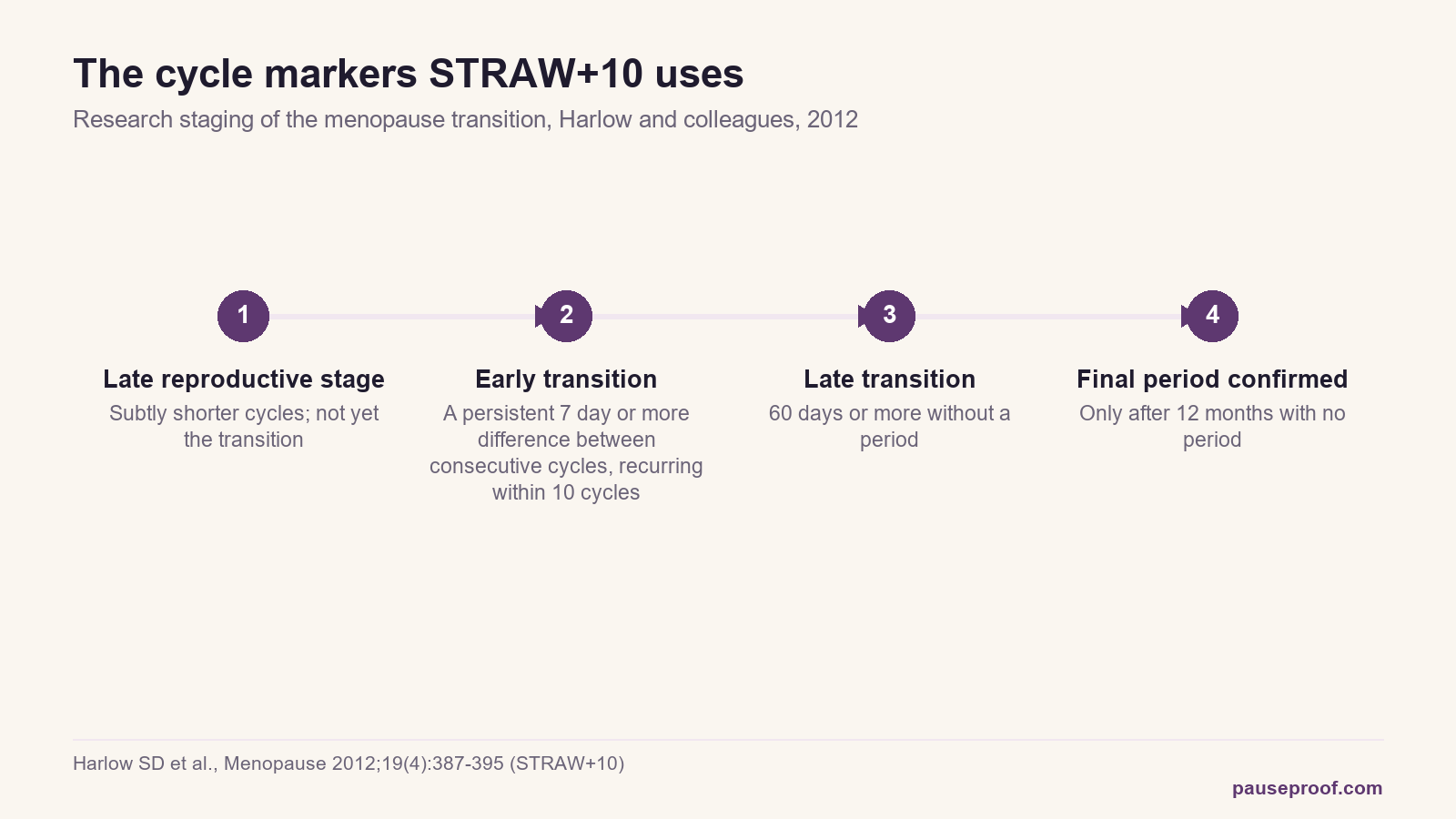
What do the NHS, NICE and STRAW+10 each say about a changed cycle?
They answer different questions: the NHS lists causes, NICE says how a clinician identifies perimenopause, and STRAW+10 stages it for research. Each was checked on 12 November 2026.
| Source, read 12 November 2026 | What it says about stress | What it says about the transition |
|---|---|---|
| NHS irregular periods page, reviewed 26 June 2026 | Lists stress and anxiety as a common cause | Irregular means a gap under 21 or over 35 days; the start of menopause, usually 45 to 55, is a cause |
| NHS stopped or missed periods page, reviewed 12 June 2026 | Lists stress as a common cause of a late or missed period | Names perimenopause, usually 45 to 55; see a GP after 3 missed periods in a row |
| NICE NG23, recs 1.3.1 and 1.3.6, updated 15 April 2026 | Says nothing about stress in section 1.3 | At 45 or over: recently started vasomotor symptoms plus any cycle change, no tests. At 40 to 45: consider FSH |
| STRAW+10 staging, Harlow and colleagues, 2012 | Not a stress tool; it stages by bleeding pattern only | Early transition: 7 day or more difference between consecutive cycles, recurring within 10 cycles. Late: 60 days or more without a period |
| Endocrine Society hypothalamic amenorrhea guideline, 2017 | Stress, weight loss and heavy exercise can stop periods; diagnosed only after other causes are excluded | Suggests evaluation when cycles persistently run over 45 days or periods stop for 3 months or more |
The striking gap is NICE. Its recommendation 1.3.1 identifies perimenopause without tests in otherwise healthy people aged 45 or over who have vasomotor symptoms that have recently started and any changes in their menstrual cycle. Both parts are in the sentence. Recommendation 1.3.6 says to consider a serum FSH test to confirm menopause in people aged 40 to 45 with symptoms including a cycle change, and in people under 40 where menopause is suspected. Stress does not appear in that section, so the guideline gives no rule for weighing it.
How do you check a run of cycles against the 7 day rule?
By subtracting, which is less glamorous than any influencer test kit and considerably more informative. In an August 2026 post on Reddit’s Perimenopause community, a woman who had just turned 45 shared her last 12 cycle lengths: 25, 24, 25, 25, 28, 26, 25, 25, 24, 25, 22 and 23 days, followed by a cycle that had reached day 27 when she posted, after an unusually long 8 day bleed.
Work through the consecutive differences and you get 1, 1, 0, 3, 2, 1, 0, 1, 1, 3 and 1 days. The largest is 3. None reaches the STRAW+10 threshold of 7, and every cycle sits inside the NHS range of 21 to 35 days, so by both definitions this run is regular, although it clearly did not feel that way to her. One reply pointed out it was roughly the variability she had in her twenties.
The arithmetic does not say what is happening to her, and it is not meant to. What it shows is that the feeling of an erratic cycle and the definitions can sit a long way apart. The 8 day bleed is a separate point: the NHS lists periods lasting longer than 7 days as a reason to see a GP. A written log of dates, as in our guide to keeping a perimenopause symptom diary, is what lets anyone do this sum.

Why is stress so hard to separate from perimenopause in your 40s?
Because the two overlap on almost every axis. The NHS puts both on the same list of causes. The perimenopause symptoms women most often report are not the hot flushes they expect: in the Hedges and colleagues survey in Menopause in 2026, the 12,681 respondents aged 35 and over most often reported fatigue (83.2 percent) and irritability (80 percent). Those are also exactly what a stressful year feels like.
Stress can also be a consequence. Broken sleep and a cycle you cannot plan around are stressful in themselves, and the PRESTO authors could not tell whether mood changed the cycle or the cycle changed mood.
And then there is the too young for this line. NICE’s own section 1.3 covers people aged 40 to 45, and people under 40 in whom menopause is suspected, so a dismissal that rests only on age does not come from that guideline. Our page on why regular periods do not rule out perimenopause covers the opposite trap. Meanwhile a supplement promising to balance your hormones and melt your stress has quietly solved neither, which has not stopped anyone selling one.

When does a changed cycle need a GP, whatever the cause?
The NHS lines below apply whether the cause turns out to be stress, the transition, or something else.
The NHS stopped or missed periods page says to see a GP if you have missed your period 3 times in a row, or if your periods have become irregular along with other symptoms such as weight gain or loss. The NHS irregular periods page says to see a GP if your periods last longer than 7 days or if you bleed between periods. A pregnancy test is worth doing first when a period is late and pregnancy is possible, because perimenopause does not rule it out.
Heavy bleeding, bleeding after sex and bleeding after 12 months without a period are separate questions and are always worth reporting promptly; our page on what gets checked first when a cycle changes sets out the usual first steps. None of this site’s pages can tell you which cause applies to you.
What NICE NG23 and the NHS say a clinician asks about a changed cycle
Built from NICE NG23 section 1.3 and the two NHS period pages, read on 12 November 2026. Tick what you can answer so you have it ready for an appointment. Nothing here is scored, and nothing says whether a change is stress or perimenopause.
General information, not a diagnosis. Bleeding after sex, very heavy bleeding, or any bleeding after 12 months without a period is worth reporting to a GP promptly.
What do women in their 40s report about their cycles changing?
We read two threads in Reddit’s Perimenopause community: a November 2025 thread asking at what age irregular periods began, where we could load 24 top level replies plus later replies running into April 2026, and the August 2026 thread above, with 5 replies. These are what people report, not findings, and replies recommending specific treatments are not repeated here.
In the November 2025 thread, the ages women gave for their first irregular cycles ran from 31 to 53, with most between 39 and 47. Some described cycles shortening first, a few days at a time; others went straight to skipped months. One woman said hers dropped from 28 or 30 days to 25 or 26 at about 39 and to 21 to 24 days by 43. Another said her missed periods and severe anxiety began at 44, at the same time as the start of the pandemic, which is the overlap this page is about in one sentence.
Not every account fitted. One woman of 51 said her cycle was still regular despite other symptoms, and an April 2026 reply saw no link at all between her cycle and diet or stress; her period app, she said, was as confused as she was.
Where the accounts agree with the guidance: early shortening matches what STRAW+10 describes, and most ages fall where the NHS says the change usually starts. Where they part company: several women described changes in their late 30s, and nobody in either thread mentioned counting the difference between consecutive cycles, which is the one number the research uses. For what happens when a period goes missing altogether, see what a missed period in perimenopause usually means.
Frequently asked questions
How long can stress delay a period?
The NHS names stress as a cause but gives no figure. The Endocrine Society suggests evaluation when cycles persistently run over 45 days or periods stop for 3 months or more, whatever the suspected cause.
Can stress cause perimenopause to start early?
None of the sources checked for this page says so. NICE section 1.3 notes that people from some ethnic minority backgrounds and with some lifelong conditions may reach menopause younger; it does not mention stress.
Is a 24 day cycle a sign of perimenopause?
Not on its own. It sits inside the NHS range of 21 to 35 days, and STRAW+10 describes shorter cycles as the stage before perimenopause begins, not the transition itself.
Can a blood test tell stress from perimenopause?
No single test does that. NICE advises against several tests, such as anti-Mullerian hormone, to identify perimenopause at 45 and over, and suggests considering FSH at 40 to 45. Other tests may rule out other causes.
Does a regular cycle mean stress is not affecting me?
Not necessarily. In the PRESTO study high stress raised the chance of an irregular cycle by about a third, so most women under high stress still reported regular cycles.
What should I bring to a GP about a changed cycle?
The start date of each period for at least a few months, how long each bleed lasted, any bleeding between periods or after sex, and any new symptoms such as hot flushes or night sweats.
Finished the page? The same five questions from the top, to see what stuck.
This article is general information, not medical advice, and is not a substitute for care from a qualified healthcare professional. Speak to your doctor about your own situation.

Leave a Reply