
Searching vaginal odor perimenopause usually means a smell has changed and you want to know why. It has several possible sources. As oestrogen falls, vaginal pH tends to rise and protective lactobacilli thin out, while bacterial vaginosis, trichomoniasis and small urine leaks can all smell. A fishy smell or new discharge is worth getting checked.
Listen to this article, about 11 minutes. A synthetic voice reads the article and announces each section title as it begins; tables are read row by row and the questions at the end are left out.
Recorded 15 November 2026 from the article as published that day. Press a chapter to jump there; the highlighted line is what is playing. A play button sits beside every section heading, and once you scroll past this player a bar at the bottom of the screen keeps the controls in reach. Tap or click any sentence to hear the reading start from there.
On this page: a dated table of what four NHS pages, the BASHH guideline and the 2020 GSM position statement each say about a changed smell, why their pH ranges overlap, the bacterial vaginosis rates measured by menopause stage, and what women in perimenopause reported on Reddit.
Think you already know this? Five questions, one minute.
Every answer is on this page. Answer from what you know now; the page fills in the rest.
-
1. According to the 2020 GSM position statement, what are women less likely to have after menopause?
The North American Menopause Society statement says women after menopause are less likely to have a Lactobacillus dominant community or a low vaginal pH. Read the section
-
2. Which NHS pages checked for this article mention menopause when they describe a smell?
The discharge, bacterial vaginosis and trichomoniasis pages do not mention menopause, and the NHS vaginal dryness page names menopause but not smell. Read the section
-
3. What range does the BASHH guideline give for vaginal pH in bacterial vaginosis?
The BASHH guideline gives above 4.5 and up to 6, while the GSM statement says pH with GSM is typically greater than 5, so the ranges overlap. Read the section
-
4. In the 2002 study of 1,486 women aged 40 or over, what share of perimenopausal women had bacterial vaginosis?
Cauci and colleagues found 11.0 percent in perimenopausal women, 9.8 percent with regular cycles and 6.0 percent after menopause. Read the section
-
5. What does the NHS vaginal discharge page say about sexual health clinics?
The NHS vaginal discharge page says many sexual health clinics offer a walk in service and often get test results quicker than GP surgeries. Read the section
Most pages on this subject were written either for 25 year olds or to sell a wash. This one sets out what the NHS, the UK sexual health guideline and the menopause literature each say, side by side, then what women in perimenopause report. It names no treatment and cannot tell you which cause applies to you.
Is a change in vaginal smell normal in perimenopause?
A change is common enough that the menopause literature describes it, but common does not mean it needs no explanation. In its 2020 position statement on genitourinary syndrome of menopause, the North American Menopause Society, now called The Menopause Society, explains that during the reproductive years a vagina dominated by Lactobacillus species keeps pH low, and that after menopause women are less likely to have that lactobacillus dominant community or a low pH.
Genitourinary syndrome of menopause, or GSM, is the current name for what older pages call vaginal atrophy, and our page on why vulvovaginal atrophy goes by three names explains the renaming. The statement lists vaginal discharge among its most commonly reported symptoms, and notes that with atrophic vaginitis a brown or yellow, sometimes malodorous, discharge may be present.
It adds a detail that matters here: the bacterial community of postmenopausal women has many similarities with that of younger women who have bacterial vaginosis, including a high pH, yet in many women with GSM this reflects fewer lactobacilli rather than more harmful bacteria. Perimenopause sits between those two states, with oestrogen rising and falling rather than simply dropping, so a smell that comes and goes fits the general pattern without proving anything about one person.
What do the NHS, BASHH and The Menopause Society each say about odour?
Less than you might hope, and almost none of it about menopause. Each page below was read on 15 November 2026. The sexual health sources describe the smell; the menopause source describes the tissue.
| Source, read 15 November 2026 | What it says about smell | What it says about menopause |
|---|---|---|
| NHS vaginal discharge page, reviewed 15 February 2024 | Normal discharge has no strong or unpleasant smell; a fishy smell points to bacterial vaginosis | Not mentioned |
| NHS bacterial vaginosis page, reviewed 19 June 2026 | A strong fishy smell, particularly after sex; about half of women have no symptoms | Not mentioned |
| NHS trichomoniasis page, reviewed 16 July 2025 | Yellow green discharge that may look frothy or smell like fish | Not mentioned |
| NHS vaginal dryness page, reviewed 24 July 2025 | Lists unusual discharge, needing to pee more often and repeat urine infections; no mention of smell | Lists menopause as a cause; perimenopause not named |
| BASHH bacterial vaginosis guideline, 2012 | Offensive fishy smelling discharge; vaginal pH rises above 4.5 and up to 6 | Not mentioned |
| North American Menopause Society GSM statement, 2020 | With atrophic vaginitis, brown or yellow, sometimes malodorous, discharge may be present | Fewer lactobacilli after menopause; with GSM, vaginal pH is typically greater than 5 |
The gap runs both ways. Not one of the four NHS pages or the BASHH guideline mentions menopause when it describes a smell, and the GSM statement mentions odour only once, in passing. So a woman of 46 reading the NHS pages gets the infections, and reading the menopause literature gets the tissue changes, and nobody puts the two next to each other.
The NHS vaginal discharge page is also blunt about self diagnosis: it says not to self diagnose and to see a GP if you are worried. Every NHS page checked points the same way: to a test, not a guess.
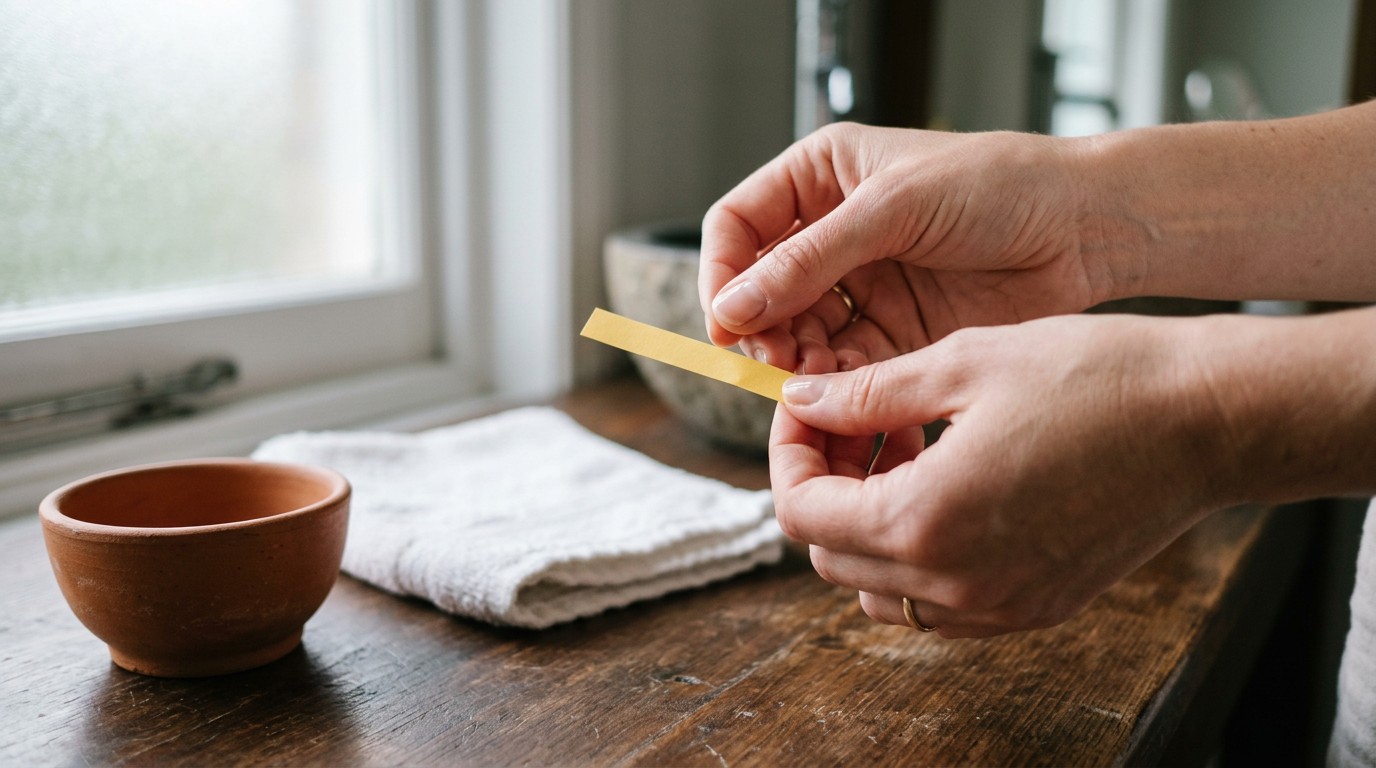
Why can a pH strip not tell bacterial vaginosis from menopause changes?
Because both raise it. The British Association for Sexual Health and HIV guideline on bacterial vaginosis says a healthy vaginal pH is kept below 4.5, and that in bacterial vaginosis it is elevated above 4.5 and up to 6. The GSM position statement says that with GSM the vaginal pH is typically greater than 5.
Put those side by side and the arithmetic does the rest. A reading of 5.5 sits inside both ranges. That is our reading of two separate documents, not a sentence either one contains, but it explains why a pH number on its own cannot separate the two. It is also why the influencer test kit with a colour chart and a discount code is less decisive than its packaging. The GSM statement says pH is not essential to make a GSM diagnosis in clinical practice anyway.
Clinicians use more than pH. The BASHH guideline describes the Amsel criteria, which combine the look of the discharge, the pH, clue cells under a microscope and a fishy smell released when an alkali is added, and notes that UK clinics often use a Gram stain instead. The NHS bacterial vaginosis page says a cotton bud may be wiped over the discharge to test for bacterial vaginosis and other infections.
Is bacterial vaginosis more common in perimenopause?
Not in the study found for this page that measured it by menopause stage. Cauci and colleagues, writing in the Journal of Clinical Microbiology in 2002, examined Gram stained smears from 1,486 women aged 40 or over: 328 with regular cycles, 237 perimenopausal women with irregular cycles, and 921 postmenopausal women.
Bacterial vaginosis, defined as a Nugent score of 7 or higher, was found in 9.8 percent of the women with regular cycles and 11.0 percent of the perimenopausal women, a difference the authors did not find significant. It was lower after menopause, at 6.0 percent. Their conclusion was that the natural fall in lactobacilli after menopause does not by itself raise the rate of bacterial vaginosis.
Two caveats. The study counted a laboratory score, not a smell, and the BASHH guideline says roughly half of women with bacterial vaginosis have no symptoms. And it is one study from 2002. Still, it cuts against the easy assumption that every changed smell in your 40s must be the transition: in these women, bacterial vaginosis was about as common in perimenopause as before it.

What do women in perimenopause report about a changed smell?
We read three threads in Reddit’s Perimenopause community, posted between November 2025 and October 2026, and the first 75 replies loaded beneath them, 25 per thread. These are what people report, not findings, and replies recommending specific products or treatments are not repeated here.
In a September 2026 thread, a woman of 48 described a smell she had noticed for about two years, somewhere between old urine and bleach. She had slight bladder leaks but said the smell was there even without one, and her gynaecology appointment was months away. In a November 2025 thread, a woman in early perimenopause said she had just tested negative for bacterial vaginosis, a urine infection and sexually transmitted infections, yet the smell crept back a few hours after every shower.
In an October 2026 thread, a woman of 36 with two years of early perimenopause symptoms and no urine infection said she seemed to smell of urine an hour after using the toilet, however carefully she cleaned. Several replies described small leaks when coughing or sneezing. Several women in the September and October threads said their own sense of smell had sharpened, and that partners could smell nothing. None of the sources checked for this page addresses that, so it stays a report.
Not every account fitted the pattern. In the October thread, one woman said a routine swab found bacterial vaginosis when she had assumed the smell was urine, and in September another said she had started getting bacterial infections month after month in her mid 40s. And the replies overall read like a shopping list of soaps, liners and supplements, several promising to balance hormones, a job no soap has ever held. The NHS bacterial vaginosis page lists perfumed products used in or around the vagina as something that raises the chance of bacterial vaginosis.
Where the accounts agree with the guidance: the NHS vaginal dryness page lists needing to pee more often and repeat urine infections, which fits the urine smell so many described, and our page on how common bladder leaks are around menopause covers that overlap. Where they part company: the forums lean on products, while every official source points to a test. The one account where a swab found an infection is the reason the test matters.

When does a changed smell need a GP or sexual health clinic?
The lines below come from the NHS and apply whatever the cause turns out to be.
The NHS vaginal discharge page says to get help from NHS 111 if your discharge changes in colour, smell or texture, if you have more than usual, if you have itching or soreness, bleeding between periods or after sex, pain when peeing, or pain in your pelvis. It also notes that many sexual health clinics offer walk in appointments and often get results quicker than GP surgeries.
The NHS vaginal dryness page says to see a GP if you have unusual discharge, or bleeding after sex, between periods or after the menopause. Our page on bleeding after sex in perimenopause covers that question separately.
The NHS cervical cancer symptoms page lists changes to your vaginal discharge among its symptoms, alongside unusual bleeding. It also says these symptoms are very common and can be caused by many different conditions. A smell together with bleeding that is unusual for you is a reason to be seen, not to wait.
If the smell comes with itching and a thick white discharge, our page on telling thrush from menopausal dryness covers that overlap, and the list of perimenopause symptoms that do have a source puts this one in context.
What the NHS pages ask about a changed smell
Each item comes from the NHS pages on discharge, bacterial vaginosis, trichomoniasis and vaginal dryness. Ticking them does not point to any cause; it gathers what a GP or sexual health clinic is likely to ask.
This list cannot tell you what is causing a smell and names no treatment. Bleeding that is unusual for you is a reason to be seen promptly.
Frequently asked questions
Is a fishy smell in perimenopause always bacterial vaginosis?
No source checked says so. The NHS links a fishy smell to bacterial vaginosis and also to trichomoniasis, which can bring a frothy yellow green discharge. Only a test can tell them apart.
Can perimenopause change how my discharge smells without an infection?
The 2020 GSM position statement says fewer lactobacilli and a higher pH are common after menopause, and that atrophic vaginitis can bring a brown or yellow, sometimes malodorous, discharge.
Is bacterial vaginosis a sexually transmitted infection?
The NHS says it is not classed as one, but sex can trigger it, and having it can raise the risk of getting a sexually transmitted infection.
Can I go to a sexual health clinic in my 40s or 50s?
Yes. The NHS pages on discharge and bacterial vaginosis point to sexual health clinics at any age, and note that many offer walk in appointments.
What does a clinician actually do to check a changed smell?
The NHS says they ask about symptoms, may examine the vagina, and may wipe a cotton bud over the discharge to test for bacterial vaginosis and other infections, including sexually transmitted ones.
Could a smell in my 40s be coming from urine rather than the vagina?
It can be hard to tell. The NHS vaginal dryness page lists needing to pee more often and repeat urine infections, and many women report small leaks. A clinician can check both.
Finished the page? The same five questions from the top, to see what stuck.
This article is general information, not medical advice, and is not a substitute for care from a qualified healthcare professional. Speak to your doctor about your own situation.

Leave a Reply