
Perimenopause heart palpitations are common in midlife and most prove benign. But cardiology guidance does not treat a racing or skipping heart as hormonal by default: it lists menopause among many possible causes, not the leading one. Palpitations with chest pain, breathlessness or fainting are an emergency, at any age.
What do palpitations in perimenopause actually feel like?
A palpitation is simply an awareness of your own heartbeat. Women describe it as a thump, a flutter, a skip, a lurch, or a run of beats that arrives from nowhere and stops just as abruptly. Researchers who asked midlife women to describe the sensation in their own words catalogued it across six dimensions, including quality, severity, duration and temporal pattern, in a study published in the journal Menopause in 2023. That is a longer list than most symptom checklists allow for, which is part of why the symptom is easy to describe badly at an appointment and easy to hear badly across the desk.
The version that sends women searching tends to arrive at rest. You are sitting down, or you have just got into bed, and your heart announces itself. Nothing caused it. It is worse in the quiet, because in the quiet there is nothing else to listen to.
When do heart palpitations need urgent attention?
This part is not hedged, and it does not depend on your age or your hormones.
The NHS advises calling 999 or going to A and E if you currently have palpitations and they do not go away, or if they come with any of these: chest pain, shortness of breath, or feeling faint or fainting. If those symptoms have already stopped, it advises an urgent GP appointment or NHS 111. Separately, it advises seeing a GP if you feel well but the palpitations keep coming back, are happening more often, last longer than a few minutes, or if you have a heart condition or a family history of heart problems.
Palpitations that start during physical exertion rather than at rest are also treated differently from palpitations that arrive while you are sitting still. Nothing in this article can tell you which kind you have, and nothing in it is a reason to wait and see.
How common are palpitations in perimenopause, really?
Almost every page on this subject repeats a figure of around 40%. It is worth knowing where that number comes from before you lean on it.
It traces to a systematic review published in Current Obstetrics and Gynecology Reports in 2021, which found only five eligible articles. Those five were cross sectional symptom surveys from five countries, carried out between 1974 and 2011. Across them, reported palpitations ran from 3.7% to 40.2% before menopause, 20.1% to 40.2% during perimenopause, and 15.7% to 54.1% after menopause. Three of the five found perimenopausal and surgically postmenopausal women reported palpitations more often than premenopausal and naturally postmenopausal women did.
So the honest version is a range twice as wide as the number people quote, drawn from five surveys, the most recent of which is now well over a decade old. The review’s own conclusion is that good quality evidence on prevalence by menopausal stage is limited, and that the way palpitations are measured varies enough to need standardising. A wellness page that rounds all of that down to a confident 40% is not lying, exactly. It is just quoting the top of the range and leaving the receipt at home.
| What the source measured | When and how big | What it establishes | What it does not |
|---|---|---|---|
| Systematic review of palpitation prevalence by menopausal status, Current Obstetrics and Gynecology Reports, 2021 | Five cross sectional surveys, five countries, fieldwork 1974 to 2011 | Reported palpitations: 20.1% to 40.2% in perimenopause | A single reliable prevalence figure. The authors call the evidence limited |
| Palpitations across the menopause transition in SWAN, Menopause, January 2023 | 3,276 women followed over the transition; 1,559 assessed for subclinical cardiovascular disease | Three distinct trajectories, and no association with subclinical cardiovascular disease | Anything about individual risk, or about symptomatic cardiac disease |
| Palpitations in midlife women, the Menopause Racing Heart pilot, Menopause, July 2025 | 15 women with palpitations and 15 without, ECG patch worn 14 to 28 days | Lower heart rate variability and longer runs of atrial tachycardia in the palpitations group | Any general conclusion. The authors describe it as a hypothesis generating pilot |
| Management of patients with palpitations, position paper, EP Europace, 2011 | Consensus document from the European Heart Rhythm Association | Postmenopausal syndrome is listed among the systemic causes of palpitations | That menopause is the likeliest cause in any individual case |
What does cardiology say actually causes palpitations?
The European Heart Rhythm Association position paper on managing palpitations does list postmenopausal syndrome as a systemic cause, alongside fever, anaemia, thyroid overactivity, pregnancy, low blood sugar and several others. So the hormonal explanation is not folklore. It is in the document.
What is also in the document is a breakdown of where palpitations actually turned out to come from, in a prospective study the paper cites. It reorders the picture considerably.
| Cause of palpitations | Share of cases | Note |
|---|---|---|
| Arrhythmias | 41% | Includes atrial fibrillation or flutter 16%, supraventricular tachycardia 10%, ventricular tachycardia 2% |
| Psychosomatic, mainly panic and anxiety | 31% | The second largest category, and a real one |
| Medication, stimulants or illicit substances | 6% | Includes everyday stimulants |
| Systemic causes | 4% | The category that contains postmenopausal syndrome |
| Structural heart disease | 3% | |
| No identifiable cause | 16% | A normal result is a common result |
Read that table twice. Anxiety is genuinely a large slice, so a clinician who raises it is not being dismissive by definition. But arrhythmias are the largest slice, and the category menopause sits in is one of the smallest. That is why the standard internet advice, which is to breathe deeply and cut down on coffee, is a reasonable thing to do second and a poor thing to do instead of an assessment.

Why do palpitations so often get called anxiety?
Partly because anxiety really does cause them. Partly because a pounding heart is written into the definition of a panic attack, so the symptom and the label share a description. And partly because a woman of 44 describing a racing heart, poor sleep and a short fuse presents a pattern that fits an anxiety story neatly, and neat stories are the ones that get told.
The trouble is that the pattern also fits a thyroid problem, iron deficiency, and the hormonal fluctuations of the transition, which is exactly why the assessment exists. If you have already been through the experience of having a symptom explained away by your age, the same dynamic is covered in our piece on being told you are too young for perimenopause, and it plays out the same way here.
What did the largest study of palpitations across the transition find?
The most useful data comes from an analysis of palpitations in the Study of Women’s Health Across the Nation, published in Menopause in January 2023. Among 3,276 women followed across the transition, three patterns emerged: a high probability group of 15.9% whose palpitations peaked from perimenopause into early postmenopause and then faded, a moderate probability group of 34.3% following the same shape, and 49.8% with a sustained low probability throughout.
Two things stand out. Half of women had palpitations as a recurring feature of the transition, which is a long way from a rare symptom. And in the 1,559 women assessed for it, palpitations were not associated with subclinical cardiovascular disease. The women in the high probability group did differ at baseline, reporting more vasomotor symptoms, poorer overall health, more depressive symptoms, higher perceived stress, more sleep problems and higher blood pressure. The palpitations travelled with the rest of the transition rather than arriving alone, which is a pattern our article on why perimenopause symptoms come and go looks at across other symptoms too.
Is anything measurable actually happening, or is it just the feeling?
This is where two good sources point in slightly different directions, and picking the comfortable one would be dishonest.
The SWAN analysis found no link between palpitations and subclinical cardiovascular disease, which is reassuring at population level. But a pilot study published in Menopause in July 2025 put an ambulatory ECG patch on 15 midlife women with palpitations and 15 without, for 14 to 28 days each, and found the palpitations group had significantly lower heart rate variability and longer runs of atrial tachycardia. Thirty women is a pilot, the authors present it as hypothesis generating, and it establishes nothing about any individual. It does suggest that the sensation is not purely perceptual.
Both findings can be true. Palpitations can be measurable and unalarming at the same time. What neither study supports is the two lines women hear most often: that it is definitely just hormones, or that it is definitely just anxiety.
What tends to happen at an assessment?
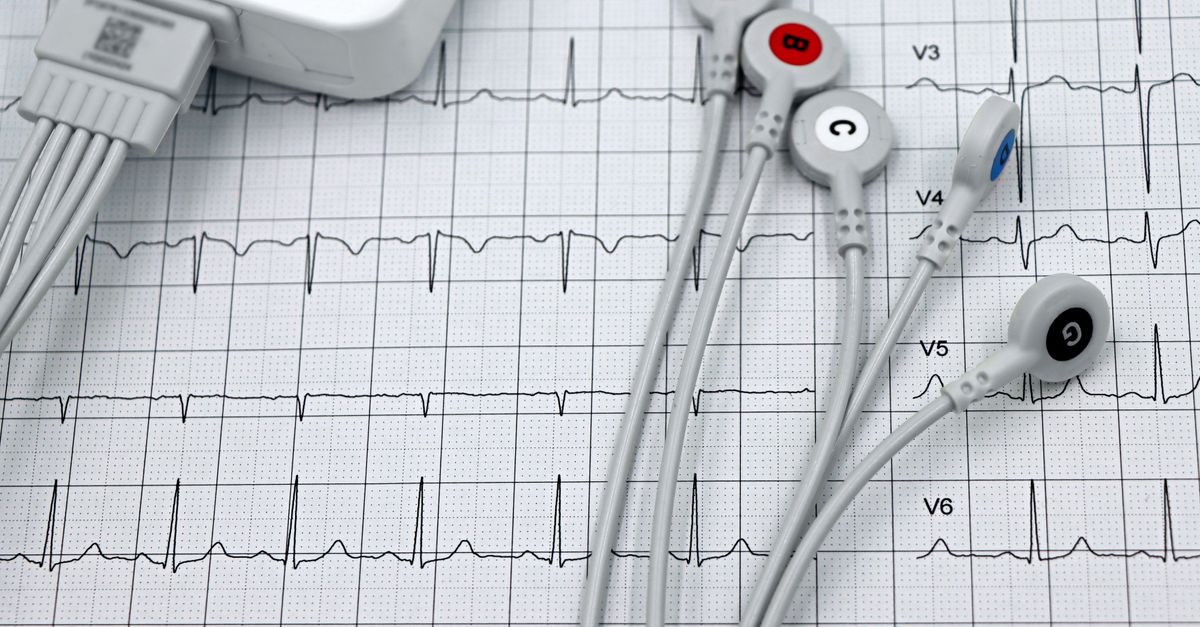
Assessment usually starts with the history, which is the part you can prepare. What the episodes feel like, how long they last, what you were doing when they started, whether they stop gradually or cut out, and whether anything else happens alongside them. Common investigations include a resting ECG, blood tests such as thyroid function and a full blood count, and where the picture warrants it, a monitor worn for days or weeks to catch an episode as it happens.
A resting ECG records a few seconds. Palpitations that arrive twice a week are unlikely to appear in those seconds, so a normal tracing does not close the question, and it is not a reason to stop describing the symptom. The same logic applies to hormone testing, which our article on a normal perimenopause blood test covers in detail. Keeping a short written record of episodes gives the history something to stand on, and our guide to what to write in a perimenopause symptom diary sets out a format that survives contact with a ten minute appointment.
Frequently asked questions
Can palpitations happen at night in perimenopause even without a hot flush?
Yes. Palpitations are frequently noticed at rest, including in bed, with no flush and no obvious trigger. The SWAN analysis found palpitations peaking from perimenopause into early postmenopause in half of the women followed, and being awake and still simply removes the distractions that mask a heartbeat during the day.
Does a normal ECG mean nothing is wrong?
Not necessarily, and not in either direction. A resting ECG captures a few seconds of rhythm, so intermittent palpitations often will not appear on it. Longer ambulatory monitoring exists precisely for that reason. A normal result is common and is not a signal to stop reporting the symptom.
Are palpitations worse in perimenopause or after menopause?
The evidence disagrees with itself. The 2021 systematic review found reported prevalence of 20.1% to 40.2% in perimenopause and 15.7% to 54.1% afterwards, with three of five studies finding perimenopausal and surgically postmenopausal women highest. The SWAN trajectories peaked in perimenopause and early postmenopause, then declined.
Can caffeine or alcohol make palpitations more noticeable?
Stimulants and some medications are a recognised category of cause, accounting for 6% of cases in the study cited by the European Heart Rhythm Association. Whether reducing them changes anything for a particular person is a question for a clinician who knows the case, not a rule that applies to everyone.
Is a fast heartbeat during exercise the same thing?
It is treated differently. Palpitations that begin during physical exertion, rather than while you are at rest, are among the features that prompt earlier investigation. If that is the pattern, it is worth saying so explicitly at an appointment rather than describing the episodes generically.
What is worth writing down before an appointment?
Time of day, what you were doing, how long the episode lasted, how it ended, and anything that happened with it such as breathlessness or dizziness. A fortnight of dated notes turns a vague account into a described pattern, which is what the history depends on.
This article is general information, not medical advice, and is not a substitute for care from a qualified healthcare professional. Speak to your doctor about your own situation.

Leave a Reply