
Estrogen decrease symptoms rarely start with a hot flash. Oestrogen falls in an uneven, fluctuating pattern rather than a straight line, so mood, sleep and energy changes often arrive years before periods shift noticeably, with vasomotor symptoms becoming most likely later, around the final period itself.
Listen to this article, about 10 minutes. A synthetic voice reads the article and announces each section title as it begins; tables are read row by row and the questions at the end are left out.
Recorded 16 October 2026 from the article as published that day. Press a chapter to jump there; the highlighted line is what is playing. A play button sits beside every section heading, and once you scroll past this player a bar at the bottom of the screen keeps the controls in reach. Tap or click any sentence to hear the reading start from there.
On this page: the STRAW+10 timeline showing when vasomotor symptoms actually cluster, the Flo Health and Mayo Clinic expectation versus experience numbers, and four dated reader accounts of which symptom came first.
Think you already know this? Five questions, one minute.
Every answer is on this page. Answer from what you know now; the page fills in the rest.
-
1. According to the STRAW+10 staging paper, how does oestradiol typically behave through most of perimenopause?
Pooled hormone data cited in the STRAW+10 staging paper shows oestradiol holding roughly steady and sometimes spiking before falling sharply in the two years around the final period. Read the section
-
2. In the reader accounts described on this page, what did several women report about symptom timing?
In a dated reader comment thread, several women described low mood or low energy preceding any noticeable change to their cycle, in one case by around eight years. Read the section
-
3. In the Flo Health and Mayo Clinic study, which figures measure the SAME group of respondents?
As the Mayo Clinic summary of the study sets out, the expectation figures come from 17,290 respondents of any age and the experience figures from 12,681 respondents aged 35 and over, a different group answering a different question. Read the section
-
4. According to STRAW+10, when are vasomotor symptoms described as most likely?
The STRAW+10 staging system describes vasomotor symptoms as likely in the late transition and most likely in the two years after the final period, before they typically ease. Read the section
-
5. Under UK guideline NG23, what does a GP need to identify perimenopause in an otherwise healthy 46 year old?
NICE guideline NG23, last updated 15 April 2026, says a healthy person aged 45 or over can usually be identified as perimenopausal from symptoms and cycle changes alone, without laboratory tests. Read the section
Most pages answering this search show a single downward line, oestrogen on one axis, age on the other, as if the hormone just drains away on schedule. It does not. This page uses the staging system researchers actually use, STRAW+10, to show which symptoms tend to cluster at which point, and what four women who lived through it actually noticed first, checked against sources on 1 October 2026.
What does falling oestrogen actually do, and why does it feel random?
Early in perimenopause, oestrogen does not decline so much as wobble. Pooled data from the Study of Women’s Health Across the Nation, cited in the STRAW+10 staging paper, shows mean oestradiol holding roughly steady, even spiking above typical reproductive levels at times, before falling away sharply in the two years either side of the final period, then levelling off. Follicle stimulating hormone (FSH) does the mirror image, rising as the ovaries respond less predictably to it. Neither line moves in a straight path.
That is the honest answer to why the symptoms feel inconsistent: a surge week can bring heavier bleeding and sore breasts, the kind of thing usually blamed on too much oestrogen, while a trough week brings the dryness and low mood usually blamed on too little. That dryness is not only vaginal, either, and when we traced the 43 percent figure on menopause and dry mouth it led back to a single 1989 study of 149 women. A supplement bottle promising to balance your hormones is promising to steady a system that a clinical trial has not steadied yet; treat that claim with the same suspicion you would give a weather forecaster who sells umbrellas.
What symptoms tend to show up before your periods even change?
Changes in the menstrual cycle itself get noticed first by definition, because they are the one symptom with a calendar attached. But several accounts suggest the felt symptoms, mood, energy, sleep, often arrive earlier and go unrecognised for longer, partly because cycles can still look ordinary while the underlying hormone pattern has already started to change.
We read a March 2025 reader comment thread under a perimenopause newsletter post, four accounts in all, each dated and attributed by name. The post’s author, Jess Mujica wrote that it took her roughly two years to connect low mood to perimenopause, because her periods had not yet started skipping; she has since described five years of transition. Bronwen Leigh said her first signs were low mood and low energy, which she and her doctor first put down to low iron, and that she was initially told she was too young for perimenopause to be considered. Lisa Bolin said hot flushes in her early forties were the symptom she consciously noticed first, though looking back she could see other signs she had missed at the time. Susan Campbell wrote that she noticed symptoms eight years before any doctor raised perimenopause, despite cycling normally throughout.

Four accounts are a pattern, not a proof, and nothing here should be read as a diagnosis for any symptom you are noticing. What they agree on is worth taking seriously: mood and energy changes can precede any visible change to the cycle, sometimes by years, and a still regular cycle does not rule perimenopause out. That lines up with clinical reporting on early perimenopause, which notes that a lengthening or worsening of premenstrual symptoms, more bad days each month rather than fewer good ones, is often among the earliest changes, sometimes with night sweats confined to the days just before a period that is still arriving on time.
Which symptoms do people expect, and which do they actually get?
The clearest numbers on the gap between what women expect and what they get come from a 2026 Flo Health and Mayo Clinic study of 17,494 users across 158 countries, led by Dr Mary Hedges and published in the journal Menopause. Read the two columns in the table below separately: the left column is what 17,290 respondents of any age said they expected, and the right column is what 12,681 respondents aged 35 and over said they were actually experiencing. These are different groups of people answering different questions, not a before and after of the same women, and the study did not test whether the gap is statistically significant.
| Symptom | Expect it (17,290 respondents, all ages) | Report having it (12,681 respondents, 35+) |
|---|---|---|
| Hot flashes | 71.1% | not separately reported at this age cut |
| Sleep problems | 67.5% | 76% |
| Weight gain | 65.2% | not separately reported at this age cut |
| Fatigue | not asked of the expectation group | 83.2% |
| Exhaustion | not asked of the expectation group | 83.2% |
| Irritability | not asked of the expectation group | 80% |
| Digestive changes | not asked of the expectation group | 76% |
The shape of the gap still matters. Hot flashes, sleep trouble and weight gain are what the marketing and the magazine articles have trained women to expect. Fatigue, exhaustion, irritability and digestive change are what the over 35s in this study actually reported, in far higher numbers, and none of those four are usually on the symptom checklists that get handed out.
What order do symptoms usually follow, according to STRAW plus 10?
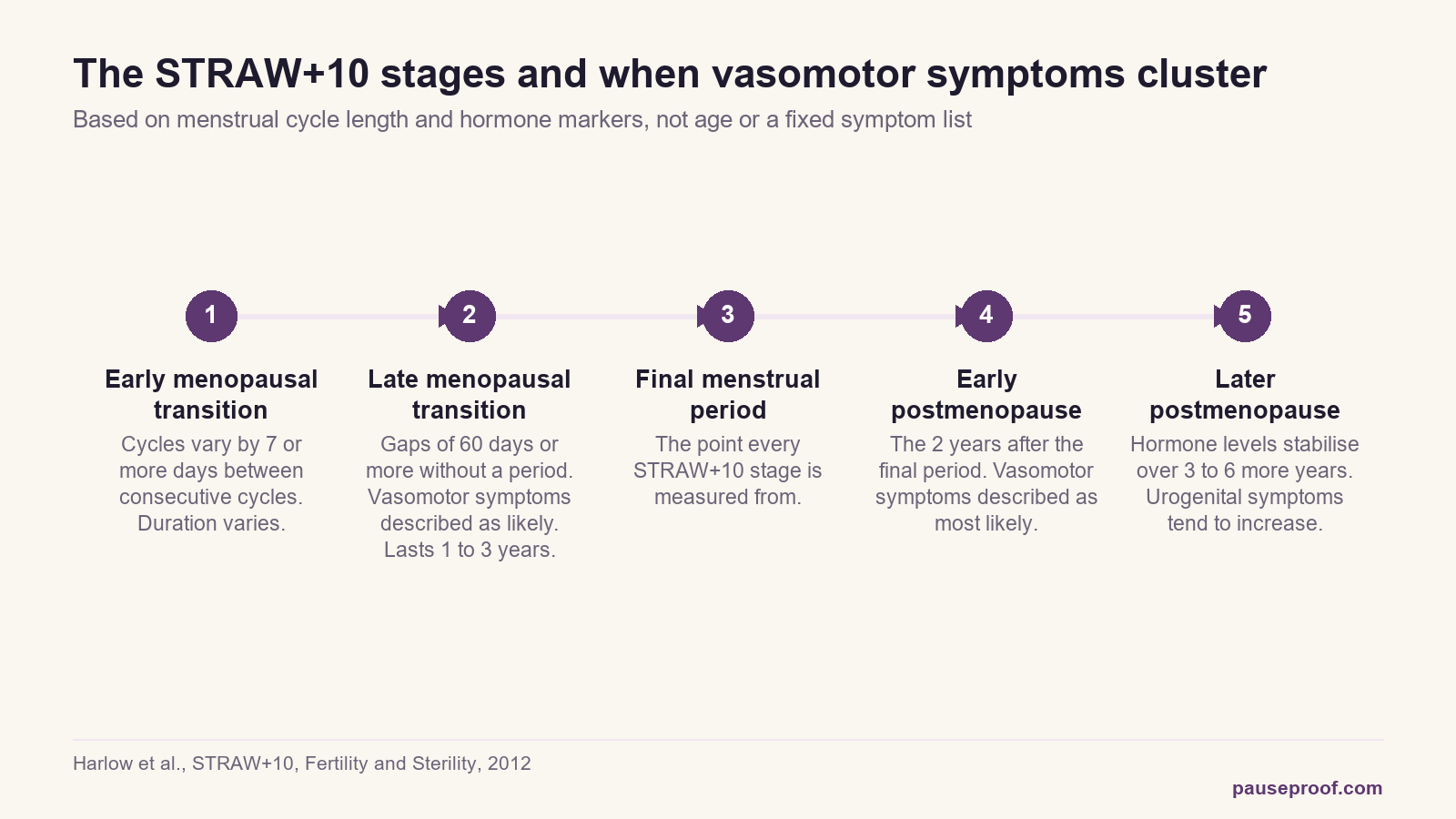
The STRAW+10 staging system is the framework menopause researchers use to describe where someone sits in the transition, built from menstrual cycle length and hormone markers rather than age or a fixed symptom list. It will not diagnose you on its own, and it cannot stage women who have had a hysterectomy or endometrial ablation, because both remove the cycle length data the system depends on. What it does well is show where, on average, vasomotor symptoms such as hot flashes and night sweats cluster against the stages defined by cycle changes.
In the late menopausal transition, marked by a gap of 60 days or more without a period and estimated to last one to three years, STRAW+10 describes vasomotor symptoms as likely. In the two years immediately after the final period, it describes them as most likely, before they typically ease as hormone levels stabilise. Increasing vaginal and urinary symptoms tend to arrive later still, in the stage researchers call late postmenopause. That is a staging description rather than a first sighting: the SWAN cohort found vaginal dryness already reported by about 1 in 5 women aged 42 to 53, as our page on vulvovaginal atrophy and its prevalence figures sets out. The earlier stages before that, where cycles are only subtly shorter or starting to vary by seven days or more between consecutive cycles, are not where the staging paper places the vasomotor peak, which fits what the reader accounts above describe: symptoms that are not hot flashes, turning up first.
When is it worth seeing a doctor, and what will they actually check?
Under UK guideline NG23, last updated 15 April 2026, a GP can identify perimenopause in an otherwise healthy person aged 45 or over from symptoms and cycle changes alone, without blood tests. For people aged 40 to 45, the same guideline says a doctor should consider an FSH blood test rather than rule it out, so if you are in that age band and have been told testing is pointless, that is worth raising again.
A doctor visit is also where this page stops being useful on its own. See a doctor for any bleeding that is unusually heavy, bleeding after sex, bleeding after twelve months without a period, or symptoms severe enough to disrupt your work or sleep. None of that is something an article, a staging chart or a symptom checklist can safely assess for you.
Three related pages worth reading next: why symptoms come and go rather than settling into a steady pattern, what a hot flash actually feels like if that is the symptom you are trying to place, and early menopause symptoms and why the timing matters if your symptoms started well before 45.
Symptom recognition checklist
Tick anything you have noticed in the past few months. This only records what you tick. It does not score, diagnose or predict perimenopause, and it is not a substitute for seeing a doctor.
A checklist cannot diagnose perimenopause. Take what you have ticked to a doctor, who can consider it alongside your cycle history.
Frequently asked questions
Does oestrogen drop at one point, or does it fluctuate the whole time?
It fluctuates for most of perimenopause, often spiking above typical levels as well as falling, before dropping sharply in the two years around the final period and then levelling off, based on pooled hormone data cited in the STRAW+10 staging paper.
Can perimenopause symptoms start while periods are still regular?
Yes. Mood, sleep and energy changes can appear years before a noticeable change in cycle length, according to reader accounts and clinical reporting on early perimenopause, though a cycle that is still regular does not confirm or rule out any single cause.
What is STRAW plus 10 and who actually uses it?
STRAW+10 is a staging system researchers use to classify where a woman sits in reproductive aging, based on menstrual cycle length and hormone markers. It is a research and clinical framework, not a test you take or a score an app can give you.
Does low oestrogen cause weight gain by itself?
The Flo Health and Mayo Clinic study found weight gain was expected by 65.2% of respondents of any age, but that figure measures expectation, not a tested cause. This page does not establish that oestrogen alone drives weight change.
Can a blood test confirm perimenopause?
UK guidance says a healthy person aged 45 or over can usually be identified as perimenopausal from symptoms and cycle changes alone, without lab tests. For people aged 40 to 45, the guidance says a doctor should consider an FSH test rather than skip it.
How long do symptoms typically last after the final period?
The STRAW+10 paper places the period of most likely vasomotor symptoms at around two years after the final period, with levels then stabilising, though individual experience varies and some symptoms, such as vaginal dryness, tend to increase later rather than ease.
Finished the page? The same five questions from the top, to see what stuck.
This article is general information, not medical advice, and is not a substitute for care from a qualified healthcare professional. Speak to your doctor about your own situation.

Leave a Reply