
Hormone replacement therapy for perimenopause falls under the same NICE recommendations as menopause, and none of them requires periods to have stopped. NICE says to offer HRT for hot flushes and sweats, to consider it for depressive symptoms that arrive with other menopause symptoms, and not to offer it to prevent heart disease or dementia.
Listen to this article, about 15 minutes. A synthetic voice reads the article and announces each section title as it begins; tables are read row by row and the questions at the end are left out.
Recorded 18 October 2026 from the article as published that day. Press a chapter to jump there; the highlighted line is what is playing. A play button sits beside every section heading, and once you scroll past this player a bar at the bottom of the screen keeps the controls in reach. Tap or click any sentence to hear the reading start from there.
On this page: NICE NG23 quoted recommendation by recommendation, what HRT is for and is not for, the risks in NICE’s own numbers, and the appointment checklist built from the guideline itself.
Think you already know this? Five questions, one minute.
Every answer is on this page. Answer from what you know now; the page fills in the rest.
-
1. What does NICE recommendation 1.3.1 say about identifying perimenopause in someone aged 45 or over?
NICE 1.3.1 identifies perimenopause without laboratory tests in otherwise healthy people 45 or over who have recent vasomotor symptoms and changes to their cycle. NICE NG23 Read the section
-
2. Which of these does NICE list as a reason not to start HRT?
Recommendations 1.6.4 and 1.6.5 say not to offer HRT for primary or secondary prevention of cardiovascular disease or for dementia prevention; the licensed indication is symptoms. NICE NG23 Read the section
-
3. According to NICE recommendation 1.4.2, what should a clinician discuss before someone starts HRT?
1.4.2 lists combined versus oestrogen-only HRT, transdermal versus oral, types of oestrogen and progestogen, sequential versus continuous combined, and dose and duration as discussion points. NICE NG23 Read the section
-
4. In NICE’s discussion aid, how does breast cancer risk behave with continued use of combined HRT?
NICE’s discussion aid states breast cancer risk with combined HRT rises with duration, is higher in current than past users, and persists at least 10 years after stopping. NICE HRT discussion aid Read the section
-
5. What does The Menopause Society’s 2022 position statement say about the benefit-risk balance of hormone therapy?
The 2022 position statement says the benefit-risk ratio is favourable for treatment of bothersome symptoms in most healthy women under 60 or within 10 years of menopause onset, without contraindications. The Menopause Society, 2022 Read the section
This page quotes the guideline rather than paraphrasing it, recommendation by recommendation, checked on 30 September 2026. It does not say whether HRT suits you, what to take or at what strength. Those belong to you and a clinician who knows your history, and a website that claims otherwise is selling something.
Can you have HRT while you are still having periods?
Nothing in the guideline says otherwise. NICE guideline NG23, last updated on 15 April 2026, uses the word perimenopause in its recommendations only in section 1.3, on identifying it. Recommendation 1.3.1 identifies perimenopause, without laboratory tests, in otherwise healthy people aged 45 or over who have vasomotor symptoms that have recently started and any changes in their menstrual cycle. Changing periods are part of the definition, not a reason to wait.
The HRT recommendations then talk about "menopause-associated symptoms" and set no requirement for periods to have ended. Recommendation 1.8.1 says to offer combined HRT, oestrogen with a progestogen, to people with a uterus, and oestrogen alone to people who have had a total hysterectomy. Section 1.4 covers everyone aged 40 or over; for 40 to 44, recommendation 1.6.6 says the balance of benefits and risks is likely to sit between that for premature ovarian insufficiency and that for people aged 45 or over. If you were told you are too young to be asking, what NICE actually says at each age sets the bands out.
One practical point matters more in perimenopause than after it. The NHS page on HRT says it is still possible to get pregnant while taking HRT, and advises contraception until 2 years after the last period if you are under 50, or 1 year after it over 50. HRT is not contraception. We cover the detail in when contraception can stop.
Which symptoms does NICE say HRT is for, and which is it not for?
NICE chooses its verbs carefully. "Offer" means the committee was confident; "consider" means the evidence was weaker; "do not offer" means it should not happen. Here is how the guideline words HRT for each symptom or aim, with the recommendation number so you can check every row yourself.
| Symptom or aim | What NG23 says | Recommendation |
|---|---|---|
| Hot flushes and night sweats | Offer HRT | 1.5.1 |
| Vaginal dryness, pain with sex, urinary discomfort | Offer vaginal oestrogen, including alongside systemic HRT | 1.5.5 |
| Depressive symptoms that do not meet a diagnosis of depression, starting with other menopause symptoms | Consider HRT | 1.5.21 |
| Diagnosed depression | Follow NICE’s depression guideline alongside NG23 | 1.5.23 |
| Sleep problems linked to night sweats | Consider menopause-specific CBT, alone or with other options including HRT | 1.5.24 |
| Low sexual desire | Consider testosterone if HRT alone is not effective | 1.5.25 |
| Fragility fracture | Risk is lower while taking HRT and falls back once it stops | Table 1 |
| Muscle mass and strength | Limited evidence HRT may help | Table 1 |
| Preventing heart disease | Do not offer HRT for this | 1.6.4 |
| Preventing dementia | Do not offer HRT for this | 1.6.5 |
Two lines in that table get lost in the noise. HRT is for symptoms: NICE is explicit that it is not a heart or brain protection plan, whatever a podcast guest says. And for hot flushes alone, recommendation 1.5.4 says not to routinely offer SSRI or SNRI antidepressants or clonidine as the first choice. Recommendation 1.4.5 adds that the efficacy and safety of unregulated hormone preparations are unknown, which covers the gummy that promises to "balance your hormones" about as politely as a guideline can. We looked at the non-prescription side in what the evidence says about natural relief for hot flashes.
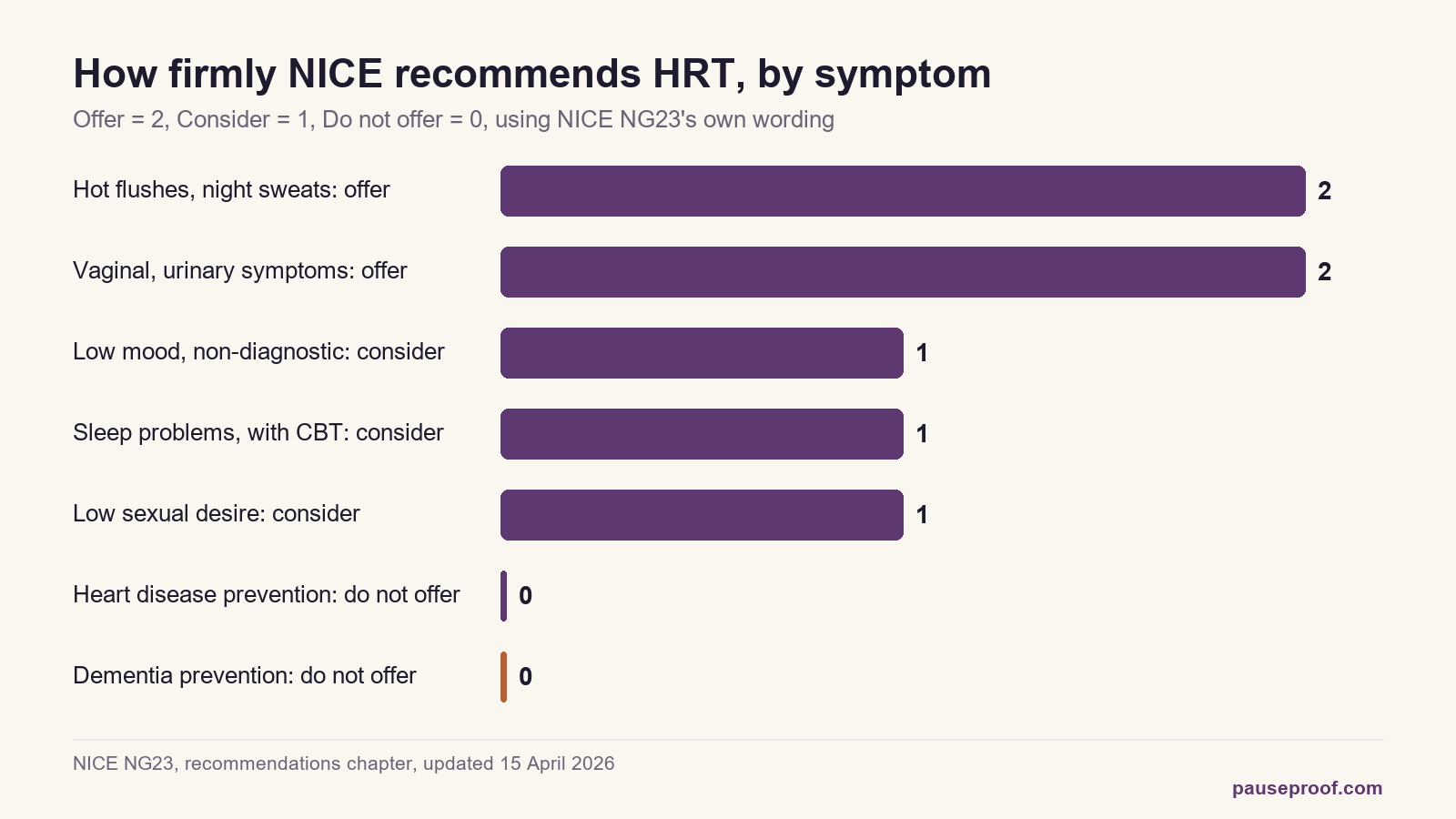
The low desire row is the one NICE says least about, a single recommendation on testosterone. Our page on what the research and women report about perimenopause sex drive takes that question further than a guideline table can.
What forms of HRT exist, and what must the conversation cover?

Systemic HRT, the kind absorbed into the bloodstream, delivers oestrogen as a tablet or through the skin as a patch, gel or spray, according to NICE’s own definitions. The progestogen that protects the womb lining comes as a tablet, a patch or an intrauterine system. Vaginal oestrogen is separate: recommendation 1.5.7 lists a cream, gel, tablet, pessary or ring, and 1.5.6 says only a minimal amount reaches the bloodstream compared with systemic HRT. What those genitourinary symptoms are, and why the condition goes by three different names, is set out in our guide to vulvovaginal atrophy and what NICE says about it.
Recommendation 1.4.2 lists what a clinician should talk through when HRT is on the table: combined versus oestrogen-only, through the skin versus by mouth, the types of oestrogen and progestogen, sequential versus continuous combined, and dose and duration. 1.4.3 says to discuss how long treatment might last at the outset, to rediscuss benefits and risks at every review, and to explain that symptoms may return when HRT stops. 1.8.3 says to use the lowest effective dosage. 1.9.2 sets reviews at 3 months and then once a year. 1.5.28 says to consider HRT through the skin rather than by mouth for people at raised risk of blood clots, including a body mass index over 30. Side effects in the first weeks are part of that review too; our page on HRT bloating and what five leaflets list covers the one the NHS page leaves out.
Bleeding is the part to know in advance, stated plainly. Recommendation 1.8.4, amended in April 2026, says vaginal bleeding is common in the first 6 months of systemic HRT and within 3 months of any change, and that bleeding outside those windows needs prompt medical attention. Bleeding after menopause has its own page.
Questions NICE expects to come up at an HRT appointment
Built from what NICE NG23 says a clinician should discuss before you start HRT. Tick off what you have covered; nothing here scores or recommends anything.
This checklist follows NICE NG23’s own discussion points. It does not score your symptoms or tell you what to choose; that conversation is between you and a clinician who knows your history.
What are the risks of HRT, in NICE’s own numbers?
NICE publishes an HRT discussion aid with absolute numbers per 1,000 women, meant to be read with a clinician. Its main estimates are for women aged 45 or over starting at 50, so they fit a 44 year old in perimenopause only roughly. The breast cancer figures combine sequential and continuous combined HRT.
| Outcome, per 1,000 women | Never took HRT | Took combined HRT |
|---|---|---|
| Breast cancer, ages 50 to 69 | 59 | 79 after 5 years of use; 92 after 10 years |
| Fragility fracture, ages 50 to 54 | 60 | 40 after 5 years of use |
| Fragility fracture, ages 50 to 59 | 127 | 80 after 10 years of use |
| Endometrial cancer, ages 50 to 54 | 4 | 1 on continuous combined; 8 on sequential combined |
| Stroke, ages 50 to 54 | 3 | Similar with oestrogen through the skin |
| Breast cancer, early menopause, ages 40 to 59 | 33 | 51 after 10 years from age 40 |
Around those numbers the guideline adds three statements. Overall, combined or oestrogen-only HRT is unlikely to affect life expectancy (1.6.1). Breast cancer risk with combined HRT rises with duration, is higher in current than past users, and persists at least 10 years after stopping. Blood clot risk is raised with HRT by mouth and not with HRT through the skin. These are population figures; a personal history of breast cancer, clots, heart disease or stroke changes the conversation, and 1.5.26 and 1.5.30 route those cases to a clinician with menopause expertise.
Why do UK and US pages say different things about HRT?
Because they are working from documents of different ages, and the documents do not agree. The US pages that rank for this search lean on federal advice written before the labelling changed. Here is what each source says today.
| Source and date | On who | On how long |
|---|---|---|
| NICE NG23, updated 15 April 2026 | Offer HRT for vasomotor symptoms; no age ceiling in the recommendation | Discuss duration at the outset and at every review; lowest effective dosage |
| The Menopause Society (then NAMS), 2022 position statement | Benefit-risk favourable under 60 or within 10 years of menopause onset, without contraindications | Longer use for documented reasons, with periodic reevaluation |
| US FDA, announced 10 November 2025 | Boxed warnings on heart disease, breast cancer and probable dementia removed | Not stated in the announcement |
| Office on Women’s Health, page updated 11 March 2025 | May be an option up to 59, usually within 10 years of menopause | "Use the lowest dose that works for the shortest time needed" |
| NHS, page last reviewed 7 February 2023 | Usually possible if you have menopause symptoms | Usually 2 to 5 years, can be longer |
One row in that table needs a second date beside it. The November 2025 announcement started the US change rather than finishing it. On 12 February 2026 the FDA approved the first updated labels, for six products, removing the boxed warning statements on heart disease, breast cancer and probable dementia, and said 29 companies had been asked to submit labelling changes, according to the FDA announcement as republished by BioSpace. So whether a particular US product still carries the old box depends on whether its own update has been approved yet. That is a question for the prescriber or pharmacist, not something a general page can settle.
There is one outright contradiction. The FDA announcement says women who start HRT within 10 years of menopause onset, generally before 60, show a reduction in all-cause mortality in randomised studies. NICE recommendation 1.6.1 says HRT is unlikely to affect life expectancy overall. Both cannot be the whole picture, and neither is a reason on its own to take or avoid HRT. The shortest time wording, meanwhile, appears nowhere in NICE’s text, and the NHS page predates the 2024 NICE update.
What do women in their forties report when they ask about HRT?
To see how the guidance meets the surgery, we read a Mumsnet thread from 2 June 2026 in which a woman about to turn 43 said her GP called her far too young for perimenopause. We read the first two of its three pages, about 50 posts. A poll on the thread drew 191 votes, 93 percent saying she was not being unreasonable. What follows is what posters report, paraphrased, not findings.

The opening poster said she wanted to discuss HRT options and had to ask several times before blood tests were booked. One reply described an older GP who kept saying you cannot be menopausal while still having periods; she paid for a specialist through work insurance. Another said it took nearly three years, and a run of contraceptives and antidepressants, before she was offered HRT. A poster who had a hysterectomy at 43, keeping her ovaries, said two GPs over about two years offered antidepressants and a meditation app.
Several posts cut the other way, and they deserve the same space. One said fibroids and other causes of heavy bleeding ought to be checked first. One poster reported that her own symptoms turned out to be an overactive thyroid. Another passed on a GP friend’s view that many women now put everything down to perimenopause. On blood tests the thread split: one poster said a test would settle it, and at least five said it would not.
Against the guideline, the pattern is mixed. The idea that periods must stop first is not in NG23; 1.3.1 builds cycle change into the definition. But at 43, recommendation 1.3.6 does let a clinician consider an FSH test, so the blood tests were within the guidance, and so is ruling out other causes. Why a normal hormone result settles little explains the swing. Whether the antidepressants these posters describe were for hot flushes or for mood cannot be told from a forum post, so 1.5.4 cannot be applied to them. If mood is the main thing, our page on depression in perimenopause sets the documents side by side.
What has changed since this was first published?
- Added in October 2026: the FDA row in the comparison table describes the 10 November 2025 announcement. The first approved label changes followed on 12 February 2026 for six products, with more pending, per the FDA announcement as republished by BioSpace. This page previously read as though every US label had already changed.
- Not rechecked on 18 October 2026: the NICE NG23 update date of 15 April 2026. The NICE site refused our automated check that day, so that date rests on our reading of 30 September 2026.
Frequently asked questions
Does HRT work as contraception?
No. The NHS says pregnancy is still possible while taking HRT and advises contraception until 2 years after the last period under 50, or 1 year after it over 50.
Do you need a blood test before HRT in perimenopause?
Not at 45 or over: NICE 1.3.1 identifies perimenopause from symptoms without laboratory tests. For people aged 40 to 45, 1.3.6 says a clinician may consider an FSH test. Our symptom diary guide covers what to bring instead.
Is vaginal oestrogen the same as HRT?
It is a local treatment. NICE 1.5.6 says only a minimal amount is absorbed into the bloodstream compared with systemic HRT, and 1.5.5 says it can be used alongside systemic HRT.
What does NICE list if HRT is unsuitable?
It names menopause-specific CBT (1.5.2) and, for moderate to severe hot flushes when HRT is unsuitable, fezolinetant under its technology appraisal (1.5.3). 1.5.26 says to consider referral to a clinician with menopause expertise.
Are compounded or unregulated hormones the same thing?
NICE 1.4.5 says the efficacy and safety of unregulated hormone preparations are unknown. A seminar that sells them as the natural upgrade is making a claim the guideline does not.
What does NICE say happens when HRT is stopped?
Recommendation 1.8.7 says tapering may limit symptoms coming back in the short term, but tapering or stopping at once makes no difference in the longer term. 1.4.3 says symptoms may return and restarting can be discussed.
Finished the page? The same five questions from the top, to see what stuck.
This article is general information, not medical advice, and is not a substitute for care from a qualified healthcare professional. Speak to your doctor about your own situation.

Leave a Reply