
No am I going through perimenopause quiz can tell you whether you are in perimenopause. Two of the four checked here say exactly that in their own words, and none of them names the validated scale it resembles. Each is published by a company selling a test, an app or a prescription discount.
Listen to this article, about 13 minutes. A synthetic voice reads the article and announces each section title as it begins; tables are read row by row and the questions at the end are left out.
Recorded 25 September 2026 from the article as published that day. Press a chapter to jump there; the highlighted line is what is playing. A play button sits beside every section heading, and once you scroll past this player a bar at the bottom of the screen keeps the controls in reach. Tap or click any sentence to hear the reading start from there.
On this page: who publishes each of the four highest ranking perimenopause quizzes and what each of them sells, the three licensed instruments those quizzes resemble with what each was actually validated for, the only two cut offs the Greene scale publishes, the wording of NICE recommendations 1.3.1 and 1.3.6, and five dated accounts from people who paid for the test the quiz pointed them at.
Think you already know this? Five questions, one minute.
Every answer is on this page. Answer from what you know now; the page fills in the rest.
-
1. The quiz ranking first for this question ends by pointing the reader at what?
Forth’s quiz asks fourteen symptom questions and closes on its own MyFORM perimenopause test kit. The page also says plainly that the quiz will not diagnose perimenopause. Read the section
-
2. The Greene Climacteric Scale’s own instrument documentation describes it as a measure built for what purpose?
The instrument’s own documentation calls it a brief and standard measure of core climacteric symptoms or complaints, for comparative and replicative purposes across different types of studies. That is a sentence about comparing studies, not about staging one person. Read the section
-
3. The Greene Climacteric Scale does publish validated cut off scores. What are those cut offs for?
The documentation gives an anxiety subscale score of 10 or more and a depression subscale score of 10 or more, both derived by comparison with the Hospital Anxiety and Depression Scale. Neither cut off is about menopause. Read the section
-
4. Under NICE NG23 recommendation 1.3.1, what identifies perimenopause in otherwise healthy people aged 45 or over?
NG23 recommendation 1.3.1, in a guideline last updated on 15 April 2026, identifies perimenopause without laboratory tests in that age group. Recommendation 1.3.6 is the separate route for people aged 40 to 45, where a serum FSH test can be considered. Read the section
-
5. The five accounts quoted in that section were drawn from which slice of the reviews, and why does the page say so?
The Trustpilot page carries 4.2 out of 5 from 1,728 reviews, so most people writing in are content. Filtering to the lowest ratings finds a pattern worth reading, but it is testimony, not evidence, and it is not a measure of how the service performs overall. Read the section
You typed the question somewhere around eleven at night, answered fourteen questions about sleep and joints and mood, and got back a result that was both alarming and completely non committal. That is what a page looks like when it has to hold your attention and also avoid saying anything it could be held to.
Who actually publishes the perimenopause quizzes on page one?
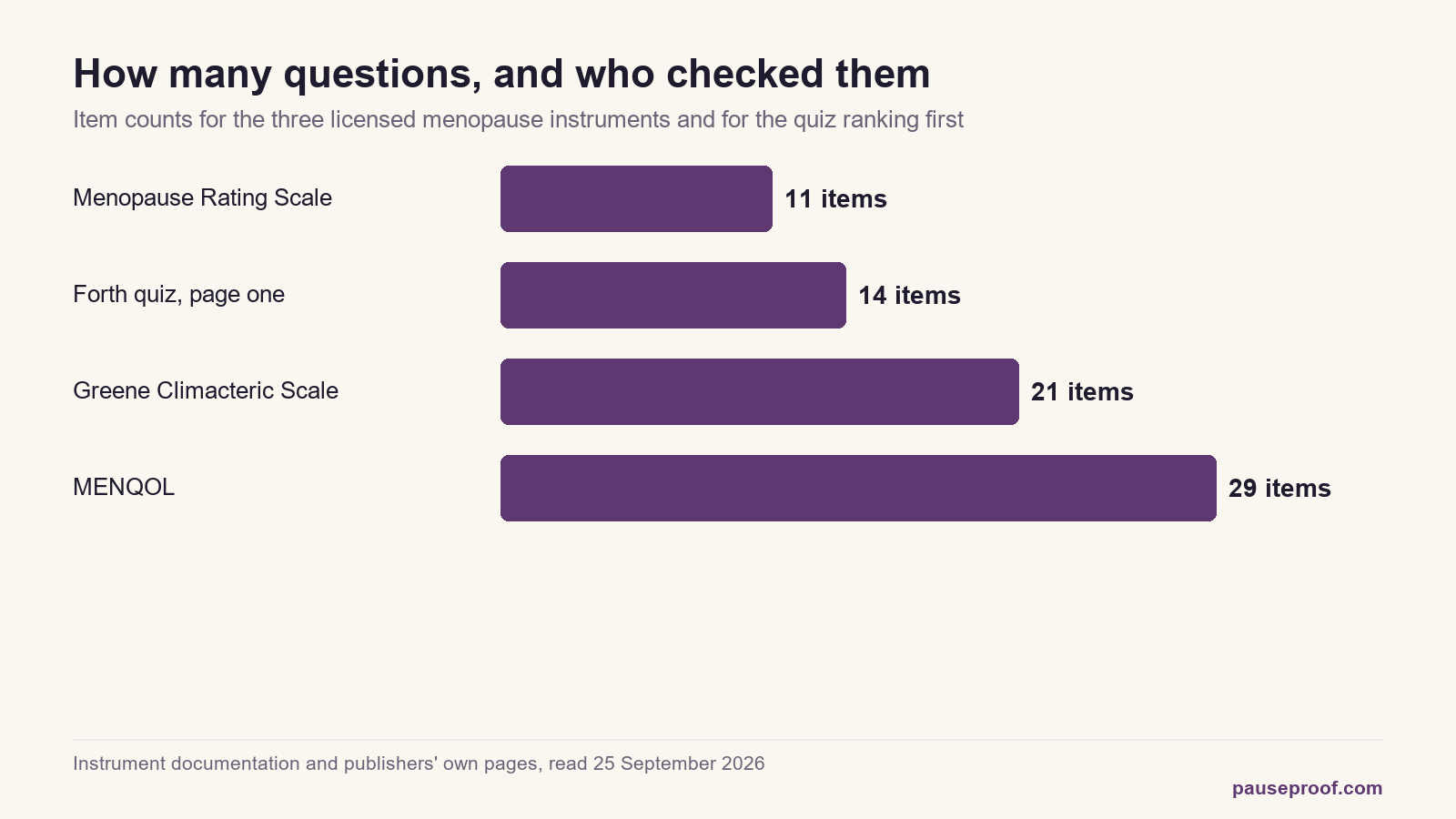
Checked on 25 September 2026. The pattern is not a conspiracy so much as an economy: a symptom quiz is cheap to build, it ranks for a question people type in a panic, and it hands a warm lead to whatever the publisher sells next. Position one belongs to Forth, whose quiz asks fourteen symptom questions and closes on its own MyFORM perimenopause test kit at 139 pounds, a two sample finger prick test taken on days 14 and 21 of the cycle. To its credit the page says plainly that the quiz is for educational purposes only and will not diagnose perimenopause.
| Publisher | What the quiz is | What the publisher sells | Its own words on diagnosis | Dated and reviewed |
|---|---|---|---|---|
| Forth | 14 symptom questions plus age | MyFORM perimenopause blood test kit, 139 pounds | for educational purposes only and will not diagnose perimenopause | 20 April 2026, its own chief medical officer |
| GoodRx | interactive quiz inside an article | prescription discounts | nothing about diagnosis in the page text | 30 October 2024, two named physicians |
| Ubie Health | three minute AI symptom checker | its own AI symptom triage product | nothing about diagnosis on the page | content updated 18 April 2024, two named obstetricians |
| Natural Cycles | quiz described as taking a few minutes | the Natural Cycles birth control app | should not be considered a diagnosis and do not replace a consultation with your doctor | 14 July 2025, a company scientist |
Two of the four tell you, at the bottom of the result, that the result cannot do the thing you came for. That is honest, and it is also an admission. None of them names the instrument it is standing on, which matters rather more than who owns the page.
Which validated scale is a perimenopause quiz borrowing from?
Three questionnaires do most of the work in menopause research, and any quiz asking about flushes, sleep, mood and joints is walking in their footprints. All three were built for a different job. The Greene Climacteric Scale is 21 items on a four point scale across vasomotor, somatic and psychological subscales, with a further probe on sexual function, and takes about five minutes. Its own instrument documentation calls it a brief and standard measure of core climacteric symptoms or complaints to be used for comparative and replicative purposes across different types of studies. That is a sentence about comparing studies with each other, not about telling one woman what stage she is in.
The Menopause Rating Scale is 11 items in three subscales, psychological, somato-vegetative and urogenital. Its methodological review in Health and Quality of Life Outcomes says it was designed and standardised to assess symptoms of ageing women under different conditions, to evaluate the severity of symptoms over time, and to measure changes before and after hormone replacement therapy. Severity, over time. Not the presence or absence of a life stage. MENQOL, 29 items, measures how bothersome each symptom is, and was developed on postmenopausal women aged 47 to 62 not taking hormone therapy. The questionnaire most often waved about as the menopause questionnaire was built on women already out the other side.
| Instrument | Items | What it was built to measure | Where it was published | Does a score say whether you are in perimenopause? |
|---|---|---|---|---|
| Greene Climacteric Scale | 21 | core climacteric symptoms, for comparison across studies | Greene, Maturitas, 1998 | No |
| Menopause Rating Scale | 11 | severity of symptoms over time, and change before and after hormone therapy | Heinemann and colleagues, Health and Quality of Life Outcomes, 2004 | No |
| MENQOL | 29 | menopause specific quality of life, and how bothersome each symptom is | Hilditch and colleagues, Maturitas, 1996 | No |
| Peri-SS | four domains | perimenopause symptoms, for digital self assessment and research | Xu and colleagues, medRxiv preprint, 2025, not peer reviewed | Not established |
There is one recent exception, and it is honest about its own limits. In July 2025 a team from Flo Health and the Mayo Clinic posted a validation of a Perimenopause Symptom Scale, or Peri-SS, built for digital self assessment. They recruited 1,255 US women aged 35 to 59 through Prolific, 633 of whom identified as perimenopausal, and tested it against the Menopause Rating Scale and a general quality of life measure twice, a week or two apart. Scores correlated with the Menopause Rating Scale at r equals 0.88, and that figure is the whole problem in one number: the new scale was validated against another symptom severity measure, not against any determination of whether a woman was in fact in perimenopause. A strong correlation means the two agree about how rough she feels. It says nothing about the question in the quiz title. And it is a preprint, not yet peer reviewed.
What does a perimenopause quiz score actually mean?
Roughly what a total out of a maximum ever means: how much you are currently putting up with. The Greene scale is the revealing case, because it does publish cut offs. It gives two. An anxiety subscale score of 10 or more is described as clinically anxious, and a depression subscale score of 10 or more as clinically depressed, both derived by comparison with the Hospital Anxiety and Depression Scale.
So the best known menopause symptom scale has validated cut offs, and neither of them is about menopause. Nobody has published a number above which you are in perimenopause. Hence the paragraph at the end of every scored quiz, gently explaining that the score does not mean what you were hoping it meant.
There is a second reason the total is softer than it looks. Two of these instruments are licensed: the Greene Climacteric Scale through RWS Life Sciences, whose page carries a usage licence request, and MENQOL through the Mapi Research Trust. So a free quiz on a commercial blog is not running the instrument. It is running something shaped like it, reworded and rescored by somebody with a product to sell, with no published psychometrics.
Does NICE need a quiz or a blood test to identify perimenopause?
It needs neither, above a certain age, and the rule it uses is shorter than any of the quizzes. NICE guideline NG23 on menopause identification and management, last updated on 15 April 2026, says at recommendation 1.3.1 to identify perimenopause without laboratory tests in otherwise healthy people aged 45 or over who have vasomotor symptoms that have recently started and any changes in their menstrual cycle. Three things: age, recently started flushes or sweats, and any cycle change.
Under 45 the guidance is different, and this is where a great deal of online writing has it backwards. Recommendation 1.3.6 says to consider using serum FSH to confirm menopause in people aged 40 to 45 with menopause associated symptoms including a change in their menstrual cycle, and in people under 40 in whom menopause is suspected. For a woman of 41, a blood test is what the guideline points towards, not a departure from it. The April 2026 amendment changed advice on unscheduled bleeding on systemic hormone therapy and left the identification recommendations alone. If a clinician has told you otherwise, what the guideline actually says about being too young sets out the age split in full.
What no quiz can supply is the second half of 1.3.1. It can ask whether your periods have changed and you can tick yes. It cannot know your cycle start dates, and that half of the rule is made entirely of dates. Cycles still arriving on time do not settle it either, which is the subject of why regular periods do not rule perimenopause out.
What do women report after a quiz sends them to a paid test?
The quiz is free, so the record of what it costs people turns up one step later, at the test kit. Forth’s Trustpilot page carries 4.2 out of 5 from 1,728 reviews, so most people who write in are content. Filtering deliberately to the one and two star reviews, an unrepresentative slice and worth saying so, a shape appears across September 2025 to September 2026. It is not that the hormone numbers were wrong. It is that a number arrived with nothing attached that answered the original question. Five accounts, paraphrased:

- Hayley, 17 November 2025: aged 45, results on a bespoke hormone test that a fertility doctor read as indicating no cycle and almost no follicles. An ultrasound scan, they write, then showed a regular cycle and six follicles. A refund was requested and they report no reply.
- Lauren Eves, 4 September 2025: a private fertility panel returned a low ovarian reserve figure and a prolactin result high enough to raise a tumour question. A panel ordered by their GP came back with both values inside range, and they report the GP put the difference down to sample handling.
- A reviewer posting on 10 September 2026: the two part cycle mapping hormone test at 139 pounds, results eight working days after the lab had the sample rather than the three to five promised, and a 75 pound cancellation fee on a private consultation booked around the earlier date. They report being offered 35 pounds.
- C Brown, 16 January 2024: tested to work out whether hormone symptoms were polycystic ovary syndrome, perimenopause or something else, and got results that drew no conclusion.
- Against the pattern, Emily Witham, 22 September 2026: a faulty sample collection device on a female hormone panel, a reply inside 24 hours and a free replacement kit.
These are what people report, and testimony is not evidence. None of them establishes that any test is inaccurate. A finger prick sample posted from a kitchen table and a venous sample drawn in a clinic are not the same measurement, which is what the GP in the second account said. What they show is the shape of the disappointment, and it is not the shape the funnel promises. The question that started the evening was whether this is perimenopause. What came back was a number and a second appointment. What a normal hormone result can and cannot answer is the longer version.
What is worth writing down instead of taking another quiz?
Recommendation 1.3.1 tells you what the appointment is about, so the useful preparation is arriving with those three things already answered rather than a score out of 42. Cycle start dates first, because nobody can reconstruct them afterwards: the first day of bleeding, every cycle, as far back as you honestly remember and forward from today. Then the symptoms that have recently started, each with roughly when, because recently started is the guideline’s own wording and a date is what makes it checkable. Then your age, which you already have. What to actually write down in a perimenopause symptom diary goes through the format that survives a ten minute appointment. It is a smaller task than a fourteen item quiz, it costs nothing, and unlike a score it is still useful in the room.

What NICE NG23 actually asks about
Recommendation 1.3.1 identifies perimenopause in otherwise healthy people aged 45 and over from three things, and 1.3.6 adds a separate route for ages 40 to 45. This is a list of what the guideline asks about, so you arrive with it already written down. It does not score anything and it does not decide anything.
A list of what the guideline asks about, not a way of working out whether you are in perimenopause. That conversation belongs with a clinician. Ticks are saved on this device only.
Frequently asked questions
Is there a perimenopause quiz that has actually been validated?
Not for deciding whether you are in perimenopause. The Peri-SS scale posted as a preprint in 2025 was built for digital self assessment and performed well psychometrically, but it was validated against the Menopause Rating Scale and a quality of life measure, both of which measure symptom burden rather than menopausal stage.
Why does every online perimenopause quiz say it cannot diagnose me?
Because no scoring threshold for perimenopause has ever been published, and because a page that implied otherwise would be making a clinical claim. The disclaimer is the accurate part of the page.
Can a quiz result be taken to a GP as useful evidence?
The score itself carries little. The material behind it can help: which symptoms, when each one started, and what has changed about your cycle. Those are the things UK guidance asks about, and a printed score is not.
How many questions should a perimenopause quiz have?
Length is not the measure. The validated instruments run from 11 items to 29 items and were built for measuring severity, not stage. A 40 item quiz with no published psychometrics is no better founded than a 10 item one.
Are the free quizzes using the real Greene or MRS questionnaires?
None of the four checked here names any instrument. The Greene Climacteric Scale is distributed under licence by RWS Life Sciences and MENQOL by the Mapi Research Trust, so a free quiz on a commercial blog is almost certainly a reworded imitation rather than the instrument itself.
If a quiz cannot answer it, what can?
For otherwise healthy people aged 45 and over, NICE NG23 identifies perimenopause from recently started vasomotor symptoms plus any change in the menstrual cycle, with no laboratory test. Between 40 and 45 it says a serum FSH test can be considered. Both routes run through a clinician, not a web page.
Finished the page? The same five questions from the top, to see what stuck.
This article is general information, not medical advice, and is not a substitute for care from a qualified healthcare professional. Speak to your doctor about your own situation.

Leave a Reply