
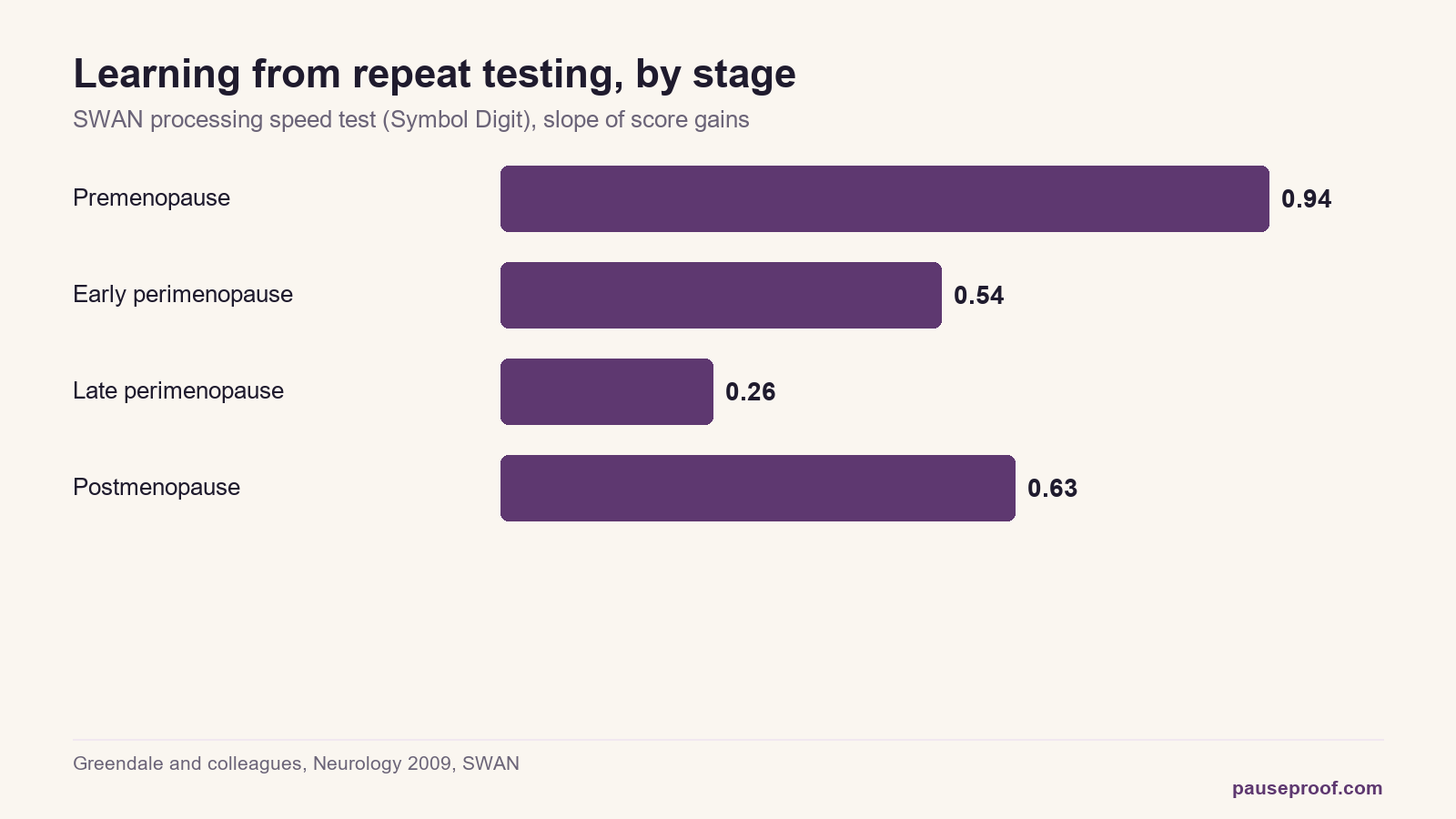
Perimenopause brain fog shows up in test scores, not only in complaints. In the SWAN study of 2,362 women, the normal improvement from repeat testing shrank or stalled during perimenopause for processing speed and verbal memory, then returned to premenopausal levels after the final period. Working memory did not change with stage.
Listen to this article, about 12 minutes. A synthetic voice reads the article and announces each section title as it begins; tables are read row by row and the questions at the end are left out.
Recorded 30 October 2026 from the article as published that day. Press a chapter to jump there; the highlighted line is what is playing. A play button sits beside every section heading, and once you scroll past this player a bar at the bottom of the screen keeps the controls in reach. Tap or click any sentence to hear the reading start from there.
On this page: the three tests SWAN gave 2,362 women, a stage by stage table of what their scores did, the evidence graded from strong to weak, and what about 75 forum posts describe, all read against the 2009 SWAN cognition paper.
Think you already know this? Five questions, one minute.
Every answer is on this page. Answer from what you know now; the page fills in the rest.
-
1. In the SWAN cognition study, what was the main sign of a perimenopause effect on test scores?
Women normally improve on tests they take again; in perimenopause that practice gain shrank or stalled (Greendale and colleagues, Neurology 2009). Read the section
-
2. What did SWAN find happened to learning on the tests after the final period?
The authors wrote that improvement rebounded to premenopausal levels in postmenopause (SWAN, Neurology 2009). Read the section
-
3. In the Flo Health and Mayo Clinic survey, what share of the 12,681 respondents aged 35 and over reported brain fog?
65.8 percent of respondents aged 35 and over reported brain fog, a different group from the all ages expectation question (Hedges and colleagues, Menopause 2026). Read the section
-
4. Across the three forum threads this page read, which complaint came up most often?
Word finding was the most common complaint, for example in an August 2026 r/Perimenopause thread. These are reports, not findings. Read the section
-
5. For people aged 40 to 45, what does NICE NG23 say about serum FSH testing?
Recommendation 1.3.6 says to consider serum FSH in people aged 40 to 45 with menopause associated symptoms including a cycle change (NICE NG23). Read the section
This page reads the cohort studies at source: who was tested, with which tests, and what happened to the scores later. Checked on 30 October 2026. It is about recognising the pattern, not treating it, and it recommends nothing.
Is perimenopause brain fog real, or just stress?
Real, and measurable, which is more than most of the internet will tell you. Plenty of pages put the fog down to tiredness and a full diary. The Harvard Health blog post on the subject, from April 2021, says the lapses are likely not just due to hormonal changes and points at disrupted sleep and stress. It names no study and gives no figures.
Sleep and stress do matter. The NHS symptoms page lists problems with memory or concentration, which it calls brain fog, among the common symptoms of perimenopause, and notes that poor sleep and tiredness can make them worse. But the longitudinal research did something a blog cannot: it tested the same women again and again through the transition.
What did the SWAN memory tests actually measure?
The best known work comes from SWAN, the Study of Women’s Health Across the Nation, a large US cohort that enrolled women aged 42 to 52. The 2009 SWAN cognition paper in Neurology followed 2,362 of them for four years. The mean age at the first cognitive test was about 45. Each woman’s stage was set by her periods, not by a blood test, and she was retested at yearly visits.
Three tests were used, each aimed at a different skill:
- Symbol Digit Modalities Test, for processing speed: pairing symbols with numbers against the clock.
- East Boston Memory Test, for verbal episodic memory: hearing a short story and recalling it straight away and again later.
- Digit Span Backward, for working memory: repeating a string of numbers in reverse.
Here is the part that matters. When people take the same test year after year, their scores normally creep up, because they learn the test. That is called a practice effect. In SWAN, a shrinking practice effect was the signal. The scores did not crash. Women got less of the usual benefit from practice, or none, which the authors described as not being able to learn as well as they had during premenopause.
| Stage (SWAN) | Processing speed (Symbol Digit) | Delayed story recall | Immediate recall and working memory |
|---|---|---|---|
| Premenopause | Improved, slope 0.94 | Improved, slope 0.14 | No significant change |
| Early perimenopause | Improved less, slope 0.54 | No significant improvement | No significant change |
| Late perimenopause | No significant improvement, slope 0.26 | No significant improvement | No significant change |
| Postmenopause | Improved again, slope 0.63 | Improved again, slope 0.13 | No significant change |
Every row comes from the Greendale and colleagues paper. A slope is the paper’s measure of how fast scores rose across repeat visits, so a bigger number means more learning from practice. In SWAN’s definitions, early perimenopause meant a period in the past three months but less regular cycles; late perimenopause meant no period for 3 to 11 months. These are not the same cut offs as the STRAW+10 staging system. If your periods are doing something odd but still arriving, our guide to irregular periods in perimenopause explains where you might sit.

Do memory scores recover after menopause?
In SWAN, yes. The authors wrote that improvement rebounded to premenopausal levels in postmenopause, and they called the difficulties possibly time limited. That is the single most useful sentence in this research, and the one the popular pages tend to leave out.
A smaller study adds a wrinkle. Weber, Rubin and Maki, writing in Menopause in 2013, tested 117 women across four stages. Women in their first year after the final period scored lower than late reproductive and late transition women on verbal learning, verbal memory and a fine motor task. The authors reported that sleep, depression and anxiety symptoms did not explain the difference. Reports of the study put that postmenopausal group at only 14 women, a number this page could not check against the full paper, so it is a small window.
The two findings are not really in conflict. SWAN’s postmenopause stage covers years, while Weber looked at the first twelve months. Read together, they suggest the dip can run through late perimenopause into the first year after the last period, and then lift. Neither can predict what any one person will experience.
How common is brain fog in perimenopause?
Common enough that it should be on every symptom list, and the numbers depend on who was asked. The largest recent survey is the Flo Health and Mayo Clinic study by Hedges and colleagues, published in Menopause in 2026, with 17,494 participants in 158 countries. When 17,290 respondents of all ages were asked which symptoms signal perimenopause, 54.1% picked brain fog. When the 12,681 respondents aged 35 and over were asked what they were experiencing, 65.8% reported brain fog. Among those aged 35 and over who said they were in perimenopause, it was 86.8%.
Those are different groups answering different questions, so the gap between them is not a tested result. The same survey is behind our page on perimenopause fatigue, the symptom that topped its list.
| Source | Who was asked or tested | What it measured | How strong |
|---|---|---|---|
| SWAN, Neurology 2009 | 2,362 US women aged 42 to 52 at entry, tested yearly for 4 years | Scores on three cognitive tests by stage | Strong: longitudinal, same women retested |
| Weber and colleagues, Menopause 2013 | 117 women across four stages | Scores on a test battery | Moderate: one time point, small groups |
| Hedges and colleagues, Menopause 2026 | 12,681 app users aged 35 and over | Self reported brain fog, 65.8% | Moderate: large, but app users and self report |
| Reisel and colleagues, BJPsych Open 2024 | 978 new patients at one private UK menopause clinic | Self reported memory problems, 93% | Weak: conference abstract, clinic authors, people already seeking treatment |
That last row deserves its label. A 93% figure travels well on social media, but it comes from people who had already booked a menopause clinic, reported by the clinic’s own staff in a conference abstract. It says nothing about perimenopause overall.
What do women with perimenopause brain fog report?
Three recent threads on Reddit’s r/Perimenopause forum, about 75 posts and replies in all, give a picture no cohort paper captures. These are what people report, not findings.
In a February 2026 thread, one woman described being unable to hold a list of three things for a minute without repeating it aloud. Her hormone tests had come back normal, and she said a nurse laughed when she voiced a fear of dementia. Replies split. Several urged her to see a specialist, one saying neurologists take cognitive worries seriously. Another said her own fog began well before her hormones changed.
In an August 2026 thread, a woman in corporate communications wrote that she now loses words mid sentence and dreads presenting. Replies described the same thing at work, and one 55 year old said she believed fog and insomnia played a part in losing her job. In a March 2026 thread, a mother of three children with ADHD said her new forgetfulness looked like ADHD traits she had never had, and commenters disagreed about whether ADHD can appear in midlife at all.
Across the three, word finding was the most common complaint, followed by losing track at work and a fear of dementia. Many replies were lists of supplements, which this site does not review or recommend, so they are left out here. The pattern lines up with the research on verbal memory. The dementia fear is where the accounts and the evidence part company, because SWAN found scores recovering after menopause. For the cross check on whether a normal hormone test rules anything out, see our page on a normal perimenopause blood test.
Where does brain fog fit in the NICE guideline?
Mostly by implication. The NICE guideline NG23, last updated on 15 April 2026, identifies perimenopause in otherwise healthy people aged 45 and over from recent vasomotor symptoms and a change in the menstrual cycle, without lab tests (recommendation 1.3.1). For people aged 40 to 45 it says to consider a serum FSH test (recommendation 1.3.6). Its list of symptoms to give people information about covers vasomotor, musculoskeletal, mood, urogenital and sexual symptoms. Memory and concentration are not named in it.
So a woman of 44 whose main complaint is losing words may not match the guideline’s picture, even when everything else fits. That is one reason the too young for perimenopause conversation goes the way it does. Our sister site covers what to do when brain fog tests come back normal in more depth.
When is memory trouble a reason to see a doctor soon?
Brain fog in perimenopause tends to be patchy: names, words, the reason you walked into the kitchen. Some changes are different and should be checked promptly by a doctor rather than put down to hormones. These include memory loss that comes on suddenly, confusion, getting lost in familiar places, trouble managing everyday tasks or money, changes that family or colleagues notice, or lapses that create a safety risk, such as leaving the cooker on or difficulty driving. The Harvard Health post gives sudden change and safety risks as reasons to see a doctor too.
Poor sleep, low mood, thyroid problems, anaemia and some medicines can fog thinking too, and a GP can consider those alongside perimenopause.
What is worth noting before an appointment about brain fog?
The thing that helps most at an appointment is a clear pattern written down. No supplement promising to balance your hormones will do that for you, and neither will a test kit with a ring light behind it. The checklist below lists what to note: when the fog started, what your cycle has been doing, how you are sleeping and the other symptoms NICE asks about. It is a note taking aid, not a memory test, and it gives no score.

If you want to track it over a few weeks, our guide to keeping a perimenopause symptom diary shows a simple layout, and the page on perimenopause insomnia covers the sleep side, which the NHS says makes fog worse.
Before a brain fog appointment: what to note
Tick each item once you have written it down. This is a note taking aid only. It is not a memory test, it gives no score and it cannot tell you what is causing the fog.
Ticks stay on this device. Memory loss that comes on suddenly, confusion, getting lost in familiar places or lapses that create a safety risk should be checked by a doctor promptly.
Frequently asked questions
Which memory skills did SWAN find were not affected?
Working memory, measured with Digit Span Backward, and immediate story recall showed no significant change at any stage in the SWAN paper.
Did SWAN use blood tests to decide each woman’s stage?
No. Stage was set from menstrual bleeding patterns reported at each visit, as the study methods describe.
Is word finding trouble part of perimenopause brain fog?
It is one of the most common things women describe, and the NHS lists problems with memory or concentration as a symptom. SWAN tested verbal memory with story recall rather than word finding itself.
Does a normal FSH result mean the fog is not perimenopause?
Not on its own. FSH moves up and down in perimenopause, and NICE NG23 identifies perimenopause from symptoms and cycle changes in people aged 45 and over without testing.
How long were the SWAN women followed for the cognition study?
Four years of annual visits, with a mean age of about 45 at the first cognitive test, according to the 2009 paper.
Were the Flo survey brain fog figures tested for statistical difference?
No. The 54.1% and 65.8% figures in the Hedges paper come from different groups answering different questions, so they should not be compared as a tested gap.
Finished the page? The same five questions from the top, to see what stuck.
This article is general information, not medical advice, and is not a substitute for care from a qualified healthcare professional. Speak to your doctor about your own situation.

Leave a Reply