
Cold night sweats wake you shivering in damp sheets rather than hot and flushed. In perimenopause the usual cause is the tail end of a hot flash: your body sweats past the point it needed to, then overshoots into shivering. Anxiety, low blood sugar, infection and some medicines also produce them.
Listen to this article, about 15 minutes. A synthetic voice reads the article and announces each section title as it begins; tables are read row by row and the questions at the end are left out.
Recorded 13 November 2026 from the article as published that day. Press a chapter to jump there; the highlighted line is what is playing. A play button sits beside every section heading, and once you scroll past this player a bar at the bottom of the screen keeps the controls in reach. Tap or click any sentence to hear the reading start from there.
On this page: the measured reason a hot flash ends in a chill, why the cold half barely appears in the literature, what a clinician is sorting between, the comfort changes that actually target the cold phase, how long vasomotor symptoms ran in the largest study, and when a night sweat needs a GP.
Think you already know this? Five questions, one minute.
Every answer is on this page. Answer from what you know now; the page fills in the rest.
-
1. In Freedman and Krell’s 1999 measurement, how wide was the thermoneutral zone in women who had hot flashes?
The study measured 0.0 degrees by two methods in the women with flashes, against 0.4 in those without, so sweating carries straight past the shivering threshold. Twenty women in total, all postmenopausal, so it is the best explanation rather than a large body of evidence. Read the section
-
2. In the 2025 interview study, how many of the twenty women described cold sweats or chills?
Eighteen of twenty, most of them only when prompted, while the symptom appeared in four of twenty four sources in the literature review. The paper is small and was commissioned by a company that sells menopause treatments, so read it as evidence the cold half is under described, not as a prevalence figure. Read the section
-
3. Which pattern in the table points away from perimenopause and towards an infection?
Nightly drenching with a fever, a cough or feeling unwell by day is the infection pattern. The chill phase of a flash is minutes long and travels with daytime flashes and cycle changes. Pattern, not sensation, is what the table sorts on. Read the section
-
4. In the SWAN analysis, what was the median total duration of frequent hot flashes and night sweats?
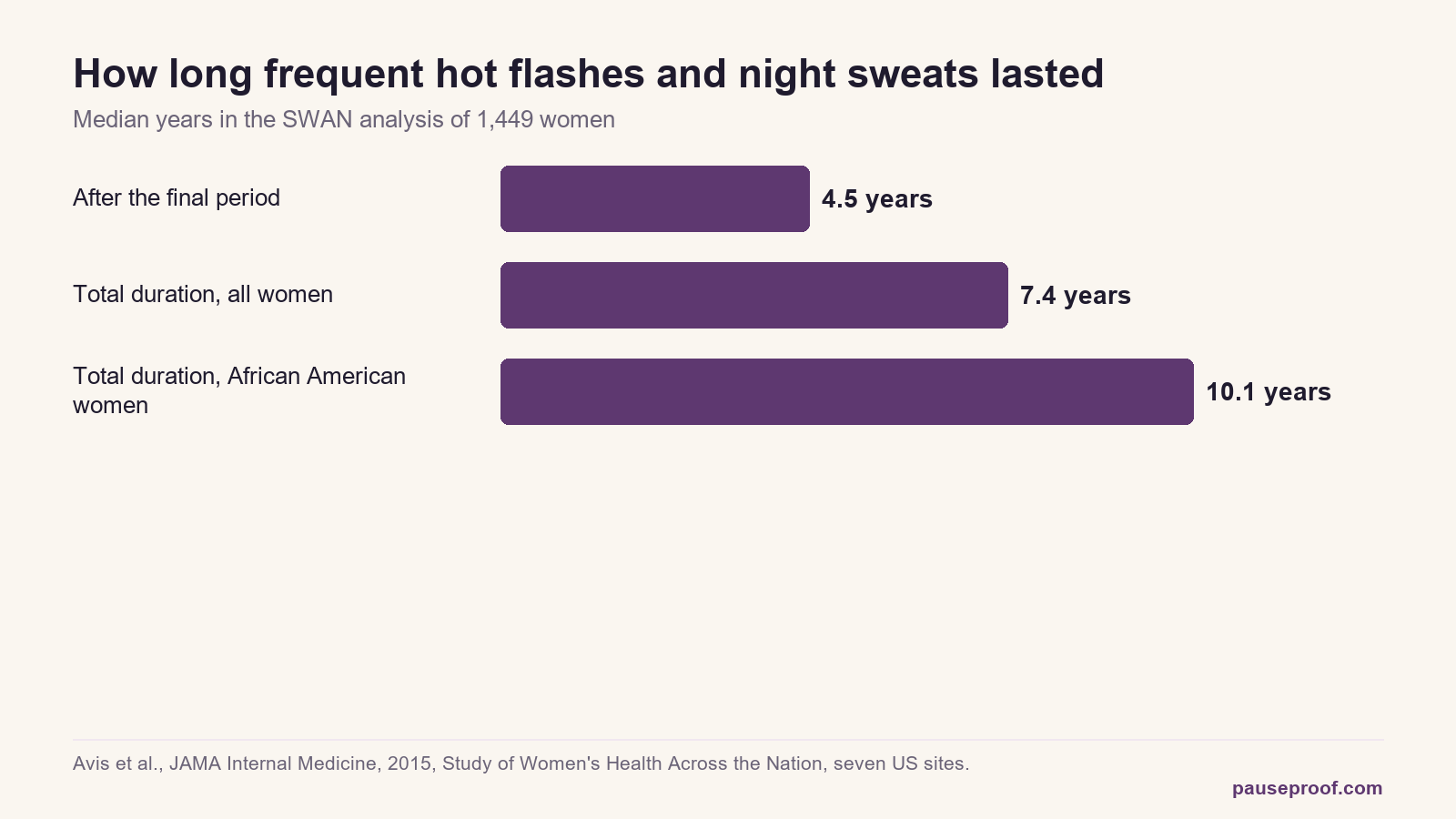
The 2015 analysis of 1,449 women found a median total of 7.4 years, 4.5 of them after the final period, and 10.1 years for African American women. Nobody has measured the cold half on its own. Read the section
-
5. Which combination does the NHS say to see a GP about?
The NHS page lists regular night sweats that wake or worry you, a very high temperature or shivering, a cough or diarrhoea, and night sweats with unexplained weight loss. If you are treated for diabetes, waking cold and clammy is worth reporting too. Read the section
Everything written about the menopausal transition promises you heat. Flushes, flashes, fanning yourself in a meeting, a red face in the supermarket. Then your version turns up at two in the morning as a cold wet nightshirt and a set of chattering teeth, and you lie there wondering whether you have the wrong symptom or the wrong decade.
You almost certainly have neither. The cold is part of the same event. It is simply the half that never made it onto the leaflet.
What are cold night sweats?
A cold night sweat is waking up damp and cold rather than damp and hot. Sometimes the heat came first and you slept through it, so the only thing you experience is the aftermath. Sometimes there is no noticeable heat at all, just clammy skin, a chill that will not shift, and sheets you now have to do something about at an hour when you can barely find the light switch.
People often call these cold flashes. It is a useful phrase and a popular one, but it is worth knowing that it is not a formal clinical term with an agreed definition, which is part of why there is so little research to point you at. Clinicians tend to file the whole thing under vasomotor symptoms, a category that covers the heat, the sweat and the chill together. If you want the heat half of the story, we have written it up separately in hot flashes at night, and what a flash actually feels like from the inside is in hot flash symptoms.
Why does a hot flash end in a chill?
Your brain keeps your core temperature inside a band. There is a temperature at which you start sweating to shed heat, and a lower one at which you start shivering to make heat. The gap between the two is the thermoneutral zone, and in most people it is wide enough that ordinary fluctuations pass without you noticing anything at all.
Robert Freedman and William Krell measured that gap directly and published the result in the American Journal of Obstetrics and Gynecology in 1999. In the women who had hot flashes, the zone was effectively gone: it measured 0.0 degrees Celsius by two separate methods, against 0.4 degrees in the women who did not have flashes. With no gap between the two thresholds, the sweating that starts to cool you does not stop at comfortable. It carries you straight past the lower threshold, and shivering begins.
That explains the sequence rather neatly, and it is worth saying plainly how small the study was: twelve women with flashes and eight without, all postmenopausal rather than in the transition. The authors used the narrow zone to explain what triggers a flash. They did not measure the chill that follows it; the overshoot into shivering is what the missing gap implies, which makes it the best available explanation rather than a large body of evidence.
Then there is the plain physics of a wet nightshirt. Evaporation cools whatever it is sitting on, and it keeps cooling long after the flash itself has finished. Your thermostat has already stopped panicking. Your pyjamas have not received the message.
Why does almost nobody mention the cold half?
Because nobody asks. In 2025, researchers ran interviews with twenty women in the United States who had moderate to severe vasomotor symptoms, and published what they found in the Journal of Patient-Reported Outcomes on 1 July 2025. Ten were postmenopausal and ten were taking endocrine therapy after breast cancer, so this was not a perimenopause group. Eighteen of the twenty described cold sweats or chills, and only one of them thought of it as something separate from a hot flash. Their own review of the existing literature found the symptom documented in only four of twenty four sources. The detail that gives the game away is this one: most participants raised it only when they were prompted.
So the symptom is common enough that almost everyone in the room recognised it, and rare enough in the literature that almost nobody had written it down. Two caveats before you carry that eighteen out of twenty anywhere. Twenty people is a very small group, and the work was commissioned by a pharmaceutical company that sells menopause treatments, which is a reason to read the framing carefully. Take it as good evidence that the cold half is under-described, not as a prevalence figure for the population.
It also explains a specific and maddening experience: describing your nights to somebody, being asked whether you get hot flushes, saying no, and being told it is probably not that. The question was the wrong shape.
How common are night sweats in perimenopause?
Common, but less universal than the leaflets suggest, and nobody has counted the cold version on its own. The largest recent figures come from the Flo Health and Mayo Clinic survey published in Menopause in 2026, summarised in The Menopause Society press release. Its numbers come from different groups of people, so the table keeps them apart rather than stacking them into one story.
| Source | Who was asked | What it found | What it cannot tell you |
|---|---|---|---|
| Hedges et al., Menopause 2026, expectation question | 17,290 app users of all ages | 62.3 percent named night sweats as a perimenopause symptom | What anyone actually felt |
| Hedges et al., Menopause 2026, experience question | 12,681 users aged 35 and over, any stage | 47.5 percent reported night sweats, 18th of 26 symptoms | Whether the sweats were hot, cold or both |
| Hedges et al., Menopause 2026, perimenopause subset | Users aged 35 and over who said they were in perimenopause | 70.3 percent reported night sweats | A clinical diagnosis; stage was self reported |
| Journal of Patient-Reported Outcomes, 2025 | 20 women with moderate to severe symptoms, half on breast cancer therapy | 18 of 20 described cold sweats or chills, most only when asked | How common chills are in anyone else |
| SWAN, JAMA Internal Medicine 2015 | 1,449 women with frequent hot flashes or night sweats | Median 7.4 years in total | How long the chill lasts; it was never counted separately |
Two things fall out of that. Night sweats are more often expected than reported across the whole survey, which makes them one of the few symptoms people overestimate rather than miss. And in the one group that described itself as in perimenopause, seven in ten reported them, so if yours arrive cold rather than hot you are in a crowded room that the questionnaires have not yet thought to ask about. The survey compared answers from different groups and did not test the gap statistically, so read it as a pattern, not a measured difference.
Is it perimenopause or something else?
Cold night sweats are not exclusive to the transition, and the useful move is not to work out the answer yourself but to be able to describe yours accurately to somebody who can. Here is roughly what a clinician is sorting between, and what tends to travel with each.
| What it may be | What the night tends to look like | What usually shows up alongside |
|---|---|---|
| The chill phase of a hot flash | Heat first, then sweat, then shivering in damp sheets. Minutes, not hours. | Daytime flashes, flushing, palpitations, cycle changes |
| Anxiety or a panic episode | You wake abruptly, clammy and cold, heart going | Dread, breathlessness, worse in stressful stretches |
| Low blood sugar overnight | Cold, clammy skin and damp nightclothes, often waking irritable | Mainly relevant to people treated for diabetes |
| An infection | Drenching, and it happens night after night | Fever, cough, feeling unwell during the day too |
| A medicine you take | Started within weeks of a new prescription and has not let up | The NHS names some antidepressants, steroids and painkillers |
| Alcohol in the evening | Worse on nights after drinking, with waking in the second half of the night | A pattern you can see once you write the nights down |
Notice how much of that table is about pattern rather than sensation. Whether the heat came first, how many nights a week, whether it started when a new prescription did. Nobody recalls that accurately in a ten minute appointment, which is why it is worth writing down. There is a guide to what to record before an appointment that covers how to do it without turning your life into a spreadsheet.

One row per night, for the appointment
The pattern is what a clinician sorts on: whether heat came first, how many nights a week, whether it started with a new prescription. Log it here and read it off later.
Kept on this device only. Four to six weeks of rows is far more useful than a paragraph from memory.
What do women with cold night sweats report?
The research barely asks, so we read what people say when somebody does. On 13 November 2026 we read the 58 comments that loaded from an October 2026 r/Perimenopause thread asking about cold flashes (128 in total) and all 20 comments on a March 2026 thread about being wet and cold after night sweats. These are accounts, not findings, and they come from people who chose to reply to a post about chills, which is not a random sample of anyone.
The sequence this page describes was the most common shape. At least seven people in the October thread described waking soaked and then shivering, one of them likening it to a switch flipping from sweating to freezing. A smaller group, at least four, said they had chills with little or no heat at all. One reported a winter trip to an emergency department with chattering teeth and a high blood pressure reading, where she was told it might be a virus; she said earlier gynaecologists had ruled out perimenopause because her periods were still regular. Another said her gynaecologist had not heard of cold flashes.
The accounts that cut against a simple hormonal story matter just as much. One commenter said her chills turned out to sit alongside a ferritin of 10, another found an underactive thyroid, and two dated theirs to starting a GLP-1 weight loss medicine rather than to perimenopause. Several credited a prescribed treatment, while in the March thread at least two others said they were still sweating months into one. None of that tells you what is behind your own nights. It is the clearest argument in this page for the table above and the appointment, not for guessing.
The March poster, 47, described two years of broken sleep despite a towel on the sheet, a colder room and then a warmer one, sweat wicking bedding and a dry top by the bed. That is most of the comfort list below, tried and found wanting. It is worth knowing before you read it: these changes take the edge off the cold half for some people and do nothing for others.
What actually helps with the cold half?
Most advice about night sweats is aimed at the heat, which is why so much of it leaves you colder. Cooling the room harder does nothing for the part of the night where you are already shivering. The cold half responds to a different set of small, unglamorous adjustments.
- Layers you can lose and get back. One heavy duvet is the wrong tool for a problem with two opposite phases. Two light layers let you shed one at the peak and pull it back for the chill.
- A dry top within reach, findable in the dark without standing up. The wet fabric is what keeps you cold, so changing it usually does more than changing the thermostat.
- Sleepwear that moves moisture rather than holding it. Anything that stays soaked will keep working against you for the next hour.
- A towel over the bottom sheet on bad weeks, so the three in the morning change is one item rather than the whole bed.
- Alcohol in the evening is worth noting in your log. What the studies say about drinking and flashes is set out in our page on hot flashes at night; your own record is the quicker way to see whether it matters for you.
None of this is a treatment and the evidence behind most of it is thin, so treat it as comfort engineering rather than medicine. If broken nights are wearing you down, that is a reasonable thing to take to a doctor rather than something to out-organise. There are options, including ones without hormones: NICE lists menopause-specific cognitive behavioural therapy among them. What suits any individual is a conversation with a clinician, not something an article can settle.
The tiredness that follows a run of broken nights is one of the most commonly reported experiences of the transition and one of the most casually dismissed, which is the subject of perimenopause fatigue.
How long do cold night sweats go on for?
Longer than most people are told. The Study of Women’s Health Across the Nation followed 3,302 women at seven sites in the United States, and the analysis of the 1,449 who reported frequent vasomotor symptoms was published in JAMA Internal Medicine in 2015. Median total duration was 7.4 years, with a median of 4.5 years continuing after the final period. For African American women in the study the median was 10.1 years. How common moderate to severe night sweats still are at 55 to 65 is covered in our page on post menopausal symptoms that carry on after the final period.
Two things to hold onto there. A median is a middle, not a forecast: half the group had it for longer. And the study measured frequent hot flashes and night sweats, not the chill specifically, so nobody has actually measured how long the cold half lasts. Symptoms also come and go rather than declining tidily, which is a subject of its own in why symptoms come and go.
When is a night sweat worth taking to a doctor?
The NHS night sweats page, last reviewed on 9 November 2023 and read again on 13 November 2026, lists menopause, anxiety, some medicines, low blood sugar and alcohol among the most common causes. It advises seeing a GP if you have night sweats regularly that wake you up or worry you, if you also have a very high temperature or feel hot, cold or shivery, a cough or diarrhoea, or if you have night sweats alongside weight loss you cannot account for. Those are worth acting on rather than waiting out.
Two additions. If you are treated for diabetes and you are waking cold, clammy and irritable, that is worth reporting, because waking that way can be a sign of a low overnight rather than anything hormonal. And if the sweats began within weeks of starting a new medicine, say so at the appointment. Do not change or stop anything on your own reading of a symptom.
Being in your forties does not make everything hormonal, and a symptom that fits perimenopause can still have a second cause underneath it. Getting it checked is not an overreaction.
Frequently asked questions
Can you have night sweats without hot flashes during the day?
Yes. Some people only get them at night, and some sleep through the heat and register only the cold afterwards. It is the same underlying event either way, and daytime flashes are not a requirement for the night ones to count.
Why do I wake up cold but not sweaty at all?
Waking cold with dry skin is not a night sweat, and it has a long list of ordinary explanations, from a dropped duvet to a cooler room in the second half of the night. If it happens most nights, or comes with anything else that concerns you, that is a reasonable thing to raise with a GP.
Do cold night sweats mean perimenopause is nearly over?
No. There is no evidence that the balance of hot to cold tells you where you are in the transition. Vasomotor symptoms commonly continue past the final period, so a change in how they feel is not a countdown.
How do I record cold night sweats before an appointment?
Note the date, whether heat came first, roughly how long you were awake, and whether you had to change clothes or bedding. A row per night beats a paragraph, and four to six weeks of it is far more useful to a clinician than a general description.
Do cold night sweats happen after menopause too?
They can. Vasomotor symptoms often continue for years after the final period, and the research on how long they persist was measured across both the transition and the years that followed it.
Is a cold flash a real medical term?
Not formally. It is a widely used description rather than a defined diagnosis, and clinicians generally group the heat, the sweat and the chill together as vasomotor symptoms. That is worth knowing if you go searching for research using the phrase, because very little is published under it.
Finished the page? The same five questions from the top, to see what stuck.
Sources rechecked 13 November 2026: the Freedman and Krell abstract, the 2025 interview study, the NHS night sweats page and the Hedges survey figures. The study descriptions were corrected and the prevalence table and forum accounts were added that day.
This article is general information, not medical advice, and is not a substitute for care from a qualified healthcare professional. Speak to your doctor about your own situation.

Leave a Reply