
Sore breasts in perimenopause are common, and the usual cause is hormonal. In a 2026 survey, 70.8 percent of app users who said they were in perimenopause reported breast tenderness. Oestradiol now swings higher and lower than it used to, and breast tissue answers to it. Pain alone is rarely cancer; a new lump or nipple change is checked.
Listen to this article, about 16 minutes. A synthetic voice reads the article and announces each section title as it begins; tables are read row by row and the questions at the end are left out.
Recorded 22 November 2026 from the article as published that day. Press a chapter to jump there; the highlighted line is what is playing. A play button sits beside every section heading, and once you scroll past this player a bar at the bottom of the screen keeps the controls in reach. Tap or click any sentence to hear the reading start from there.
On this page: why erratic oestradiol rather than falling oestradiol is what hurts, the NHS page that lists menopause under breast pain and the NHS page that forgets it, the cyclical against noncyclical split with the age pattern that matters at forty, the 2 to 7 percent figure and what it does not mean, and the NICE referral rules in plain words.
Think you already know this? Five questions, one minute.
Every answer is on this page. Answer from what you know now; the page fills in the rest.
-
1. How does oestradiol behave through the transition, according to the 2019 study summarised on this page?
Per the 2019 study of the menopause transition; same tissue, wider swing, which is why tenderness stops lining up with a date. Read the section
-
2. Which NHS page names hormone changes during the menopause among the causes of breast pain?
The NHS breast pain page does, plainly; the NHS menopause symptoms page does not mention breasts anywhere, though it finds room for sensitive teeth. Read the section
-
3. According to the StatPearls chapter on mastalgia, which age group does noncyclical breast pain usually affect?
Per the StatPearls chapter, which puts breast pain at up to 70 percent of women at some point, about two thirds of it cyclical. Read the section
-
4. In women who come forward with breast pain, in roughly what share is cancer found, per the mastalgia chapter?
Not a personal risk score, and not a reason to ignore a lump or a skin change, which are assessed on their own merits whether or not the area hurts. Read the section
-
5. Under NICE guideline NG12, who is referred on a suspected cancer pathway?
Per NG12; pain alone is not among the criteria, which is exactly the reason not to wait for pain to be the thing that sends you. Read the section
Type sore breasts into a search box and the internet offers two answers, both usually wrong for a woman in her forties: you are pregnant, or it is cancer. The likelier explanation is duller, better documented, and almost never mentioned in the same breath as menopause.
Why do breasts get sore in perimenopause?
Breast tissue responds to hormones, which is why it aches before a period and changes in pregnancy. The model most of us carry into our forties is that oestrogen simply runs down like a battery. It does not. Through the transition it becomes erratic rather than uniformly low, and erratic is the part that hurts.
A 2019 study of the menopause transition, published in Frontiers in Psychology, summarises the earlier hormone research this way: luteal phase oestradiol in the transition has been shown to reach levels sometimes double those usually seen in the late follicular phase, while early follicular levels can fall lower than is typical in reproductive aged women. Same tissue, wider swing.
The older primary research points the same way. A 1996 study by Santoro and colleagues in the Journal of Clinical Endocrinology and Metabolism reported higher oestrogen excretion and lower luteal progesterone excretion in perimenopausal women, with altered ovarian function visible from about age 43. The supplement aisle has since turned that finding into a slogan about balancing your hormones. The study itself sold nothing. It measured.
That is a mechanism you can feel. Tenderness that arrives unannounced, sits for a week or ten days, lifts, then does the same thing six weeks later on a completely different date is behaving exactly as an erratic hormone would. It is also why symptoms come and go, then come back is the ordinary shape of this decade rather than evidence that nothing is really happening.
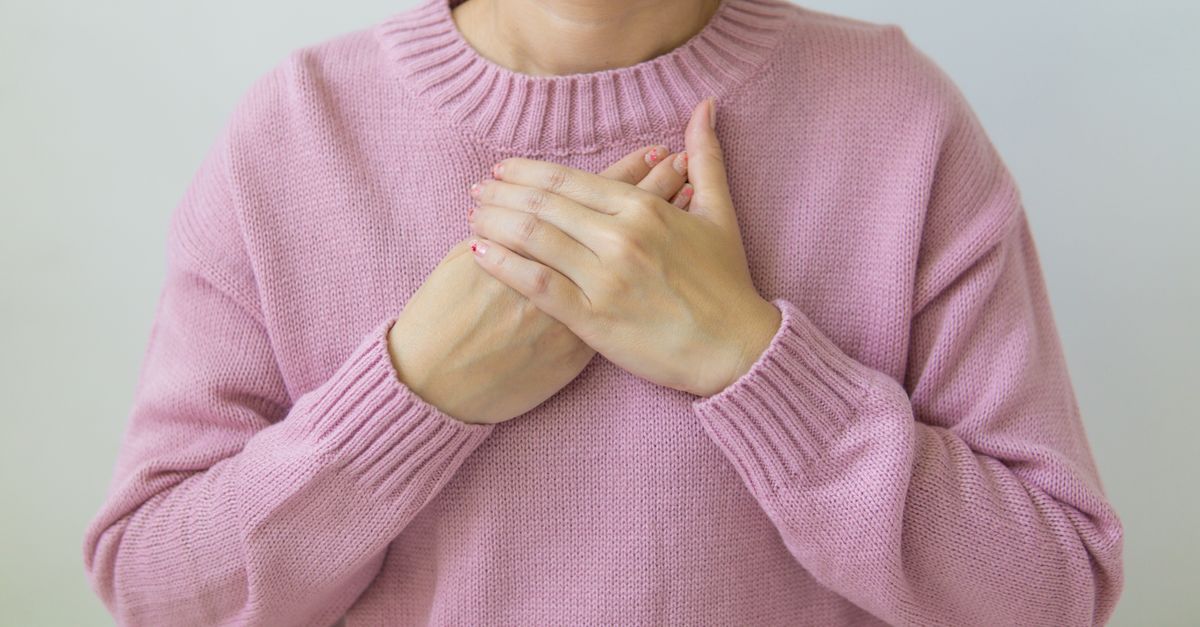
If it is hormonal, why is it missing from the symptom lists?
Here is where it gets faintly ridiculous. The NHS page on breast pain names hormone changes during the menopause among the causes, plainly and without fuss. The NHS page on menopause symptoms does not mention breasts anywhere. We reread both on 22 November 2026. The breast pain page was re-reviewed on 23 October 2026 and still lists menopause; the symptoms page, last reviewed on 19 May 2026, still has no breasts on it. It does find room for sensitive teeth and painful gums, which are real, and which come up in far fewer conversations than this does.
Neither page is wrong. They were written to answer different questions and nobody joined them up. The cost lands on the reader, who either files the soreness under one of those things and forgets it, or finds the other sort of article and spends a fortnight quietly terrified.
The same gap shows up in numbers. The Hedges et al. survey of Flo app users, published in Menopause in July 2026, asked people which of 26 symptoms they thought belonged to perimenopause, and separately asked those aged 35 and over which ones they had. Breast tenderness was recognised by 32.5 percent of 17,290 respondents of all ages, 20th of the 26. It was reported by 60.3 percent of the 12,681 respondents aged 35 and over, 12th of the 26 and ahead of hot flashes at 50 percent.
Those are two different groups answering two different questions, and the paper did not test the gap between them, so read it as a mismatch rather than a measurement. Split by the stage people said they were in, breast tenderness was reported by 70.8 percent of the self identified perimenopause group and 43.8 percent of the postmenopause group, which was tiny: 85 people in the whole survey. The authors also say plainly that the questionnaire has not been validated.
| What was measured | Who answered | Breast tenderness | Hot flashes, for comparison |
|---|---|---|---|
| Recognised as a perimenopause symptom | All ages, 17,290 | 32.5% (20th of 26) | 71.1% (1st) |
| Reported as a current symptom | Aged 35 and over, 12,681 | 60.3% (12th of 26) | 50.0% (16th) |
| Reported, self identified perimenopause | Part of the 35 and over group | 70.8% | 74.7% |
| Reported, self identified postmenopause | Part of the 35 and over group, very small | 43.8% | 75.0% |
| Reported, everyone else aged 35 and over | Part of the 35 and over group | 57.5% | 43.1% |
Is it cyclical pain, or the other kind?
Clinicians sort breast pain into cyclical, meaning tied to the menstrual cycle, and noncyclical, meaning not. The StatPearls chapter on mastalgia, a clinical reference hosted on the National Library of Medicine’s Bookshelf, puts breast pain at up to 70 per cent of women at some point, with only around 30 per cent of them seeking medical attention. About two thirds of affected women have the cyclical kind and about one third the noncyclical kind.
The age detail is the one that matters here. That chapter notes noncyclic mastalgia usually affects women aged 40 or older, often perimenopausal, and lists perimenopause among the hormonal causes of breast pain alongside the menstrual cycle itself. So the kind of breast pain that is hardest to explain by the calendar is also the kind most likely to turn up at exactly this age.
| Cyclical breast pain | Noncyclical breast pain | |
|---|---|---|
| Share of cases | About two thirds of affected women | About one third |
| Timing | Builds in the run up to a period and eases once bleeding starts | No fixed relationship to bleeding |
| How it is described | Dull, heavy or aching, worse in the two weeks before a period | More often focal, meaning one area rather than a general heaviness |
| Typical age | Any reproductive age | Usually 40 or older, often perimenopausal |
| Where perimenopause fits | The cycle it is anchored to stops being predictable | Perimenopause is named among the hormonal causes |
The awkward part is that both categories are sorted against a cycle, and the cycle is precisely what is moving. Pain that used to arrive on day 24 now turns up whenever it likes, which can make an entirely ordinary cyclical pattern look like something new and sinister. And if your periods are still regular, that does not settle it either, because the hormone swings begin before the calendar shows anything at all.
A description cannot settle which kind it is, and neither can a very confident article. The categories are a sorting device clinicians use with the rest of the picture in front of them, and the honest use of them here is as a way of organising what you have noticed before you say it out loud, not as a label to award yourself in the waiting room.

Could it be pregnancy, the pill or HRT instead?
The same NHS breast pain page lists other causes that crowd into this decade: pregnancy, and medicines including the contraceptive pill, hormone replacement therapy (HRT) and some antidepressants. Any of them can sit alongside perimenopause rather than instead of it, which is part of why the pattern gets so hard to read.
Pregnancy is less far fetched than it feels. The NHS menopause symptoms page says it is possible to get pregnant during perimenopause, and that contraception is still needed for 2 years after the final period at 40 to 49, or 1 year at 50 and over. Irregular periods make a late one hard to spot, and our page on whether a woman in the menopause can still get pregnant goes through it in more detail.
HRT is the other one people meet head on. The NHS page on HRT side effects lists breast pain or tenderness under both oestrogen and progestogen, says side effects often go away after a few weeks, and advises speaking to a GP if they are severe or last longer than 3 months. It also notes that HRT side effects can look like menopause symptoms, so the soreness may not be the HRT at all. Which of those applies is a question for whoever prescribed it.
Does breast pain mean breast cancer?
Usually not. The NHS says plainly that breast pain by itself is unlikely to be a symptom of cancer. The mastalgia chapter puts a number on it: breast pain is rarely linked to breast cancer, and cancer is found in roughly 2 to 7 per cent of women who present with breast pain. A larger UK study of 1,972 women referred with pain alone found a much lower rate, 0.4 percent, and our page on sore breasts after the menopause and what gets checked sets out its figures.
Two things that figure does not mean. It is not a personal risk score, because it describes women who came forward with pain, most of whom turned out to have something benign. And it is not a reason to ignore anything else you notice. Pain being low risk on its own is exactly why a lump or a skin change is assessed on its own merits, whether or not the area hurts. The same NICE rules decide what happens with other symptoms people fear at this age, and whether hot flashes can be a symptom of cancer, and what the NICE rules say applies them to the flushes.
Which changes get checked rather than watched?
The UK referral rules are public and specific. NICE guideline NG12 tells GPs to refer on a suspected cancer pathway anyone aged 30 and over with an unexplained breast lump, with or without pain, and anyone aged 50 and over with discharge, retraction or other changes of concern in one nipple only. It says to consider the same referral for skin changes that suggest breast cancer, and for an unexplained lump in the armpit at 30 and over. Under 30, an unexplained breast lump is considered for non urgent referral. We checked those rules against NICE’s own NG12 recommendations on 25 October 2026. The guideline was last updated on 15 April 2026, and the breast recommendations still carry their 2015 tag, unchanged.
Pain alone is not among those criteria. That is reassuring, and it is also the reason not to wait for pain to be the thing that sends you. Separately, the NHS breast pain page, re-reviewed on 23 October 2026, says to see a GP if there is a lump, swelling, a nipple change or skin that looks or feels dimpled like orange peel, if the pain is not improving, if breast cancer runs in the family, or if the pain is new or different for you. It asks for an urgent GP appointment or NHS 111 when breast pain comes with a very high temperature or feeling hot, cold or shivery, or when part of the breast is hot, swollen or changes colour. That new or different line matters at this age, because perimenopausal soreness is often both.
None of that is a verdict, and none of it is something to settle at home. It is a list of changes that get looked at rather than watched, and a clinician assesses them on the day.

What do women with sore breasts in perimenopause report?
We read three threads from r/Perimenopause posted between March and July 2026, about 70 replies in all. What follows is what people report, paraphrased, not a finding, and nobody in these threads is a clinician we could identify.
In a May 2026 thread, the poster had not had a normal period since 2019 and still took a pregnancy test, because the soreness felt so like early pregnancy. A reply from someone with an IUD described doing the same. Others wrote about going up several bra sizes, sleeping in a sports bra and lying with ice packs on their chest, and at least two said it was among their first signs of perimenopause.
Medicines came up in both directions. One person, posting in that thread and again in a March 2026 thread, said the tenderness began on the highest strength of their oestrogen patch and went away when the dose was lowered; they called perimenopause “the curse that keeps cursing”. Others said HRT had calmed the pain back to the days before a period, one said they were achy almost all the time on HRT, and one on a combined pill said the aching started with the pill. That spread fits the NHS listing both the pill and HRT among the causes.
Imaging came up too. In a July 2026 thread, a 41 year old described two years of noncyclical aching that moved from one breast to the other, and said mammograms, ultrasounds, an MRI and CT scans had found nothing. Three people in the March thread described clear mammograms, one after extra images, and one posted an update three weeks later saying all was fine. One reply cut the other way on cause: an earlier ultrasound had shown fibrocystic tissue, which they linked to their own monthly pain.
Many replies offered something to try, mostly evening primrose oil, with iodine on the skin, castor oil and cutting caffeine close behind, and one person said the oil did nothing for weeks. The NHS breast pain page says there is little evidence that vitamin E tablets or evening primrose oil help, and this site recommends none of them.
Where the accounts and the guidance agree: soreness that wanders, ignores the calendar and arrives with other changes, and people who got checked mostly describing clear results, which fits pain alone rarely being cancer, though a forum is not a sample. Where they part company is the remedies.
What is worth writing down before an appointment?
The pattern, not the adjectives. Which breast, whereabouts in it, whether it is one spot or all over, when it started, what it seems to track with, and what else changed in the same months. The mastalgia chapter is blunt about why that is worth the effort: history and physical examination are the first steps, and imaging is considered where the pain is noncyclical and focal or the examination finds something. What you can describe shapes what happens next.
If your cycle is still running, the most useful entry remains the start date of each period, because it is the one thing that cannot be misremembered later. That is the core of what is worth writing down before an appointment, and it is also why a hormone test that comes back normal settles less than people expect. One blood draw describes one day of a system that has stopped being steady.
You will have noticed there is no list of twelve things to try at the end of this. That is deliberate. This site has no clinician on the masthead, so it will not hand you a regimen, a supplement or a reason to change anything you are already taking, and the search results that will happily do all three are usually selling something. What is worth having is a clear account of what changed, when, and in which breast. That is the part only you can bring, and it is the part that makes the appointment useful.
Rechecked on 22 November 2026: the NHS breast pain page and its revised advice on when to see a GP, the NHS menopause symptoms page, and the survey figures from Hedges et al., with three forum threads added as reported accounts.
What to write down before the appointment
The pattern, not the adjectives. History and examination come first, so what you can describe shapes what happens next. Tick each item once it is on paper.
A list of what to bring, not a way of working out what the pain is. Ticks are saved on this device only.
Frequently asked questions
Are sore breasts a symptom of perimenopause?
Breast pain is a recognised hormonal symptom and perimenopause is named among its causes, although it does not appear on the NHS menopause symptoms page. Soreness with no other explanation, arriving alongside other changes in your forties, fits the pattern. On its own it is not proof of anything.
Why does the soreness no longer follow my cycle?
Cyclical breast pain is anchored to a cycle, and in the transition the cycle itself moves. Ovulation becomes less predictable and oestradiol swings more widely, so pain that used to arrive in the week before bleeding can turn up at any point, or skip a month entirely.
How common is breast pain in women in their forties?
Breast pain affects up to 70 per cent of women at some point, and only around 30 per cent of them seek medical attention for it. Noncyclical pain, the kind not tied to bleeding, usually affects women aged 40 or older and often perimenopausal ones.
Is breast pain usually a sign of breast cancer?
No. Breast pain by itself is unlikely to be a symptom of cancer, and cancer is found in roughly 2 to 7 per cent of women who present with breast pain. That figure describes people who came forward with pain. It is not a personal risk estimate.
What counts as a change to get checked rather than watched?
A lump, a change in the shape of a breast, dimpled skin, discharge or retraction of one nipple, or redness and swelling with a high temperature. Those are assessed whether or not the area is painful, which is precisely because pain on its own carries low risk.
Is it worth going if the pain settles before the appointment?
A pattern that has come and gone is still useful information, and it is common for the symptom to quieten in the fortnight before you are seen. Anything found by touch is assessed on the day whether or not it is sore at the time.
Finished the page? The same five questions from the top, to see what stuck.
This article is general information, not medical advice, and is not a substitute for care from a qualified healthcare professional. Speak to your doctor about your own situation.

Leave a Reply