
Are hot flashes symptoms of cancer? On their own, almost never. The NICE cancer referral guideline mentions night sweats only as something to weigh alongside an unexplained lump, and never mentions hot flushes. What changes the picture is what comes with them: a lump, weight loss without trying, fever, or a cough that will not go away.
Listen to this article, about 13 minutes. A synthetic voice reads the article and announces each section title as it begins; tables are read row by row and the questions at the end are left out.
Recorded 22 November 2026 from the article as published that day. Press a chapter to jump there; the highlighted line is what is playing. A play button sits beside every section heading, and once you scroll past this player a bar at the bottom of the screen keeps the controls in reach. Tap or click any sentence to hear the reading start from there.
On this page: the NICE NG12 lymphoma recommendations quoted word for word, a table of where night sweats sit in every recommendation, the 1.2 percent sweating figure from 4,362 GP records before a lymphoma diagnosis, what 20 accounts across three forum threads report about being tested, and a checklist of the companions a GP asks about.
Think you already know this? Five questions, one minute.
Every answer is on this page. Answer from what you know now; the page fills in the rest.
-
1. Which cause does the NHS night sweats page put first in its list of the most common reasons?
The NHS night sweats page lists menopause symptoms first, then anxiety, some medicines, low blood sugar, alcohol or drug use and hyperhidrosis. Cancer is not on that list. Read the section
-
2. In NICE NG12 recommendation 1.10.6 on non-Hodgkin lymphoma in adults, what is the main trigger for considering a referral?
NICE NG12 makes an unexplained swollen lymph node or enlarged spleen the trigger, and lists night sweats among the associated symptoms to take into account. Read the section
-
3. Which symptom does the NHS non-Hodgkin lymphoma page describe as the most common?
The NHS lymphoma symptoms page, reviewed 10 March 2026, names the painless lump as the most common symptom, ahead of fever, night sweats, breathlessness, itching and weight loss. Read the section
-
4. According to the NHS tuberculosis page, how long does a cough last before it counts as a TB symptom worth checking?
The NHS tuberculosis page lists a cough lasting more than 3 weeks, alongside a high temperature or night sweats that do not go away. Read the section
-
5. In the Shephard study of 4,362 people diagnosed with non-Hodgkin lymphoma, what share had excessive sweating recorded in the year before diagnosis?
Shephard and colleagues, British Journal of General Practice 2015 found sweating recorded for 53 cases, 1.2 percent, against 0.3 percent of controls; 14 percent is the figure for swollen lymph nodes. Read the section
Checked on 13 October 2026 and rechecked on 22 November 2026. This page describes guidance and groups of people. It cannot tell anyone what their own symptoms mean.
Are hot flashes on any official list of cancer symptoms?
No. The two lists that matter in the UK are the NHS symptom pages and the NICE guideline GPs use to decide who gets a fast cancer referral. Neither treats a hot flush as a cancer sign.
The NHS night sweats page, reviewed on 9 November 2023 and still showing that date on 22 November 2026, although its own planned review date of 9 November 2026 had passed, puts menopause first when it lists the most common reasons for night sweats. The others on that list are anxiety, some medicines, low blood sugar, alcohol or drug use, and a harmless condition called hyperhidrosis. Cancer is not on that list at all.
The NICE guideline is NG12, Suspected cancer: recognition and referral, published on 23 June 2015 and last updated on 15 April 2026. Its recommendations organised by site of cancer, read in full for this page, use the words night sweats in four places. All four are about lymphoma. The words hot flush and flushing do not appear anywhere in that chapter.
A search for night sweats turns up lymphoma within a few results, and a mind awake at 3am is very good at joining dots. Patient.info’s night sweats page says lymphoma is the cancer most often linked with night sweats, and in the same breath that other causes are much more likely. Hot flashes, meanwhile, are common and long lasting: in the US SWAN study, 1,449 of 3,302 women had frequent hot flashes or night sweats, for a median of 7.4 years. How long menopausal hot flashes last goes through those figures in detail.
What does the NICE cancer guideline actually say about night sweats?
Here is the exact wording, because consumer pages tend to paraphrase it loosely. Recommendation 1.10.6 of NICE NG12 says: “Consider a suspected cancer pathway referral for non-Hodgkin lymphoma in adults presenting with unexplained lymphadenopathy or splenomegaly. When considering referral, take into account any associated symptoms, particularly fever, night sweats, shortness of breath, pruritus or weight loss.”
Read the sentence slowly. The trigger is an unexplained swollen lymph node or an enlarged spleen. Night sweats come second, as something that adds weight to a referral the lump has already put on the table. Recommendation 1.10.8 on Hodgkin lymphoma has the same shape, with alcohol induced lymph node pain added to the list. The other two mentions are the matching recommendations for children and young people.
Night sweats do not appear in the leukaemia recommendation either. Recommendation 1.10.1 asks GPs to consider a very urgent full blood count in adults with pallor, persistent fatigue, unexplained fever, unexplained persistent or recurrent infection, generalised lymphadenopathy, unexplained bruising or bleeding, unexplained petechiae, or an enlarged liver and spleen.
Weight loss has its own rule. Recommendation 1.13.2, new in 2026, covers people aged 60 and over who lose more than 5 percent of body weight within six months without explanation. Most readers here are under 60, but it shows how much more weight the guideline gives weight loss than sweats.
The guideline also defines its own timings, on its terms page. A suspected cancer pathway referral means a diagnosis or ruling out of cancer within 28 days. Urgent means within 2 weeks. Very urgent means within 48 hours.
| NG12 recommendation | What triggers action | Where sweats sit |
|---|---|---|
| 1.10.6 Non-Hodgkin lymphoma, adults | Unexplained lymphadenopathy or splenomegaly | An associated symptom to take into account |
| 1.10.8 Hodgkin lymphoma, adults | Unexplained lymphadenopathy | An associated symptom to take into account |
| 1.10.1 Leukaemia, adults | Pallor, fatigue, fever, infections, bruising, bleeding and more | Not mentioned |
| 1.13.2 Weight loss, aged 60 and over | More than 5 percent lost within 6 months | Not mentioned |
| Every other recommendation in the chapter | Site specific symptoms | Not mentioned |
Source for every row: NICE NG12, recommendations organised by site of cancer, last updated 15 April 2026, read on 13 October 2026 and again on 22 November 2026, when all four night sweats mentions and the leukaemia and weight loss recommendations read exactly as quoted here.

Which cancers can cause sweats or flushing?
A few, and each one usually brings company. Lymphoma is the one people think of. The NHS non-Hodgkin lymphoma symptoms page, reviewed on 10 March 2026, lists a painless lump or swelling in the neck, armpit or groin as the most common symptom, then a high temperature, night sweats, shortness of breath, itchy skin and sudden unexplained weight loss.
True flushing of the skin belongs to a much rarer group. Cancer Research UK describes carcinoid syndrome as a group of symptoms including flushing of the skin and diarrhoea, caused by some neuroendocrine tumours that produce large amounts of hormones.
Then there is cancer treatment itself. Hormone treatments for breast cancer bring on menopause type symptoms. Breast Cancer Now lists hot flushes and night sweats among the side effects of tamoxifen. In that case the flush is caused by the treatment, not by a new cancer. One of the two placebo controlled trials of the Relizen pollen extract, read trial by trial was run in 39 breast cancer survivors, so that page picks up where this one stops for anyone whose flushes come from treatment.
| Cause | What usually comes with the sweats or flushing | Source |
|---|---|---|
| Menopause and perimenopause | Named first among the most common reasons for night sweats | NHS night sweats |
| Lymphoma | A painless lump in neck, armpit or groin; fever; weight loss; itching | NHS lymphoma symptoms |
| Neuroendocrine tumour (carcinoid syndrome) | Flushing of the skin with diarrhoea | Cancer Research UK |
| Breast cancer hormone treatment | Hot flushes and night sweats as side effects | Breast Cancer Now |
What else causes hot flashes besides menopause?
Most of the list is not cancer at all, and some of it is easy to check.
| Cause | The clue that travels with it | Source |
|---|---|---|
| Overactive thyroid | Warm skin, excessive sweating, palpitations, tremor, weight loss | NHS overactive thyroid |
| Tuberculosis | A cough lasting more than 3 weeks, high temperature, weight loss | NHS tuberculosis |
| Some medicines | Some antidepressants, steroids and painkillers | NHS night sweats |
| Anxiety | Named among the most common reasons for night sweats | NHS night sweats |
| Low blood sugar | Named among the most common reasons for night sweats | NHS night sweats |
| Alcohol or drug use | Named among the most common reasons for night sweats | NHS night sweats |
The thyroid is worth singling out, because the NHS notes that a blood test can often show whether a thyroid problem is behind the symptoms. What a hot flash actually feels like sets the two side by side. The NHS tuberculosis page, reviewed on 10 September 2026, lists a high temperature or night sweats that do not go away among its reasons to see a GP.
How often did people later diagnosed with lymphoma report sweats?
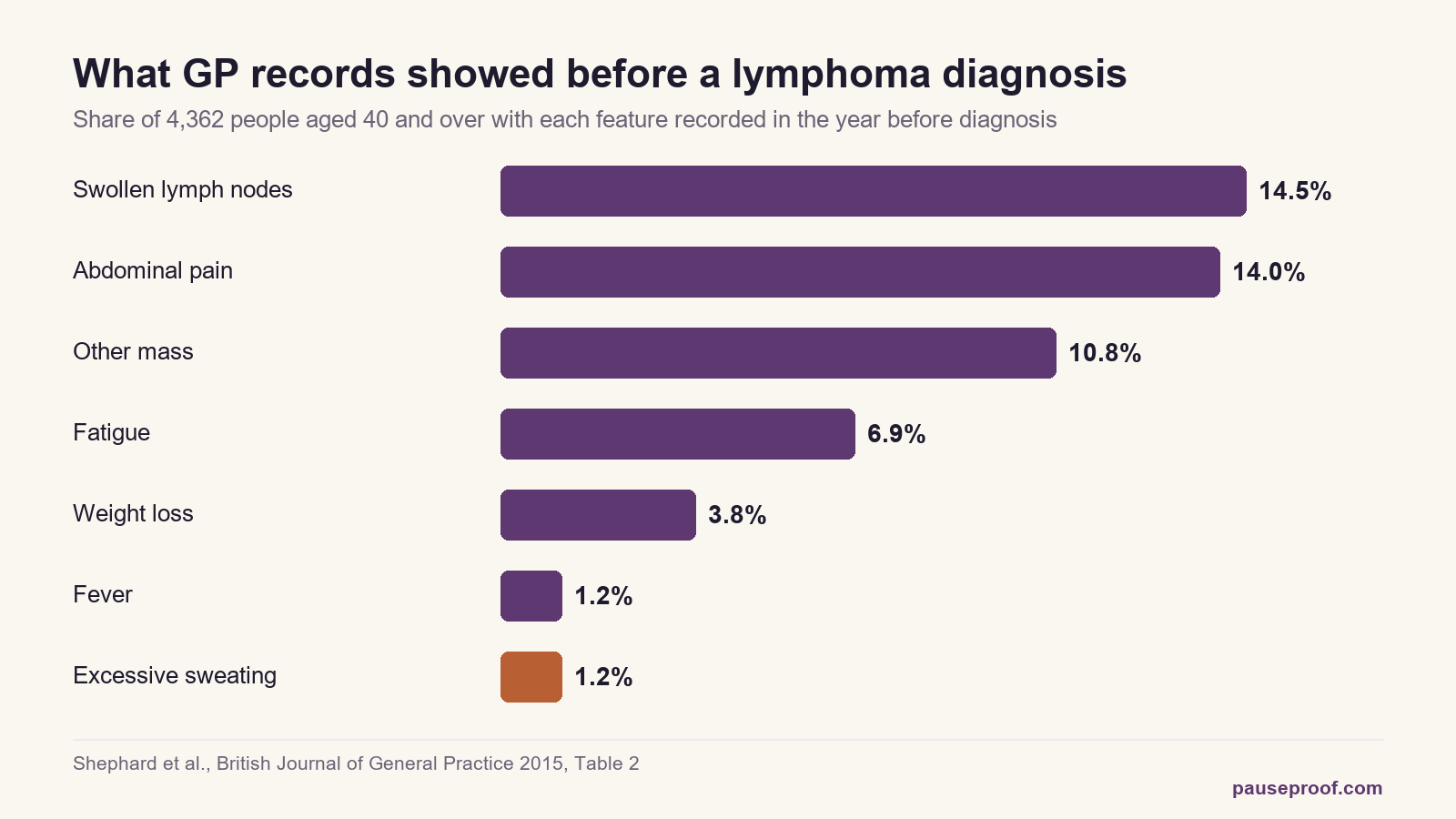
Rarely, at least in GP records. The best UK evidence comes from Shephard and colleagues, writing in the British Journal of General Practice in 2015. They compared the GP records of 4,362 people aged 40 and over who were diagnosed with non-Hodgkin lymphoma between 2000 and 2009 with 19,468 matched people who were not.
In the year before diagnosis, excessive sweating was recorded for 53 of the 4,362 cases, which is 1.2 percent, against 0.3 percent of the comparison group. Fever was also 1.2 percent. Swollen lymph nodes were recorded for 14 percent of cases and almost none of the comparison group, which is why the lump, not the sweat, carries the weight. In people aged 60 and over, unexplained lymphadenopathy had a positive predictive value of 13 percent for lymphoma.
Two cautions. A GP record holds only what someone wrote down, and the authors noted that their sweating and fever figures were far lower than other reports. And this study cannot tell you how many women with hot flashes have cancer. It counts the other direction: how many people with lymphoma had sweats on file.
What do women who feared cancer report about the tests?
This section reports what people wrote online. It is testimony, not evidence, and nothing here is a finding about anyone else’s symptoms. For this page, 20 accounts were read across three threads in r/Perimenopause, posted between April and August 2026.
The pattern was consistent: when sweats were severe, doctors often checked for cancer first. In an April 2026 thread, a 38 year old described soaking night sweats every night. She said her family doctor was concerned about cancer and ordered a whole body MRI, a chest X ray and repeated blood tests, and that all of it came back fine. Her doctor and a second clinician then disagreed about whether perimenopause was the cause.
A reply in the same thread described a similar start just before 39: cancer raised first, normal blood work, then thyroid, blood sugar and vitamin checks before anyone discussed perimenopause. Another, from a woman now 48, said years of tests in her mid 30s never gave a straight answer, and the sweats faded by about 43 or 44.
The fear itself shows up too. In another April 2026 post, a 34 year old with two years of drenching night sweats said her thyroid had been ruled out and that she kept finding pages that pointed to lymphoma. In an August 2026 thread, a 41 year old with a family history of lymphoma and breast cancer asked where to even start.
One account cut against the pattern: a commenter said night sweats are not always perimenopause, and that medicines or allergies can play a part, which matches the NHS list. Where the accounts and the guidance agree is the order of things: other causes first, then perimenopause as the working explanation. Several replies moved on to treatment, which this page does not cover.
Which signs alongside hot flashes mean seeing a GP soon?
The NHS night sweats page says to see a GP if you have night sweats regularly that wake you up or worry you; if you also have a very high temperature, or feel hot, cold or shivery; if you have a cough or diarrhoea; or if you have night sweats and are losing weight for no reason.
The NHS lymphoma page adds a painless lump or swelling in the neck, armpit or groin, itchy skin and shortness of breath. The same page is careful to say that these symptoms are common, have many causes, and do not definitely mean lymphoma, but are worth checking.
Any bleeding after twelve months with no period at all also needs a GP appointment, whatever else is going on, and NICE NG12 lists unexplained post menopausal bleeding among its referral triggers. The page on symptoms of ovarian cancer after menopause on this site covers the other signs that guideline looks for after menopause.
If the hot flashes come with none of those, the guideline the GP uses for perimenopause is NICE NG23, last updated 15 April 2026. Recommendation 1.3.1 identifies perimenopause from symptoms alone in otherwise healthy people aged 45 and over. Why hot flashes are worse at night and perimenopause fatigue cover what else tends to travel with them.
What to note before a GP appointment about sweats
These are the features the NHS night sweats and lymphoma pages and NICE NG12 list alongside sweats. Tick what applies and take the list with you. It counts nothing and means nothing on its own.
This list is a memory aid for the appointment. It does not score, diagnose or predict anything, and only a clinician can assess what the symptoms mean together.
Frequently asked questions
Can a hot flash on its own be the first sign of cancer?
Not according to the UK referral guideline. NICE NG12 never mentions hot flushes, and it mentions night sweats only as a symptom to take into account alongside an unexplained lump or enlarged spleen.
Are drenching night sweats different from a hot flash?
The NHS defines night sweats as sweating so much that night clothes and bedding are soaking wet even though the room is cool. Menopause can cause exactly that, so drenching alone does not point to cancer; the companions matter more.
Do blood tests rule out lymphoma?
Not on their own. The NHS lymphoma page says the GP will feel for lumps and may arrange a blood test, then refer for more tests if needed. Normal bloods are reassuring about general health, and the GP decides what else is needed.
I have had breast cancer. Are my hot flashes a sign it is back?
Hormone treatment is a common cause: Breast Cancer Now lists hot flushes and night sweats as side effects of tamoxifen. Any new or changed symptom after cancer belongs with your treating team, and nothing here replaces that conversation.
I am under 40. Does that change anything?
Under 40, NICE NG23 does not identify perimenopause from symptoms alone, so tests are more likely. Told you are too young for perimenopause explains the age bands.
Does a family history of lymphoma change the picture?
The NICE recommendations quoted on this page do not list family history as a referral trigger for lymphoma. A family history is still worth telling the GP, because it is part of the whole picture they assess.
Finished the page? The same five questions from the top, to see what stuck.
This article is general information, not medical advice, and is not a substitute for care from a qualified healthcare professional. Speak to your doctor about your own situation.

Leave a Reply