
The symptoms of ovarian cancer after menopause are bloating that stays, feeling full quickly, pelvic or tummy pain, and needing to pee more urgently or often. None is unusual alone. NICE guidance says tests are due when they are persistent or frequent, particularly more than 12 times a month, especially from age 50.
Listen to this article, about 17 minutes. A synthetic voice reads the article and announces each section title as it begins; tables are read row by row and the questions at the end are left out.
Recorded 17 November 2026 from the article as published that day. Press a chapter to jump there; the highlighted line is what is playing. A play button sits beside every section heading, and once you scroll past this player a bar at the bottom of the screen keeps the controls in reach. Tap or click any sentence to hear the reading start from there.
On this page: the CA125 thresholds by age that NICE set in April 2026, a table of bloating patterns, how common the cancer is and how it is found, and a checklist of what NICE asks about.
Think you already know this? Five questions, one minute.
Every answer is on this page. Answer from what you know now; the page fills in the rest.
-
1. Which of the following is one of the four main symptoms of ovarian cancer listed by the NHS and NICE?
The four main symptoms include feeling full quickly, bloating, pelvic or tummy pain, and needing to pee more urgently or often, as detailed on the NHS ovarian cancer symptoms page. Read the section
-
2. Why does NICE guidance recommend testing for new IBS type symptoms in women aged 50 or over?
Recommendation 1.5.5 asks for tests in anyone aged 50 or over with symptoms suggesting IBS in the last 12 months, because IBS rarely presents for the first time at that age, as set out in NICE NG12 on ovarian cancer. Read the section
-
3. According to the Goff symptom index, how long must symptoms have been present to fit the positive criteria?
The index counts as positive when symptoms occur more than 12 times a month and have been present for less than a year, as published by Goff and colleagues, writing in the journal Cancer. Read the section
-
4. Since the April 2026 update to NICE NG12, what CA125 level leads to an urgent scan for a woman aged 60 to 69?
Recommendation 1.5.9 and its Table 1 now set thresholds by age, 24 IU/ml or greater at 60 to 69, replacing the single 35 cut off, in NICE NG12 on ovarian cancer. Read the section
-
5. What did the UKCTOCS clinical trial find regarding ovarian cancer screening for women without symptoms?
The large scale trial showed that while screening detected some cancers earlier, it did not significantly reduce deaths, as reported in UKCTOCS, reported in The Lancet in 2021. Read the section
Most symptom lists stop before that last sentence, which is a shame, because a list of bloating, fullness, tummy pain and trips to the loo describes half the population after a big lunch. What guidance uses is the pattern: how often, how new, how many together. This article sets that pattern out. It cannot tell anyone what their own symptoms mean.
What are the symptoms of ovarian cancer after menopause?
The NHS ovarian cancer symptoms page, reviewed on 17 November 2025, names four main symptoms: a swollen tummy or feeling bloated; pain or tenderness in the tummy or the area between the hips; no appetite or feeling full quickly after eating; and an urgent need to pee or needing to pee more often. It lists other symptoms too: indigestion, constipation or diarrhoea, back pain, feeling tired all the time, losing weight without trying, and unusual bleeding from the vagina. Constipation on its own far more often has another cause, and our guide to menopause and constipation and the NHS bowel warning signs sets out when a change still needs a GP.
The UK guideline for GPs uses the same four. NICE guideline NG12 on suspected cancer, last updated on 15 April 2026, tells GPs to carry out tests if a woman, especially if 50 or over, reports persistent abdominal distension, early satiety or loss of appetite, pelvic or abdominal pain, or increased urinary urgency or frequency on a persistent or frequent basis. What changes with age is the likelihood: the American Cancer Society reports that roughly half of women diagnosed are 63 or older.
Bleeding is the exception to every rule about patterns. Any bleeding after twelve months without a period gets checked, once is enough, and we explain why in why even spotting after menopause gets checked. That twelve month line is also the only thing that dates menopause at all, which is the subject of how you know if you have started menopause. If those twelve months arrived before you turned 45, early menopause symptoms and why the timing matters covers the separate questions that raises.
How is this different from ordinary menopause bloating?
Bloating is common, which is exactly the problem. The Rome Foundation Global Epidemiology Study surveyed 51,425 people in 26 countries and found 17 per cent reporting bloating at least weekly. Our article on the gut changes that turn up in midlife covers how thin the evidence is for blaming hormones.
The table below sets the two patterns side by side. It summarises how guidance sorts who is offered tests, not a way to sort yourself: plenty of people in the left column still get examined, and asking is always allowed.
| What to look at | Pattern that is common and often benign | Pattern the guidance treats as a reason to test |
|---|---|---|
| How often | Some days, some weeks, often after particular meals | Persistent or frequent, particularly more than 12 times a month (NICE CG122) |
| How new | Familiar for years, with the same ups and downs | New, or clearly changed, within the last year (Goff symptom index) |
| Bowel symptoms | A long history of IBS type symptoms | Symptoms suggesting IBS within the last 12 months at 50 or over, because IBS rarely starts at that age (NICE NG12) |
| How many together | One symptom on its own | Two or more of bloating, fullness, pain and urinary change, though any one that persists counts under NICE |
| Direction | Settles, then returns in a familiar way | Getting more frequent or more persistent, which NICE names as the reason to go back after a normal test |

Symptom Pattern Checklist
These are the things NICE NG12 asks GPs to look for when deciding whether to offer tests. Ticking them does not tell anyone what their symptoms mean.
Ticks are saved on this device only.
Where does more than 12 times a month come from?
From a symptom study published in 2007. Goff and colleagues, writing in the journal Cancer, compared women with ovarian cancer against women without it and found that four symptoms were linked to the cancer: pelvic or abdominal pain, urinary urgency or frequency, increased abdominal size or bloating, and difficulty eating or feeling full. Their index counted as positive when any of them happened more than 12 times a month and had been present for less than a year.
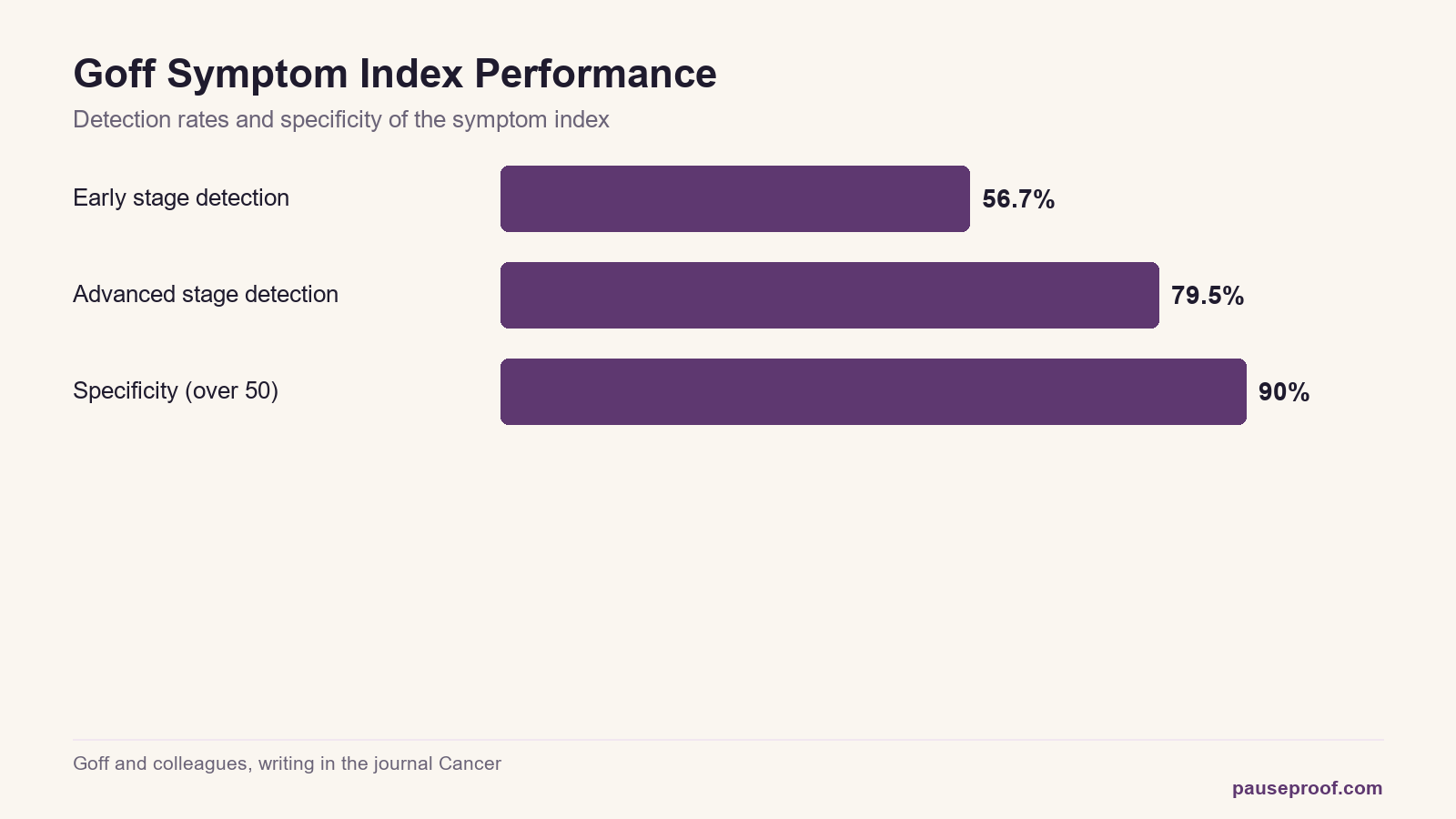
In the confirmatory sample it picked up 56.7% of early stage cancers and 79.5% of advanced ones. Its specificity was 90% in women over 50, which means about 1 in 10 women in that comparison group who did not have cancer met the criteria anyway. A symptom rule is a filter for who gets a test. It is not a diagnosis in either direction.
Here is how the threshold reads across the sources, each checked on 14 September 2026.
| Source | What it says, in its own terms | Version read |
|---|---|---|
| NICE NG12, suspected cancer | Tests if symptoms are persistent or frequent, particularly more than 12 times per month, especially at 50 or over. Urgent referral if an examination finds ascites or a pelvic or abdominal mass | January 2026 text |
| NICE CG122, ovarian cancer | Same four symptoms and wording. Consider tests for unexplained weight loss, fatigue or changes in bowel habit | 2011 recommendations, list read on NCBI Bookshelf |
| NHS symptoms page | See a GP with any symptom, or again if symptoms have not gone away, are worse or are more frequent | Reviewed 17 November 2025 |
| Goff symptom index | Any of the symptoms more than 12 times a month, present for less than a year | Cancer, 2007 |
| US Preventive Services Task Force | Recommends against screening women without symptoms; women with symptoms are outside that recommendation | Grade D, February 2018 |
What test does the pattern lead to?
In the UK, a blood test first for anyone aged 40 or over. NICE amended the ovarian cancer section of NG12, its guideline on suspected cancer, in April 2026, and recommendation 1.5.9 now ties the CA125 level that triggers an urgent, direct access ultrasound scan of the abdomen and pelvis to age. Before that update one figure, 35 IU/ml, applied at every age. From 50 upwards, every age band now has a lower trigger. If the scan suggests ovarian cancer, the woman is referred to a gynaecological cancer service on a suspected cancer pathway.
| Age | CA125 that leads to an urgent scan, since April 2026 | Before April 2026 |
|---|---|---|
| 39 or under | CA125 not used on its own; consider an urgent scan for persistent symptoms (1.5.6, NICE NG12) | 35 IU/ml or greater |
| 40 to 49 | 35 IU/ml or greater (1.5.9, NICE NG12) | 35 IU/ml or greater |
| 50 to 59 | 31 IU/ml or greater (1.5.9, NICE NG12) | 35 IU/ml or greater |
| 60 to 69 | 24 IU/ml or greater (1.5.9, NICE NG12) | 35 IU/ml or greater |
| 70 to 79 | 25 IU/ml or greater (1.5.9, NICE NG12) | 35 IU/ml or greater |
| 80 and over | 31 IU/ml or greater (1.5.9, NICE NG12) | 35 IU/ml or greater |
The committee explains its reasoning under the recommendations. Moderate certainty evidence showed that in women over 50 the CA125 level predicts well enough to justify a strong recommendation for a scan, and the committee chose not to call a result below 35 normal. Pages written before April 2026 still give 35 as the single cut off. This one did too, until we checked the guideline again on 17 November 2026.
CA125 is a pointer, not a verdict. A study of 50,780 women tested in UK primary care, by Funston and colleagues in PLOS Medicine, 2020, found that among women aged 50 and over with a CA125 of 35 or more, 15.2% were diagnosed with ovarian cancer within a year, and 20.4% with a different cancer. Most raised results were neither. That study used the old single cut off, so its figures describe the 35 line, not the new age bands.
A result below the threshold is not the end of the conversation either. Under recommendation 1.5.11, when CA125 does not meet the threshold for the woman’s age, or meets it but the scan is normal, the GP looks for other causes, and if none is found, advises her to come back if her symptoms become more frequent or persistent.
Why is there no screening test to catch it earlier?
Because the largest trial to try it did not save lives. UKCTOCS, reported in The Lancet in 2021, followed more than 200,000 women aged 50 to 74 for around 16 years. Screening found some cancers earlier but did not significantly reduce deaths. The US Preventive Services Task Force recommends against screening women who have no symptoms and no known high risk hereditary syndrome. That leaves symptoms, and their pattern, as the main route to a test.
How common is ovarian cancer after menopause?
Less common than the worry it causes, and more common with age. The American Cancer Society’s estimates for 2026 put new US diagnoses at about 21,010 this year and a woman’s lifetime risk at about 1 in 91. In the UK, Cancer Research UK counts 7,748 new cases a year.
The figure that explains why this article spends so long on patterns is how the cancer gets found. In England in 2022, 38% of cases with a known stage were diagnosed at stage I or II. Of cases diagnosed in England in 2019, 34% came through an urgent suspected cancer referral and 29% through an emergency presentation, meaning the diagnosis was made through an emergency route such as A&E rather than a planned referral.
| Figure | Number | Source and period |
|---|---|---|
| New diagnoses a year, US | About 21,010 | American Cancer Society, estimate for 2026 |
| Lifetime risk, US | About 1 in 91 | American Cancer Society, 2026 |
| Women diagnosed who are 63 or older, US | About half | American Cancer Society, 2026 |
| New cases a year, UK | 7,748 | Cancer Research UK, 2019 and 2021 to 2022 |
| Staged cases found at stage I or II, England | 38% | Cancer Research UK, 2022 |
| Diagnosed through an urgent suspected cancer referral, England | 34% | Cancer Research UK, 2019 |
| Diagnosed through an emergency presentation, England | 29% | Cancer Research UK, 2019 |
Those numbers describe populations, not any one person. They do show why the symptom route matters: with no screening programme, a GP appointment for a persistent pattern is the planned way in, and the emergency route is the one nobody wants.
What do people who went through this report?
For this article we read two public Reddit threads in full, about 45 comments, and nine accounts of symptoms or outcomes. Two described events more than three years old and are left out. The seven below are what people report, not evidence, and forum posters are not a random sample of anyone.
In a thread in r/Menopause posted around December 2025, a post-menopausal woman described three months of steady bloating, low back pain, needing to pee often, new digestive trouble and tiredness. She said she had raised it with her primary care doctor three times, been put down as anxious and refused a transvaginal scan, and got a pelvic examination booked through urgent care instead. She did not post an outcome. One reply described similar symptoms and a doctor who arranged an ultrasound, a second scan after the first showed an enlarged ovary, and a blood test, with a clear result. Another described a haemorrhaging cyst, with low back pain and spotting, that needed no treatment. A third said her mother’s similar symptoms were put down to urinary infections, menopause and old scar tissue before stage 3 ovarian cancer was found.

In r/Ovariancancer, under a post sharing a symptoms graphic around October 2025, one commenter described constant constipation or diarrhoea and feeling full however little she ate. Another described 16 months of knowing something was wrong, with doctors unable to explain it, before arriving at an emergency department with fluid in her abdomen and a stage 3 diagnosis. A third cut against the whole list: she said she had none of the symptoms on the graphic, was breathless from fluid around a lung, and was diagnosed at stage IV. Her worry was that women without the listed symptoms would think they were fine.
Where the accounts agree with the guidance: the symptoms people described were mostly persistent, new, and several at once, and gut symptoms were often attributed to something else first, which is the exact trap NICE’s rule on new IBS type symptoms at 50 is written to catch. Where they part company: the guidance says little about repeat visits that go nowhere, and one account describes a presentation the main list would not have flagged. None of these stories says anything about what another person’s symptoms are.
What if the tests were normal and the symptoms carry on?
Then they are worth raising again. NICE builds that return visit into the pathway, and the NHS page says to go back if symptoms have not gone away, are worse or are more frequent. A written record makes that second appointment more useful, and what to write down in a symptom diary sets out one a doctor can use. For the other changes that carry on, see what continues after menopause and what eases.
If any of these symptoms are happening most days, that is a reason to book a GP appointment. Sudden severe abdominal pain, or a swollen abdomen with breathlessness, is a reason to seek urgent medical help rather than wait. If you are not sure whether your symptoms fit the pattern but you are still worried, that is also a reason to book.
Frequently asked questions
Is bloating after menopause usually a sign of ovarian cancer?
No. Bloating is common at every age, and the Rome Foundation study found 17 per cent of people reporting it at least weekly. Guidance looks at the pattern: bloating that is persistent or frequent, particularly more than 12 times a month, and new. Only an examination and tests can say what is causing it.
Can a normal CA125 blood test rule out ovarian cancer?
Not on its own. NICE says that after a normal CA125, the GP looks for other causes and, if none is found, advises the woman to return if symptoms become more frequent or persistent. A normal result describes the day the blood was taken.
Does ovarian cancer cause bleeding after menopause?
The NHS lists unusual vaginal bleeding among the other symptoms of ovarian cancer, and among the less common causes of bleeding after menopause. Whatever the cause, any bleeding after twelve months without a period needs a doctor, even if it happened once.
Is back pain on its own a symptom to worry about?
Back pain appears on the NHS list of other symptoms, not the four main ones, and it has many common causes. It carries more weight alongside the main symptoms, or when it is new and persistent. Back pain that is severe or getting worse is worth a GP appointment whatever the cause.
Why does age 50 keep coming up in the guidance?
Risk rises with age: roughly half of women diagnosed in the US are 63 or older, according to the American Cancer Society. NICE also says IBS rarely starts for the first time in women aged 50 or over, so new bowel symptoms at that age get tests for ovarian cancer. Symptoms under 50 still count.
Does family history change any of this?
It changes the screening picture. The US Preventive Services Task Force recommendation against screening does not cover women with a known high risk hereditary cancer syndrome, who are assessed separately. A family history of ovarian or breast cancer is worth mentioning at any appointment about these symptoms.
Finished the page? The same five questions from the top, to see what stuck.
This article is general information, not medical advice, and is not a substitute for care from a qualified healthcare professional. Speak to your doctor about your own situation.

Leave a Reply