
A full list of perimenopause symptoms runs to 28 items once NICE, the NHS, The Menopause Society and a 2026 survey of 17,494 women are set side by side. Only seven appear on all three official lists. The two that respondents aged 35 and over reported most, fatigue and exhaustion, are not a listed item on any of them.
Listen to this article, about 15 minutes. A synthetic voice reads the article and announces each section title as it begins; tables are read row by row and the questions at the end are left out.
Recorded 21 November 2026 from the article as published that day. Press a chapter to jump there; the highlighted line is what is playing. A play button sits beside every section heading, and once you scroll past this player a bar at the bottom of the screen keeps the controls in reach. Tap or click any sentence to hear the reading start from there.
On this page: a 28 row table showing which perimenopause symptoms NICE, the NHS and The Menopause Society each name, the share of 12,681 survey respondents aged 35 and over who reported each one, and what 27 forum accounts say tipped them off.
Think you already know this? Five questions, one minute.
Every answer is on this page. Answer from what you know now; the page fills in the rest.
-
1. How does NICE recommendation 1.2.2 introduce its symptom groups?
NICE NG23, last updated 15 April 2026, says symptoms may include five groups, each given with examples, so it is not a full inventory. Read the section
-
2. How many symptoms does the NHS menopause symptoms page list across its headed sections and its other symptoms list?
The NHS symptoms page, reviewed 19 May 2026, has seven headed sections and nine other symptoms. Read the section
-
3. Where did hot flashes rank among the 26 symptoms respondents aged 35 and over reported experiencing?
Hot flashes came 16th at 50.0%, while fatigue came first at 83.2%, in Hedges and colleagues, Menopause 2026. Read the section
-
4. Which of these was reported by 76.0% of survey respondents aged 35 and over but named by none of the three official sources?
Digestive issues were reported by 76.0% in the 2026 survey; night sweats and vaginal dryness are named by all three sources. Read the section
-
5. Of the 27 top level replies read on the January 2026 forum thread, how many named hot flashes as the symptom that tipped them off?
None did; brain fog came up most, in 8 replies, on the r/Perimenopause thread. These are reports, not findings. Read the section
Most pages on this topic hand you a list of 34 symptoms and no clue where the number came from. We could not trace it to any guideline or study, and none of the official sources below publishes a list of 34. So this page does the dull, useful thing instead: it puts every symptom next to the source that names it, with a tick or a blank, and the share of women who said they had it. Checked against each source on 3 November 2026.
Which perimenopause symptoms do all the official sources name?
Seven. Changes to periods, hot flushes, night sweats, low mood, vaginal dryness, low sex drive and joint and muscle pain are named by all three. Everything else depends on which page you happen to read. The table below is the whole list, with the last column taken from Hedges and colleagues, Menopause, 2026, which asked 12,681 respondents aged 35 and over which of 26 symptoms they were experiencing or had experienced.
| Symptom | NICE NG23 | NHS | Menopause Society | Reported, aged 35 plus |
|---|---|---|---|---|
| Changes to periods | Yes | Yes | Yes | Not asked |
| Hot flushes | Yes | Yes | Yes | 50.0% |
| Night sweats | Yes | Yes | Yes | 47.5% |
| Low mood | Yes | Yes | Yes | 77.3% |
| Vaginal dryness | Yes | Yes | Yes | 38.4% |
| Low sex drive or other sexual problems | Yes | Yes | Yes | 56.4% |
| Joint and muscle pain | Yes | Yes | Yes | 61.7% |
| Bladder and urinary symptoms | Partly | Yes | Yes | 46.1% |
| Painful sex | Yes | In passing | Yes | 30.3% |
| Sleep problems | In passing | Yes | Yes | 76.1% |
| Memory problems or brain fog | No | Yes | Yes | 65.8% |
| Weight gain | No | Yes | Yes | 65.0% |
| Irritability or mood swings | No | Yes | As mood changes | 79.3% |
| Anxiety | No | In passing | As mood changes | 75.0% |
| Headaches and migraines | No | Yes | No | 63.2% |
| Hair thinning | No | Yes | No | 57.8% |
| Dry or itchy skin | No | Yes | No | 54.8% |
| Palpitations | No | Yes | No | 45.2% |
| Sensitive teeth or sore gums | No | Yes | No | 33.9% |
| Weakening bones | No | Yes | No | Not asked |
| Fatigue | No | In passing | No | 83.2% |
| Dizziness | No | In passing | No | 49.8% |
| Physical and mental exhaustion | No | No | No | 82.9% |
| Digestive issues, bloating, constipation | No | No | No | 76.0% |
| Breast tenderness | No | No | No | 60.3% |
| Changed body odour | No | No | No | 38.6% |
| Tinnitus | No | No | No | 37.3% |
| New allergies or sensitivity to smells | No | No | No | 31.5% |
Two things about that last column. It is a survey of Flo app users, so they chose to take part, and anyone using hormonal contraception was left out. And it had no comparison group, so a percentage tells you how common a symptom was in that group, not that perimenopause caused it. Changes to periods and weakening bones read “Not asked” because neither was among the 26 items.
NICE is the shortest list for a reason. Recommendation 1.2.2 of NICE NG23, last updated on 15 April 2026, tells clinicians that “as well as changes in menstrual cycle, symptoms may include” five groups: vasomotor symptoms, genitourinary symptoms, effects on mood, musculoskeletal symptoms and sexual difficulties. Each comes with “for example”, so it is a set of examples, not a full inventory. Sleep problems turn up later, in 1.5.24, and only alongside hot flushes. The guideline’s glossary adds pain with sex and pain when urinating under genitourinary symptoms, which is why urinary symptoms get a “Partly”.
What is on the NHS list, and what is only mentioned in passing?
The NHS menopause symptoms page, last reviewed on 19 May 2026, has seven headed sections and then nine “other symptoms”, sixteen in all. The headed ones are period changes, hot flushes and night sweats, sleep problems, mood changes with poor memory and brain fog, weight gain, vaginal problems, and UTIs. The other nine run from palpitations and migraines to hair thinning, dry and itchy skin and “sensitive teeth, painful gums or other mouth problems”. Weight gain is the heading that misleads most, because the long studies found the scale climbing at the same pace before and during the transition while the fat underneath moved; our page on why perimenopause weight gain shows up at the waist before the scale sets out those numbers.
Then there are the ones the NHS mentions without listing. Anxiety and dizziness appear as things a hot flush can bring on, not as symptoms of their own. Painful sex appears as an effect of vaginal dryness. Tiredness appears as something that makes mood and memory worse. That is why four NHS cells in the table say “In passing”: the words are on the page, but you would not find them by scanning the list. The Menopause Society symptoms page works the same way, folding anxiety and irritability into “mood changes”.
Which symptoms did 12,681 women aged 35 and over actually report?
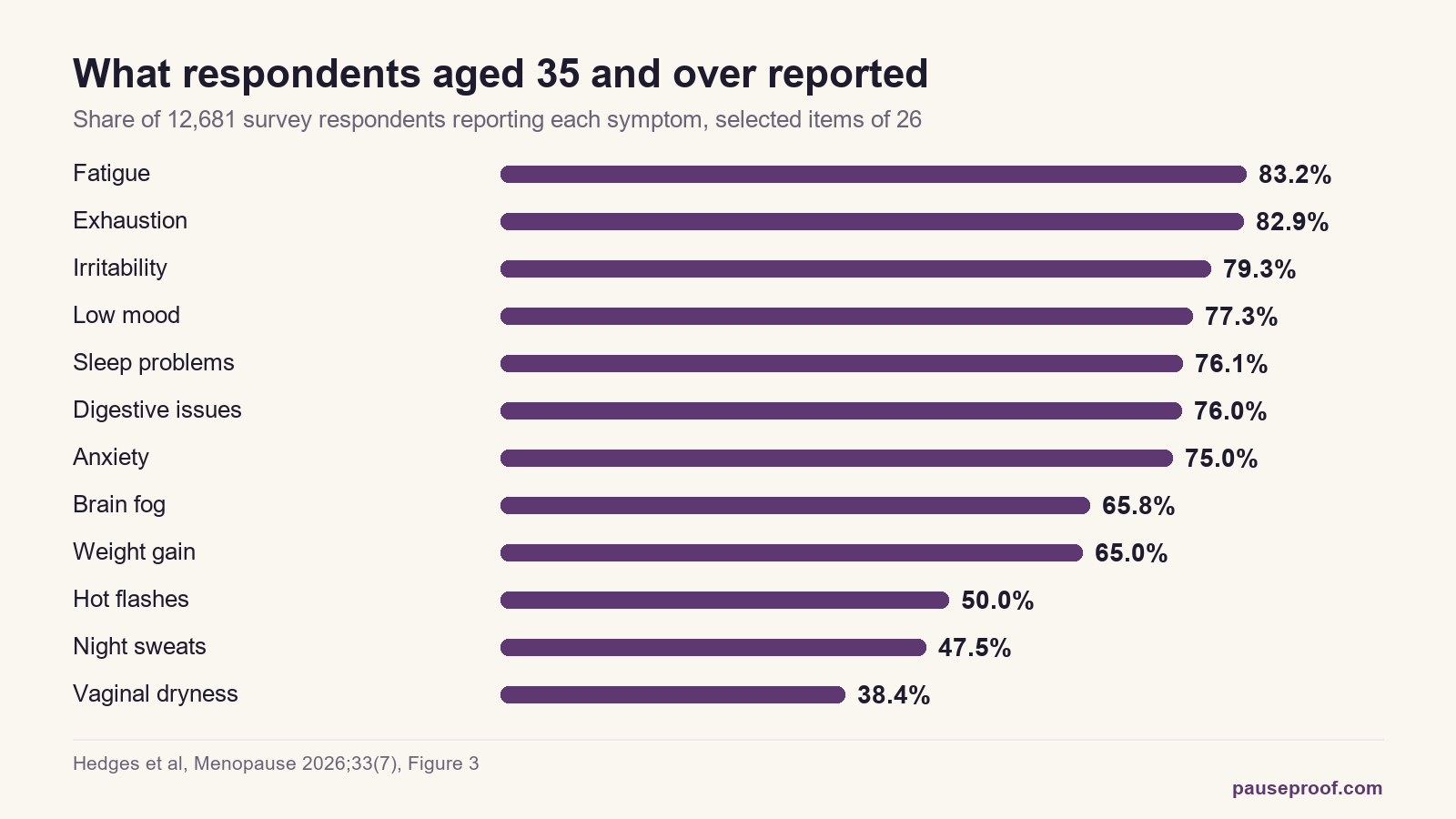
Not the list you would guess. Asked separately which symptoms they thought belonged to perimenopause, 71.1% of 17,290 respondents of all ages picked hot flashes, the top answer. Asked what they were actually experiencing, the 12,681 respondents aged 35 and over put fatigue first at 83.2% and physical and mental exhaustion second at 82.9%. Hot flashes came 16th of 26, at 50.0%. What a flash itself feels like from the first flicker to the chill afterwards, and which group each of those percentages comes from, is laid out in our guide to hot flash symptoms and how long each episode lasts.
Those are two different groups answering two different questions, so the gap is a pattern, not a measured difference, and the paper did not test it statistically. Its own conclusion calls it a discordance between what women know and what they report. The survey tool itself is described by its authors as not yet validated. Even so, 17,494 participants from 158 countries makes it one of the widest pictures there is of what this stage feels like from the inside. The fatigue and exhaustion page goes through why those two items sat apart on the checklist.

Which common symptoms are missing from the official lists?
Six rows have no tick at all: physical and mental exhaustion (82.9%), digestive issues (76.0%), breast tenderness (60.3%), changed body odour (38.6%), tinnitus (37.3%) and new allergies or sensitivity to smells (31.5%). Fatigue and dizziness come close, mentioned only in passing. Exhaustion and digestive issues were each reported by at least three in four respondents, far more than reported hot flashes.
A missing tick does not mean a symptom is imaginary, and it does not mean it is caused by perimenopause either. It means the source has not named it. That matters in an appointment, because a clinician working from a short list may not ask about bloating or breast pain, and you may not think to mention them. We have covered several of these on their own: bloating and digestive changes, sore breasts and the stranger ones in which weird symptoms have a source.
What do people say was the symptom that tipped them off?
We read the 27 top level replies loaded on one large r/Perimenopause thread from January 2026, which asked which symptom made people think they were losing their mind before they connected it to hormones. These are what people report, not findings, and the question invites the frightening symptoms, so take the mix with that in mind.
- Brain fog came up most: 8 of the 27 replies, including several who lost words mid sentence and one who feared a mild stroke before anyone mentioned perimenopause.
- Anxiety came next, in 6 replies, one describing anxiety so sudden the writer thought they were dying, and another whose pounding heart led to a run of tests with their GP and a cardiologist.
- Rage that felt out of character was the first answer in 3 replies, the top one with 590 upvotes.
- Joint, hip or shoulder pain led 3 replies, and single replies named vertigo, muscle twitching, itching, crying spells and pelvic pain.
- One reply said there was no single moment at all: a few bad days became every day, so slowly that nothing seemed worth reporting.
Not one of the 27 named hot flashes as the symptom that tipped them off. One listed “poor temperature regulation” among many others, and another said they had expected heat waves because that was what their mother described. That lines up with the survey and cuts against the guidance: brain fog sits on the NHS list, anxiety and rage sit only under mood, and NICE names none of the three.
When is a symptom on this list not perimenopause at all?
This is the part of the list that needs saying plainly. Almost every symptom in the table has other causes, and a list makes it easy to file everything under one heading. Bleeding is the clearest example. The NHS says to see a GP or a sexual health clinic about bleeding between periods or after sex, and names small growths such as polyps or fibroids among the usual causes.
One r/Menopause account from August 2026 shows how that goes wrong. A poster in their late 40s reported spotting, cramps and vague gut symptoms that were first put down to perimenopause. Back again with sharper pain, they were sent for scans, which found fibroids and adenomyosis. One of the 15 replies told the same story over years of irregular heavy bleeding, and most of the rest shared their own fibroid or adenomyosis diagnoses. It is one thread, and it is testimony, but the point it makes is the NHS’s point too.
If a symptom is new, severe, getting steadily worse, or involves bleeding that is unusual for you, it needs to be checked by a doctor whether or not it appears on a perimenopause list.
How do you use a symptom list without it becoming a diagnosis?
Use it as a prompt, not a verdict. Symptoms come and go in perimenopause, so a few weeks of dated notes in a symptom diary beat a memory of the worst week. If you are 45 or over, NICE recommendation 1.3.1 identifies perimenopause from recently started hot flushes and any change in the cycle, without a blood test. Between 40 and 45, 1.3.6 says to consider an FSH test. The checklist below follows the NICE groups and the NHS extras so nothing gets left out of the appointment. It scores nothing and points to no answer.

What to note before an appointment
Tick each area once you have written down whether it applies, when it started and how often it happens. The groups follow NICE recommendation 1.2.2 and the NHS symptoms page.
This list scores nothing and suggests no answer. It is a memory aid for a conversation with a clinician.
Frequently asked questions
How many perimenopause symptoms are there?
There is no official count. The NHS names 16, the 2026 Flo survey asked about 26, and the table on this page reaches 28 by combining the sources.
Is fatigue a symptom of perimenopause?
It was the most reported symptom in the 2026 survey, at 83.2% of respondents aged 35 and over, but NICE does not name it and the NHS mentions tiredness only in passing.
Why do some lists say 34 symptoms?
We could not trace the figure to a guideline or a study. It appears to be a popular online list rather than a clinical one.
Does NICE have a symptom checklist?
Not as such. Recommendation 1.2.2 gives five groups of example symptoms alongside cycle changes, and says symptoms can range from minor to severe.
Can you have perimenopause symptoms with regular periods?
Yes. Symptoms often start before cycles change enough to meet the staging criteria, which use a persistent difference of seven days or more between consecutive cycles.
Is the 2026 survey reliable?
It is large and peer reviewed, but its sample is self selected app users, its questionnaire is not yet validated, and it had no comparison group.
Finished the page? The same five questions from the top, to see what stuck.
This article is general information, not medical advice, and is not a substitute for care from a qualified healthcare professional. Speak to your doctor about your own situation.

Leave a Reply