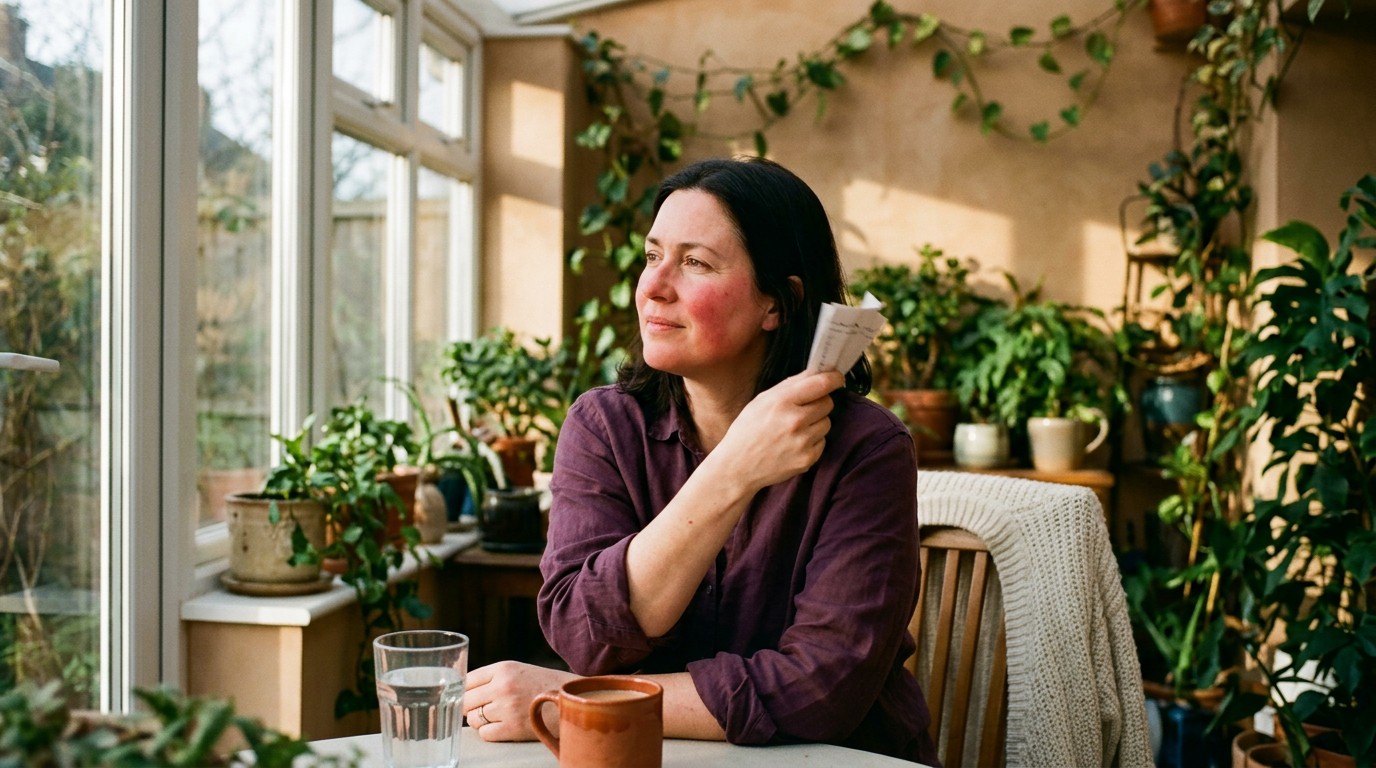
Hot flashes during period in 40s can be an early sign of perimenopause, but the flush alone does not settle it. One study found 43% of women aged 18 to 45 without menstrual symptoms logged chills and sweats in one cycle. What matters is the cycle beside it: lengths starting to vary by a week or more.
Are hot flashes around your period an early sign of perimenopause?
It can be, and it is also the least conclusive way perimenopause could announce itself. Hot flushes are the symptom everybody is braced for: in the Flo app survey reported by The Menopause Society, 71.1% of 17,290 respondents of all ages named them as a sign of perimenopause, more than any other symptom. So when the heat arrives the day before a period, at 43 or 46, the conclusion writes itself. The trouble is that the timing points two ways at once.
A flush that clusters around bleeding says your temperature control is reacting to your cycle. It does not say which decade of your cycle it is. Researchers documented it in women from 18 upwards long before anyone sold a ring promising to decode it. The flush can look the same at 30 and 45. The calendar around it does not.
Why would a flush turn up right before or during a period?
Oestrogen falls in the days before a period, and the usual explanation is that the brain’s temperature control briefly overreacts to that fall. It fits the timing, but the studies below recorded when flushes happened, not what caused them, so treat the mechanism as a reasonable account rather than a measured one.
The best timing data comes from a small diary study. Hale and colleagues, writing in Climacteric in 2003, analysed 98 complete flow to flow diaries from 24 women with a mean age of 47 who were still menstruating and not taking hormones. Night sweats peaked in the premenstrual window, except in cycles where no ovulation was detected. Daytime flushes, taken across all cycles, showed no cyclic pattern, although they did in the ovulatory cycles. Twenty four women from a convenience sample make this a pattern, not a rule.
So if what you notice is waking hot and damp in the nights before bleeding, that is the version with evidence behind the timing. The chill that often follows is covered in why night sweats leave you freezing.
Do women in their twenties and thirties get period hot flashes too?
Yes. Hahn, Wong and Reid, in Fertility and Sterility in 1998, asked women aged 18 to 45 to keep a daily calendar for one full cycle, recording episodes of chills and sweats alongside their menstrual symptoms. At least one episode was logged by 83.4% of 157 women with confirmed premenstrual syndrome, 81.5% of 27 women with chronic cycle related symptoms, and 43.1% of 58 women recruited because they had no menstrual cycle symptoms at all.
The counts differed as much as the percentages: an average of 5.6 episodes per cycle in the premenstrual syndrome group, 9.5 in the chronic group and 1.2 in the controls. In every group the episodes tracked the day to day symptom scores. The patients came from a specialist premenstrual syndrome clinic, so the high figures describe women who were already struggling with their cycles. The 43.1% is the number to hold on to: more than four in ten women with no cycle complaints recorded a menopause style episode in a month. None of that rules perimenopause out in your forties. It means a premenstrual flush is not, on its own, the switch flipping.
What turns a period flush into a perimenopause pattern?
The cycle pattern around it, plus age, which is what the guidance actually leans on. The STRAW+10 staging system defines entry to the early menopausal transition as a persistent difference of seven days or more between the lengths of consecutive cycles, and places vasomotor symptoms as likely in the late transition, once there are gaps of 60 days or more. NICE guideline NG23 identifies perimenopause without laboratory tests in otherwise healthy people aged 45 and over with recently started vasomotor symptoms and any change in their menstrual cycle, and says to consider an FSH test from 40 to 45 when symptoms include a change in the cycle.
Here is everything this article could verify at its source, with what each one can and cannot tell you. Every row was read on 15 September 2026.
| What was measured | What it found | What it cannot tell you | Source |
|---|---|---|---|
| Chills and sweats over one cycle, women 18 to 45 | 43.1% of women with no cycle symptoms had at least one episode; 83.4% with premenstrual syndrome | Whether any of them were perimenopausal. Clinic sample, one cycle | Hahn et al, 1998 |
| When in the cycle symptoms peak, women averaging 47 | Night sweats peaked premenstrually except in anovulatory cycles; daytime flushes were not cyclic overall | Anything about larger groups. 24 women, convenience sample | Hale et al, 2003 |
| Flushes in women 45 to 56 with regular, unskipped periods | 55% had ever had vasomotor symptoms, ranging from 25.6% of other Asian to 66.7% of Native American respondents | Timing within the cycle, which was not asked | Reed et al, 2014 |
| Cycle change that marks the early transition | A persistent 7 day or greater difference between consecutive cycle lengths | Anything after hysterectomy, ablation, or with PCOS | STRAW+10, 2012 |
| When a clinician can identify perimenopause without tests | Aged 45 and over, recent vasomotor symptoms plus any cycle change; FSH considered at 40 to 45 | What your own symptoms are. It guides clinicians, not self assessment | NICE NG23 |
Read together, the rows say a period flush is common enough at almost any reproductive age to be weak evidence alone, while the same flush beside cycles that jump from 26 days to 34, or a first two month gap, sits in a different context. The Reed survey of 1,513 women adds that flushes turn up in many women in their late forties whose periods have not changed, which we unpack in why regular periods do not settle the question.
What do people who get flushes around their period report?
The research above is small and old. Forum threads are neither, and they are not evidence either. Three threads were read in full for this article, two in r/Perimenopause and one in r/Menopause, roughly 110 comments in all. What follows is what people report, paraphrased.

In a thread posted on 14 September 2026 asking whether hot flashes cluster around menstruation, the poster, a few years short of 48 by her own description, spent a cool autumn day overheating and fanning herself before her period arrived, despite usually being the one who feels cold. Her cycles were still regular, she said, but closer together and much heavier. A commenter tagged late perimenopause described night sweats that first came only around a period while cycles were fairly regular, grew more frequent once cycles turned irregular, and were worst in gaps over three months. Another said period flushes were among her earliest signs and only later spread across the month.
The same thread holds the account that cuts against the tidy story: a commenter aged 36 said she had had flushes before her periods for eight years. In an r/Menopause thread from April 2026 asking at what age night sweats or flushes began, reported starting ages ran from the late twenties, alongside a stated diagnosis of premature ovarian insufficiency, to 61, with a large cluster from the mid thirties to the late forties. One commenter aged 52 described severe night sweats around her cycle. And in a February 2026 thread about symptoms in the weeks before a period, most people described sleep, mood and a wired, jittery feeling rather than heat, with one commenter reporting cycles anywhere from 15 to 57 days.
Where the accounts agree with the research: night sweats around bleeding come up more than daytime flushes, as in the Hale diaries, and heat spreading across the month as cycles turn irregular fits STRAW+10 placing these symptoms in the later transition. Where they part company: many commenters treat a period flush as proof of perimenopause, while the thirty somethings in the same threads, and Hahn’s control group, suggest it proves much less. These are experiences, not diagnoses.
What is worth writing down, and when is a flush something else?
Dates, not impressions. The most useful record is the first day of each period for several months, because STRAW+10 compares consecutive cycle lengths and memory cannot reconstruct them. Beside it, note the days flushes or night sweats happened. A wearable promising to read your hormones from your wrist will not keep that record better than a notes app. The fuller version is in what to write down before your appointment, and what a flush typically feels like is in our guide to hot flash symptoms. Dates matter in the other direction as well, because once bleeding stops it is the twelve month count that decides how cramps with no period either side of that line should be read.

None of this record can tell you whether you are in perimenopause. It is what makes a conversation with a doctor quicker and harder to brush aside, and it matters more if you are between 40 and 45, where NICE says a blood test may be considered and where a single normal result settles less than it seems. If your next stop is the supplement aisle rather than a doctor, each of those remedies is graded against its strongest trial in what the evidence shows on natural relief for hot flashes.
Night sweats also have causes that have nothing to do with the menopause. The NHS lists anxiety, some medicines including certain antidepressants, steroids and painkillers, low blood sugar, alcohol and hyperhidrosis. The same page says to see a GP if night sweats regularly wake you or worry you, if they come with a very high temperature, a cough or diarrhoea, or if you are losing weight for no reason. If you use a hormonal coil or the pill, the cycle pattern this article relies on may not be visible at all, which is covered in recognising perimenopause without periods to track.
Frequently asked questions
Can you get hot flashes before a period in your thirties?
Yes. In the Hahn, Wong and Reid study of women aged 18 to 45, 43.1% of women with no menstrual cycle symptoms recorded at least one episode of chills and sweats over a single cycle, and the figure was above 80% in women with premenstrual syndrome. Missed or changing periods before 40, with or without flushes, are still worth raising with a doctor, because menopause before 40 is assessed differently.
Why are my night sweats worse before my period than my daytime flushes?
That is the pattern one diary study found. Among 24 menstruating women with a mean age of 47, night sweats peaked in the premenstrual window, while daytime flushes showed no cyclic pattern across all cycles. The group was small, so it describes a tendency, not what your own body is doing.
Does a hot flash during my period mean my periods are about to stop?
No. STRAW+10 places vasomotor symptoms mostly in the late transition, but flushes are commonly reported years earlier, including in women whose periods are still regular. How long the transition lasts varies widely, which we set out in our piece on how long perimenopause lasts.
Is a hot flash around my period just a PMS symptom?
It can be part of a premenstrual pattern at any reproductive age, and the Hahn study found flush episodes tracked day to day menstrual symptom scores. In the forties it can also reflect the transition. Which it is depends on the wider picture, including cycle changes, which is a question for a clinician rather than a label to self apply.
Should I time a blood test to my period to check for perimenopause?
Timing and whether a test is useful are decisions for the clinician ordering it. NICE NG23 identifies perimenopause without tests from 45 with recent vasomotor symptoms and cycle changes, and says an FSH test may be considered from 40 to 45. Hormone levels swing widely in the transition, so one result describes one day.
Do hot flashes around a period get worse as perimenopause goes on?
Many people report that flushes first cluster around bleeding and later spread across the month as cycles become irregular, and that pattern fits STRAW+10, which associates vasomotor symptoms with the later stage. It is not universal. Some women never have flushes at all, and some have them only at night.
This article is general information, not medical advice, and is not a substitute for care from a qualified healthcare professional. Speak to your doctor about your own situation.

Leave a Reply