
Painful intercourse after menopause is common: studies put it at roughly 40 to 75 percent of postmenopausal women, depending on who was counted. It usually comes from thinning, drier tissue as oestrogen falls, but it is not always the menopause, and bleeding after sex is a reason to see a GP rather than wait.
Listen to this article, about 11 minutes. A synthetic voice reads the article and announces each section title as it begins; tables are read row by row and the questions at the end are left out.
Recorded 6 November 2026 from the article as published that day. Press a chapter to jump there; the highlighted line is what is playing. A play button sits beside every section heading, and once you scroll past this player a bar at the bottom of the screen keeps the controls in reach. Tap or click any sentence to hear the reading start from there.
On this page: five studies of pain with sex after menopause set beside exactly who each one counted, the documented disagreement over whether it worsens with time, and what women reported in 2025 and 2026 about raising it.
Think you already know this? Five questions, one minute.
Every answer is on this page. Answer from what you know now; the page fills in the rest.
-
1. In the AGATA study of 913 postmenopausal women, roughly what share reported pain with sex about a year after menopause?
The AGATA study reported 67.5 percent a year after menopause, in women attending gynaecology clinics, which is why it runs higher than population samples. Read the section
-
2. In SWAN, was having less sex across the menopausal transition linked to developing pain with sex?
Waetjen and colleagues found no consistent link between falling frequency and new pain; vaginal dryness was among the factors most strongly linked to it. Read the section
-
3. According to The Menopause Society statement, when is another cause more likely than genitourinary syndrome of menopause?
The 2020 statement of The Menopause Society lists skin conditions, infections, vulvodynia, pelvic floor tension and other conditions as alternatives to consider. Read the section
-
4. In the REVIVE survey of 3,046 women with symptoms, what share had ever discussed them with a healthcare professional?
REVIVE found 56 percent had ever discussed them, and only 24 percent linked their symptoms to the menopause. Read the section
-
5. Which of these does the NHS vaginal dryness page list as a reason to see a GP?
The NHS vaginal dryness page says to see a GP for bleeding after sex, between periods or after the menopause. Read the section
Search for this and the first few pages are mostly shop windows, with a product carousel by the second paragraph. This page sells nothing. It sets out what five studies counted, where the experts disagree about whether it gets worse, what women report about how long they waited to mention it, and what the NHS vaginal dryness page says should send you to a GP. It names no treatment; that conversation belongs in a consulting room.
What counts as painful intercourse after menopause?
Doctors call it dyspareunia, which is a long word for pain before, during or after sex. After the menopause the most common cause is a group of changes the 2020 position statement of The Menopause Society calls genitourinary syndrome of menopause, or GSM: as oestrogen falls, the tissue of the vulva and vagina becomes thinner, drier and less elastic, and the bladder and urethra share the same oestrogen sensitive lining.
The NICE menopause guideline NG23, last updated on 15 April 2026, uses plain words for the same thing. Its genitourinary symptoms include vulvovaginal dryness, pain with sex, vulvovaginal discomfort or irritation, and discomfort or pain when urinating. The NHS page, reviewed on 24 July 2025, lists pain or discomfort, including during sex, beside soreness, itching, needing to pee more often and repeat urine infections. Our longer page on vulvovaginal atrophy and its three names covers the condition itself; this one is about the symptom people actually type into a search box.
Pain at the entrance, a stinging or tearing feeling, is the pattern most linked to dryness. Pain felt deep inside is a different question, and it is one reason the section on other causes below exists.
How common is painful sex in the years after the final period?
Anywhere from about 1 in 13 women to 3 in 4, which sounds like nobody knows. In fact the studies are counting different people. A clinic sample of women who came to a gynaecologist will always score higher than a random sample of the population, and a survey that only recruits women who already have symptoms is measuring something else again. Read the second column before the third.
| Source, checked 6 November 2026 | Who was counted | What it found on pain with sex |
|---|---|---|
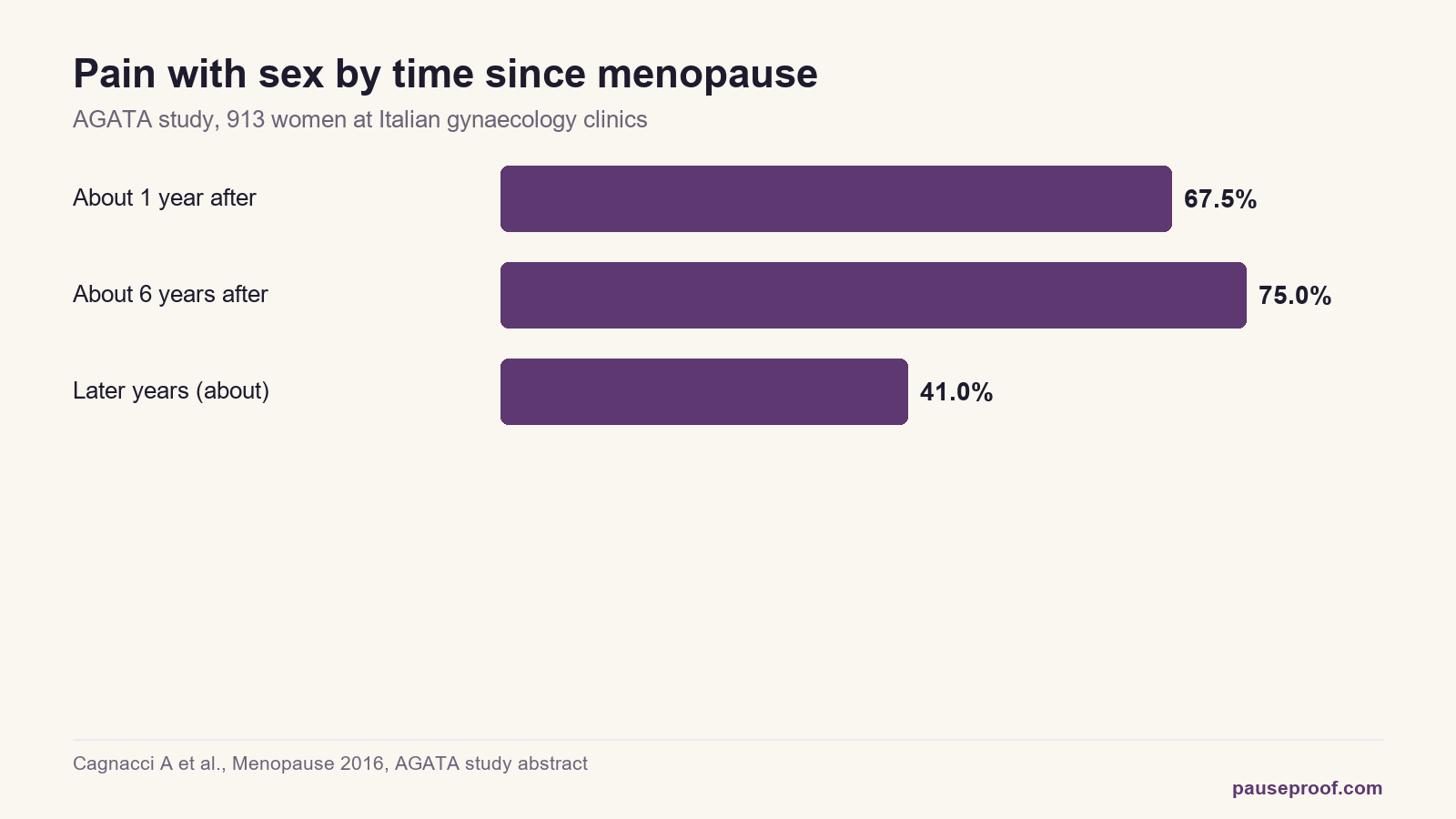
| AGATA study, Cagnacci and colleagues, Menopause, 2016 | 913 postmenopausal women attending 22 gynaecology outpatient services in Italy | 67.5% about a year after menopause, 75% at six years, then about 41% in the later years |
| Huang and colleagues, Menopause, 2010 | 1,017 postmenopausal women aged 55 to 75, a population based US cohort followed for 2 years | 40% of the women who were sexually active at the start |
| SWAN, Waetjen and colleagues, Obstetrics and Gynecology, 2022 | 2,247 US women with no sexual pain at the start, followed for up to 13 years across the transition | 48.4% developed pain with sex at least sometimes |
| REVIVE survey, Kingsberg and colleagues, Journal of Sexual Medicine, 2013 | 3,046 US postmenopausal women who already had vaginal symptoms | 44% named pain with intercourse as a symptom |
| Natsal-3, Mitchell and colleagues, BJOG, 2017 | 6,669 sexually active British women aged 16 to 74, all ages, not menopause specific | 7.5% had pain for 3 months or more in the past year |
Three things fall out of the table. First, the menopause specific figures cluster between about 40 and 75 percent, which is a lot of people quietly putting up with something. Second, the 7.5 percent from Natsal-3 is not a contradiction: it covers women from 16 to 74 and only counts pain lasting three months or more. Third, SWAN found that almost half of the women who began the study pain free went on to report pain at some point, so this is something many women meet for the first time in their late forties or fifties.

Does it get worse with time, or can it ease on its own?
Here the experts and the cohort data do not quite agree, and the ranking pages tend to pick one side. The Menopause Society statement says that, unlike hot flushes, which usually improve over time, GSM is generally progressive without effective therapy. It also found GSM in 84 percent of women six years after menopause in one study it cites.
The symptom studies are less tidy. In the AGATA study, the physical signs on examination, such as thinning and pallor of the tissue, rose steadily with time since menopause. Reported pain with sex did not: it rose from 67.5 to 75 percent by year six and then fell to about 41 percent. The authors note that signs and symptoms were not strictly linked, apart from dryness. In Huang’s 2010 cohort, half of the women who were not taking oestrogen and had symptoms at the start were still symptomatic two years later, which means the other half were not.
Both can be true. The tissue changes tend to progress; whether a given woman feels pain depends on more than tissue, including whether she is still having the kind of sex that hurts. A falling figure in the later years may partly reflect women who stopped. One popular belief did not survive testing, though. In SWAN, having less sex across the transition did not predict developing pain, and vaginal dryness was among the factors most strongly linked to it. The old line that you simply need to keep in practice is not supported by the data.
Is pain during sex always caused by the menopause?
No. The Menopause Society statement lists conditions that can look like GSM or sit alongside it, including lichen sclerosus and lichen planus, which are skin conditions of the vulva, thrush and other infections, vulvodynia, pelvic floor muscles that tighten in anticipation of pain, chronic pelvic pain, diabetes and psychological factors. It says another cause is more likely when symptoms are chronic or recurrent and do not respond as expected.
The British data point the same way. In Natsal-3, painful sex was strongly associated with vaginal dryness, but also with anxiety about sex, lack of enjoyment, depressive symptoms and past experiences of sex that was not wanted. None of that makes the pain less real. It is why a clinician will usually want to examine rather than assume. If itching or discharge is part of the picture, our page on telling thrush from menopausal dryness covers the overlap.
How long do women report waiting before raising it?
We read one 152 comment thread on r/Menopause and six comments from r/Perimenopause posted in the past year that mentioned painful sex and a doctor. Four are summarised here in our own words. They are what people report, not evidence of what is typical.
A woman of 42, writing on r/Perimenopause in August 2026, said dryness and painful sex were her very first symptoms, at 33, and that no doctor suggested perimenopause. A 44 year old, posting in July 2026, said she raised painful sex and was told to try more foreplay and lubricant. A 36 year old in the same month listed painful sex among several symptoms and said she had been told she was too young. And one woman in September 2026 said sex had become very painful about ten years earlier, that a separate medical condition had narrowed what her doctor could offer, and that her interest in sex had only begun to return in the past year.
In the larger December 2025 thread, the anger was mostly about not being warned. Several commenters said no relative and no clinician had ever told them this could happen. Where an account gave a timeline, it ran to years rather than months: about nine years in one, about ten in another. The common thread was less that women stayed silent and more that, when they spoke, the too young reflex or the lubricant leaflet got there first.
The survey data fill in the other half. In REVIVE, only 56 percent of 3,046 women with symptoms had ever discussed them with a healthcare professional, and only 24 percent linked them to the menopause. So silence and dismissal both play a part, and the accounts above cannot say which is more common.
When does pain or bleeding after sex need a doctor?
The NHS vaginal dryness page says to see a GP if you have bleeding after sex, between periods or after the menopause. It also says to see a GP if symptoms have lasted a few weeks and self care is not working, or if they are affecting daily life.
Bleeding after the menopause is not something to wait out, even if it is light and even if dryness seems the obvious explanation. Thin tissue can bleed easily, but only an assessment can rule out other causes. Our pages on why any bleeding after menopause gets checked and bleeding after sex in perimenopause explain what that assessment usually involves.
Who can you see about it, and what is worth saying?
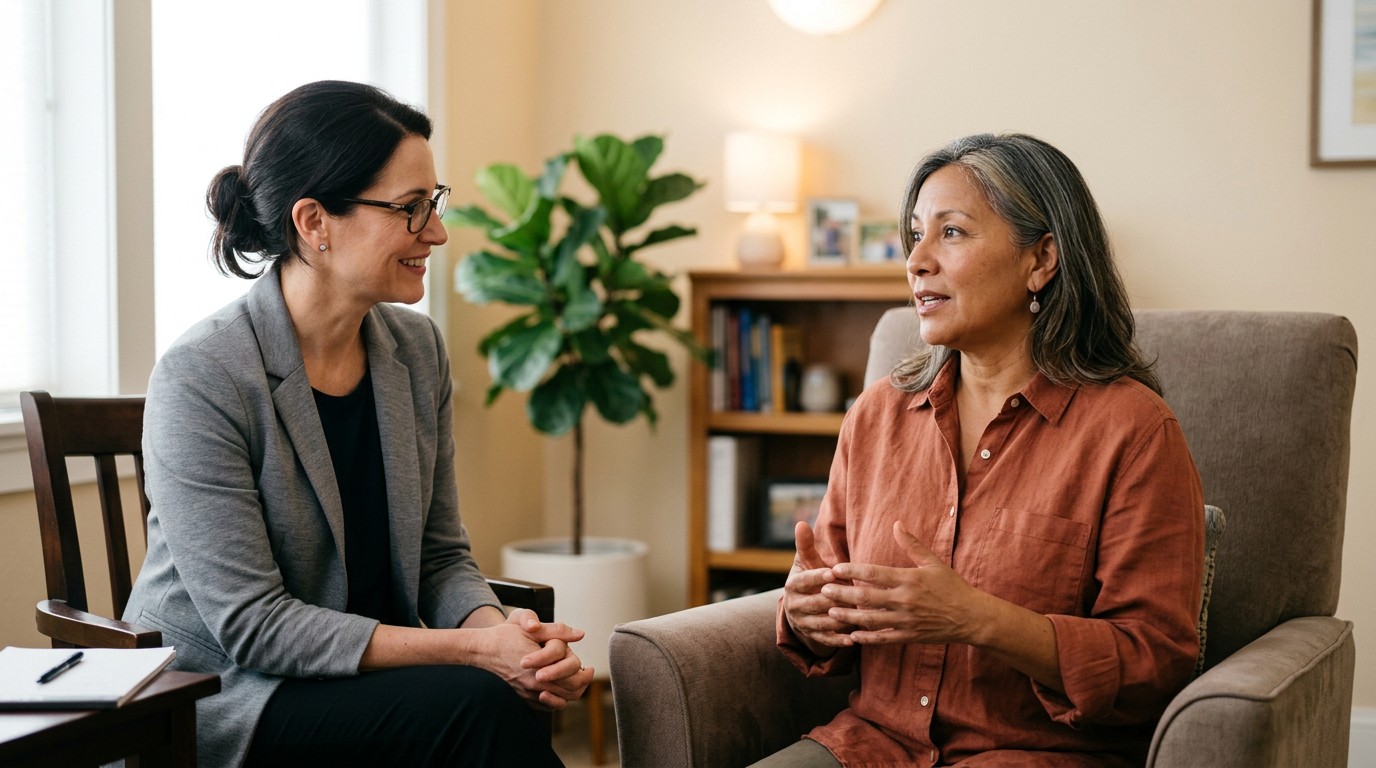
In the UK the usual first stop is a GP or a practice nurse, and many practices let you ask for a female clinician when you book. A sexual health clinic is another route. A GP can refer on to a menopause clinic or gynaecology if things are not straightforward. It is worth booking a longer appointment if you can, because this tends to come up in the last two minutes otherwise.
The NHS page leaves out what to say, so the checklist on this page turns its symptom list into notes you can take in. Mention where the pain is, at the entrance or deep inside, how long it has been going on, any bleeding after sex or after your periods stopped, any urinary symptoms, and any other condition you are being treated for. The REVIVE finding that only about a quarter of women linked symptoms to the menopause suggests saying the word yourself. If desire has changed too, that is a separate topic, covered in our page on perimenopause and sex drive, and it helps to keep the two apart.
This page set the published figures side by side with who each study counted, checked on 6 November 2026. It does not tell you what you have or what to use; that needs a clinician who can examine you.
Notes to take to the appointment
Built from the symptoms the NHS vaginal dryness page lists. Tick what applies so you can say it in the first minute rather than the last. Nothing here is scored.
General information, not a diagnosis. Bleeding after the menopause should be checked by a GP even if it is light.
Frequently asked questions
Can painful sex start before periods stop?
Yes. SWAN followed women from their forties, before their final period, and 48.4% of those who began pain free later reported pain with sex at least sometimes. Dryness often starts in late perimenopause.
Is painful sex after menopause the same as vaginal atrophy?
Not exactly. Vaginal atrophy, now usually called genitourinary syndrome of menopause, is the most common cause, but skin conditions, infections, pelvic floor tension and other conditions can cause the same pain.
Does having less sex cause the pain?
SWAN tested this and found that falling sexual frequency across the menopausal transition did not predict developing pain. Vaginal dryness was one of the factors most strongly linked to it.
Why do the prevalence figures vary so much?
They count different people. Clinic samples score higher than population samples, some surveys only recruit women who already have symptoms, and definitions range from any pain to pain lasting three months.
Is it normal to bleed a little after sex after menopause?
It is common enough to have a known cause, thin tissue, but the NHS lists bleeding after sex or after the menopause as a reason to see a GP, so it should be checked rather than assumed.
Can I see someone other than my GP?
In the UK a practice nurse or a sexual health clinic are other routes, and a GP can refer to a menopause clinic or gynaecology. You can ask for a female clinician when booking.
Finished the page? The same five questions from the top, to see what stuck.
This article is general information, not medical advice, and is not a substitute for care from a qualified healthcare professional. Speak to your doctor about your own situation.

Leave a Reply