
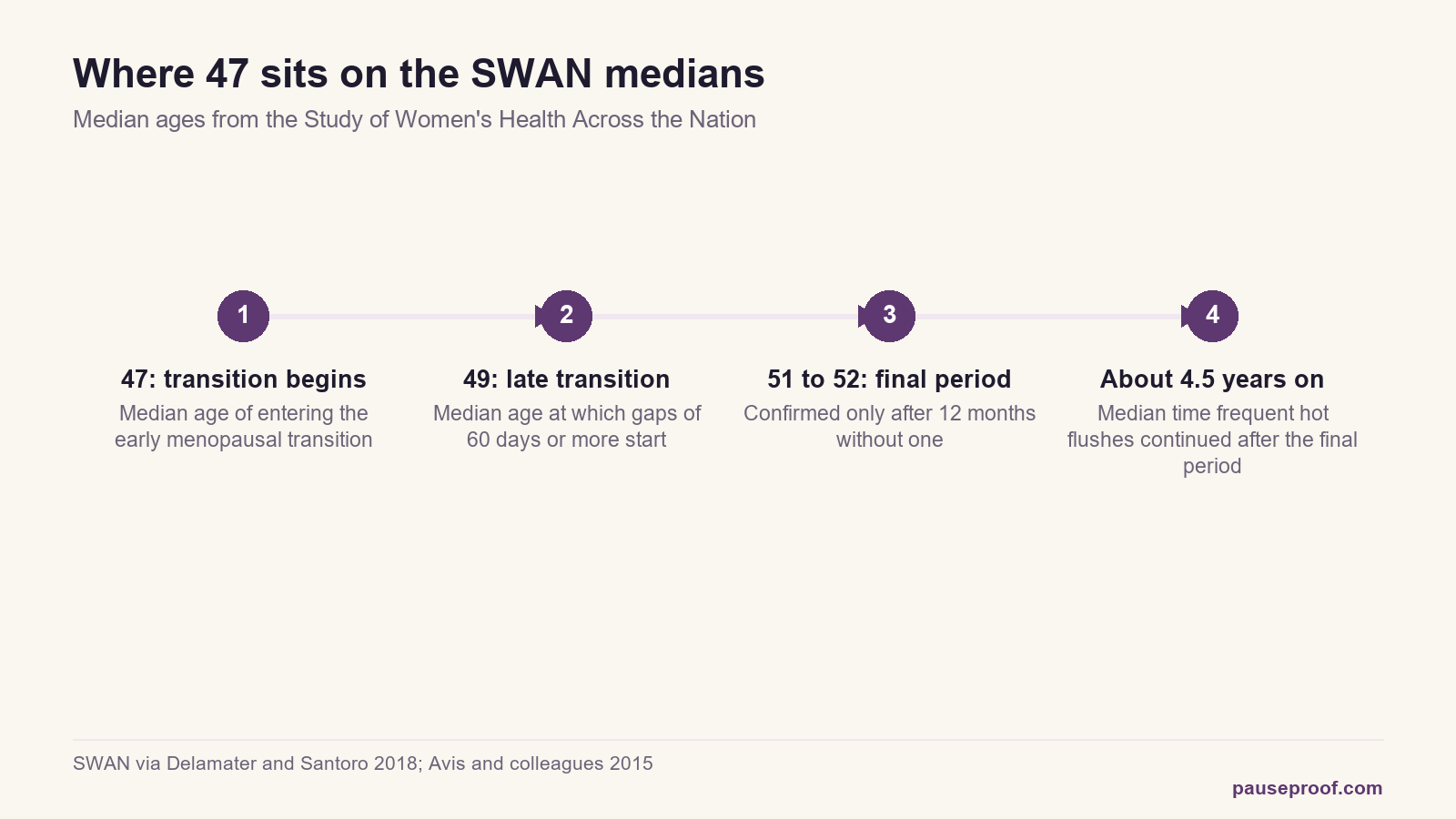
Perimenopause symptoms age 47 are common, because 47 is the median age at which women in the large SWAN study entered the menopausal transition. The late stage, marked by gaps of 60 days or more, came at a median of 49, and the final period at 51 to 52. Half of women sit either side of each of those ages.
Listen to this article, about 13 minutes. A synthetic voice reads the article and announces each section title as it begins; tables are read row by row and the questions at the end are left out.
Recorded 11 November 2026 from the article as published that day. Press a chapter to jump there; the highlighted line is what is playing. A play button sits beside every section heading, and once you scroll past this player a bar at the bottom of the screen keeps the controls in reach. Tap or click any sentence to hear the reading start from there.
On this page: a worked timeline placing 47 against the SWAN median ages with the source on every row, the STRAW+10 cycle rules in their own words, and what women of 47 reported in two 2026 forum threads.
Think you already know this? Five questions, one minute.
Every answer is on this page. Answer from what you know now; the page fills in the rest.
-
1. In SWAN, as summarised by Delamater and Santoro, what was the median age at which women entered the menopausal transition?
The review gives median onset at 47, the late transition at 49 and the final period at 51 to 52 (Delamater and Santoro, 2018). Read the section
-
2. In the 2026 Flo app survey, which symptom did the 12,681 respondents aged 35 and over report most often?
Fatigue and exhaustion each came to 83.2% in that group; hot flashes led a separate list of what respondents of all ages expected (Hedges and colleagues, Menopause, 2026). Read the section
-
3. Under STRAW+10, what marks entry to the late menopausal transition?
STRAW+10 marks the late transition by amenorrhoea of 60 days or longer (Harlow and colleagues, 2012). Read the section
-
4. What does NICE NG23 recommendation 1.3.1 say about identifying perimenopause in otherwise healthy people aged 45 or over?
Rec 1.3.1 of NICE NG23, last updated 15 April 2026, identifies perimenopause without lab tests from 45 when vasomotor symptoms have recently started alongside any cycle change. Read the section
-
5. In SWAN, what was the median total duration of frequent hot flushes and night sweats?
The median total was 7.4 years, with 4.5 of them after the final period (Avis and colleagues, JAMA Internal Medicine, 2015). Read the section
So if you are 47 and something has shifted, you are not early, you are not late, and you are not imagining it. You are standing almost exactly on the line the biggest long term study of midlife women drew through the middle of everyone. Every figure below was checked against its source on 5 November 2026.
Where does 47 sit on the perimenopause timeline?
The Study of Women’s Health Across the Nation, SWAN, followed thousands of American women through midlife. A review by Delamater and Santoro in Clinical Obstetrics and Gynecology, 2018 summarises its timing like this: the transition lasts “a median of four or more years”, with median onset at age 47, the late transition at a median age of 49, and the final menstrual period at 51 to 52.
A median is the middle person in the queue, not a deadline. At 47, roughly half of women have already started and half have not. Here is the worked timeline, with the source on every row.
| Step | What defines it | Median age in SWAN | Where a 47 year old sits |
|---|---|---|---|
| Early menopausal transition (STRAW+10 stage -2) | A persistent difference of 7 days or more between consecutive cycle lengths, recurring within 10 cycles (STRAW+10, 2012) | 47 (Delamater and Santoro, 2018) | Right at the median: about half of women have entered it by now, half have not |
| Late menopausal transition (stage -1) | A gap of 60 days or longer with no bleeding; lasts on average 1 to 3 years (STRAW+10) | 49 (Delamater and Santoro) | About two years ahead, on the median |
| Final menstrual period | Confirmed only in hindsight, after 12 months with no period (NICE NG23, rec 1.3.1) | 51 to 52 (Delamater and Santoro) | About four to five years ahead, on the median |
| Frequent hot flushes ending | Median of 4.5 years of frequent flushes after the final period (Avis and colleagues, 2015) | No single age published; adding 4.5 to 51 or 52 gives roughly 56 | A rough sum of two medians, not a forecast for anyone |
The last row is where honesty beats tidiness. Nobody published an age at which hot flushes end. That figure is simply the SWAN final period median plus the median time flushes carried on afterwards, two numbers from different analyses added together. It gives a sense of scale, not a prediction, and anyone selling you a prediction is usually selling something else too.
If you want the wider age picture, from the late thirties to the mid fifties, it is in our guide to the age perimenopause usually starts. This page stays at 47.
Which symptoms are most common in your late forties?
Not always the ones people expect. In Hedges and colleagues, Menopause, 2026, a survey of 17,494 Flo app users in 158 countries, 17,290 respondents of all ages were asked which symptoms they thought signal perimenopause. Hot flashes topped that list at 71.1%, then sleep problems at 67.5% and weight gain at 65.2%. A different group, the 12,681 respondents aged 35 and over, were asked what they had actually experienced: fatigue and physical or mental exhaustion each came to 83.2%, irritability to 80% and digestive problems to 76%. Weight gain earned its place on the expectation list honestly enough, though the cohort figures in how much weight women actually gain in perimenopause show the waist moving more than the scale.
Those are two different groups answering two different questions, and the authors ran no statistical test on the gap, so read it as a description rather than a finding. Still, at 47 the tiredness and the short fuse may arrive well before any flush does.
The SWAN numbers point the same way. The Delamater and Santoro review reports that hot flushes and night sweats were reported by 39% of SWAN women in the early transition, rising to a cumulative 67% later on. So at the median age of entering the early stage, most women in that stage were not yet flushing.
A US survey of 4,432 Flo users aged 30 and over, Cunningham and colleagues in npj Women’s Health, 2025, found psychological symptoms such as anxiety, low mood and irritability appearing well before physical ones and peaking at 41 to 45. Several of its authors work for Flo, and it is self report, so it cannot say what caused anything. What it does suggest is that by 47, mood changes may already have a few years of history behind them. The NHS symptoms page lists the wider set, from palpitations and joint pain to hair thinning and sensitive gums; there is a sourced rundown in our full list of perimenopause symptoms.
What do your periods say at 47 that symptoms cannot?
Quite a lot, because the research staging system ignores symptoms almost entirely and looks at bleeding. STRAW+10, published in Menopause in 2012, defines entry to the early transition as “a persistent difference of 7 days or more in the length of consecutive cycles”, where persistent means it happens again within 10 cycles. The late transition begins with “amenorrhea of 60 days or longer”.

Two details trip people up. Consecutive means one cycle against the next, not your current cycle against the one you had at 30. A cycle that has drifted from 28 days to 24 over a few years is a 4 day shift, and it does not meet the definition. A 26 day cycle followed by a 35 day one does, if it happens again within ten cycles. And STRAW+10 places hot flushes in the late stage, saying vasomotor symptoms are “likely to occur” there, which sits awkwardly beside SWAN’s 39% in the early stage. The staging chart and the cohort data genuinely disagree about how early flushes start, and both are serious sources.
STRAW+10 also says plainly that women who have had a hysterectomy or endometrial ablation “cannot be staged by menstrual bleeding criteria”, and that the cycle rules do not fit women with polycystic ovary syndrome. If that is you, the cycle tool on this page does not apply, and your symptoms carry more of the weight. Writing cycle lengths down is the cheapest evidence there is; our page on what to put in a perimenopause symptom diary shows how.
Which STRAW+10 stage describes this cycle pattern?
Pick the pattern closest to your recent cycles. This shows the wording of the staging system for that pattern. It is not a diagnosis and it cannot say what is happening in your body.
Staging wording from STRAW+10 (Harlow and colleagues, Menopause, 2012). General information only, not medical advice.
Do you need a blood test for perimenopause at 47?
Usually not, under UK guidance, and 47 is the reason. NICE guideline NG23, last updated 15 April 2026, says in recommendation 1.3.1 that perimenopause is identified without laboratory tests in otherwise healthy people aged 45 or over who have vasomotor symptoms that have recently started and any change in their menstrual cycle. Recommendation 1.3.6 says to consider an FSH blood test in people aged 40 to 45, which is a different age band from yours.
Hormone levels swing widely in perimenopause, so a single result describes the morning it was drawn more than the year you are having. One normal result does not rule anything out, which is explained in what a normal hormone test can and cannot tell you. The age rule is about identifying perimenopause. It does not stop a clinician testing for something else, such as thyroid problems or low iron, which can look similar.
Here the at home test kit with the influencer discount code deserves a raised eyebrow. A one off reading is exactly the kind of evidence the guideline sets aside at 47. It will tell you a number. It will not tell you a stage.
What do women who are 47 report in perimenopause forums?
We read two r/Perimenopause threads from 2026 in which women gave their age as 46, 47 or 48, about 38 comments in total. What follows is what people report, not evidence about what is typical, and treatment suggestions made in those threads are left out on purpose.
In an April 2026 thread asking whether low oestrogen is likely at 47, the original poster said her GP had seen no point in testing. Another commenter said her own doctor had declined for the same reason, that levels change from day to day, and several replies agreed with that reasoning, which matches NICE 1.3.1. One commenter, also 47, described cycles running 50 to 70 days apart. Under STRAW+10, any gap of 60 days or more is the marker of the late stage, so on that one sign she may have reached it ahead of the SWAN median of 49.
The same thread shows how wide the range is. One woman said her last period came at 46. Another, about to turn 47, said she had noticed changes since 37 and still had periods. A 48 year old listed fatigue, irritability, poor sleep, palpitations and brain fog, then pointed out that kidney disease could explain half of them, which is the overlap problem in a single comment. In a May 2026 thread titled 47 here, the poster said her symptoms had started about five years earlier and that several doctors had not listened.
Where the accounts agree with the guidance: nobody at this age was routinely tested. Where they cut against the tidy medians: STRAW+10 would put these women of the same age in different stages, which is why a median is a middle and not a rule. If your symptoms vanish for months and return, our piece on why symptoms come and go, then come back covers that pattern.

How long does this stage usually last from 47?
The sources measure different things, which is why the numbers never seem to match. Laid side by side, they stop contradicting each other.
| Source | What it measures | Figure it gives |
|---|---|---|
| STRAW+10 | The late transition only | 1 to 3 years on average |
| SWAN, via Delamater and Santoro | The whole menopausal transition | A median of four or more years |
| SWAN, Avis and colleagues | Frequent hot flushes and night sweats, start to finish | Median 7.4 years in total, 4.5 of them after the final period |
| NHS symptoms page, reviewed 19 May 2026 | Symptoms in general | Usually 7 to 9 years, sometimes longer |
On the medians, a woman entering the transition at 47 would reach the late stage around 49, her final period around 51 or 52, and frequent flushes might carry on for several years after that. Avis and colleagues in JAMA Internal Medicine, 2015 found something worth knowing at 47: women whose frequent flushes began while they were still premenopausal or in the early stage had the longest run of all, a median of more than 11.8 years. That is a group average, not a forecast.
In the Cunningham survey, only 36% of women aged 46 to 50 had spoken to a health professional about perimenopause or menopause symptoms. Being told you are too young to raise it is common. At 47 it does not hold up against any of these sources.
When is a change at 47 a reason to see a GP?
Most changes at 47 are worth raising when they get in the way of work, sleep or relationships, and the NHS says to contact a GP if you think you have perimenopause symptoms and want to know your options. Some changes should be checked regardless of whether they are perimenopause.
The NHS lists these: palpitations or a fast heartbeat; a bleeding pattern that has changed so that you are bleeding more, not less, than before; and any vaginal bleeding after 12 months or more without a period. The NHS menopause overview notes that menopause usually happens between 45 and 55, so a final period at 47 sits inside that range, but the bleeding rules apply whatever your age.
If you go, take dates. A list of cycle start dates and the symptoms that come with them gives a GP more to work with than any test result described earlier. It is also very hard to wave away.
Frequently asked questions
Is 47 a normal age to start perimenopause?
Yes. In the SWAN study the median age at which women entered the menopausal transition was 47, so about half had started by then and half had not.
Can I still have regular periods at 47 and be in perimenopause?
Symptoms can come before cycle changes, and NICE asks about any change in the cycle rather than a set pattern. STRAW+10 only stages by cycle length, so the two frameworks look at different things.
What does a 60 day gap between periods mean at 47?
STRAW+10 uses a gap of 60 days or longer without bleeding to mark the late menopausal transition, which on average lasts 1 to 3 years. Only a clinician can say what it means for you.
Is it possible to reach menopause at 47?
Yes. The NHS says menopause usually happens between 45 and 55, and menopause is confirmed only after 12 months without a period.
Does NICE recommend an FSH test at 47?
No. NICE NG23 recommendation 1.3.1 identifies perimenopause without lab tests from 45 in otherwise healthy people. The FSH recommendation, 1.3.6, covers ages 40 to 45.
Why do I feel tired and irritable at 47 but have no hot flushes?
In the 2026 Flo app survey published in Menopause, fatigue and irritability were reported more often than hot flashes by respondents aged 35 and over, and SWAN found 39% flushing in the early transition. Tiredness has other causes too, which is a reason to get it checked.
Finished the page? The same five questions from the top, to see what stuck.
This article is general information, not medical advice, and is not a substitute for care from a qualified healthcare professional. Speak to your doctor about your own situation.

Leave a Reply